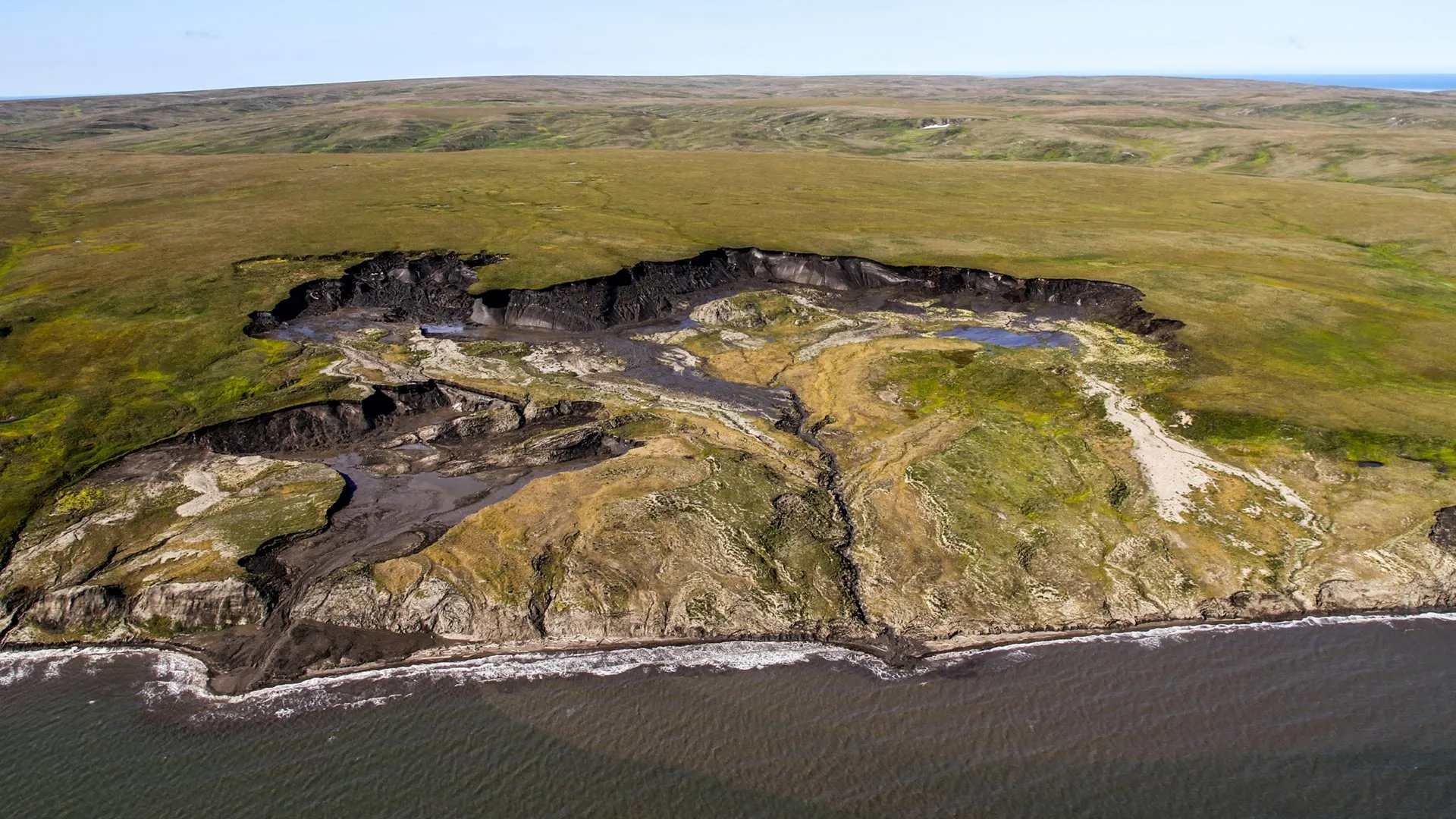
Off the coast of Canada's Yukon Territory, a small island called Qikiqtaruk — also known as Herschel Island — is yielding big discoveries about Earth's climate future. Scientists studying its shores have found that when ancient carbon from thawing permafrost washes into the Arctic Ocean, most of it settles quietly into the seabed rather than escaping into the atmosphere as a greenhouse gas. This discovery offers a cautiously hopeful counterweight to long-standing fears about permafrost thaw accelerating climate change.
Permafrost is frozen ground that covers huge swaths of the Arctic. It contains enormous stores of carbon — about 1,300 billion tonnes — left behind by dead plants and other organic material over thousands of years. As the Arctic warms faster than anywhere else on Earth, that frozen ground is starting to thaw. Carbon that was locked in the soil can now reach the ocean through rivers and eroding coastlines.
Scientists from the Alfred Wegener Institute and MARUM - Centre for Marine Environmental Sciences in Germany wanted to know what happens to that carbon once it enters the sea. Do microorganisms break it down and release climate-warming gases? Or does most of it stay hidden on the ocean floor?
The team collected sediment samples from the seafloor near Herschel Island and analyzed layers deposited over roughly 50 years. Their findings, published in the journal Nature Geoscience, revealed something surprising: only about 10 percent of the organic carbon that reaches the ocean gets converted into gases by microorganisms. The other 90 percent stays buried in the seabed.
"Although the sea here carries away huge quantities of organic carbon from the coast, surprisingly little of it ends up in the ocean's active carbon cycle," said Dr. Manuel Ruben, lead author of the study. "Microorganisms convert around ten percent of the organic carbon from the sediments into gases, which rise into the water and can then enter our atmosphere."
The researchers used carbon isotopes — tiny chemical signatures — to trace where the microorganisms were getting their food. They discovered that the bacteria living in the sediment act like selective eaters, preferring fresh carbon from recent marine sources like algae over the old carbon released from frozen ground.
"The sediment is home to 'gourmet' bacteria that apparently prefer fresh carbon stemming from, for example, more recent algal remains over the 'old' carbon from permafrost deposits," explained Professor Gesine Mollenhauer, a geochemist at the Alfred Wegener Institute.
Because these microbes favor newer material, the ancient carbon from thawing permafrost may contribute less to atmospheric greenhouse gas levels than scientists once feared. Still, the researchers caution that the full picture remains unclear, since some carbon may already break down before it reaches the seafloor.
Currently, up to 0.02 billion tonnes of carbon enter the Arctic Ocean each year from land. Climate forecasts suggest this outflow could increase by 70 to 150 percent by the year 2100. But even with more carbon flowing into the sea, the new study suggests much of it may settle into sediments rather than accelerate warming.
Understanding where permafrost carbon ends up matters not just for climate predictions, but also for coastal communities that depend on Arctic waters for food and livelihoods, since changes in sediment and water chemistry can reshape entire ecosystems.