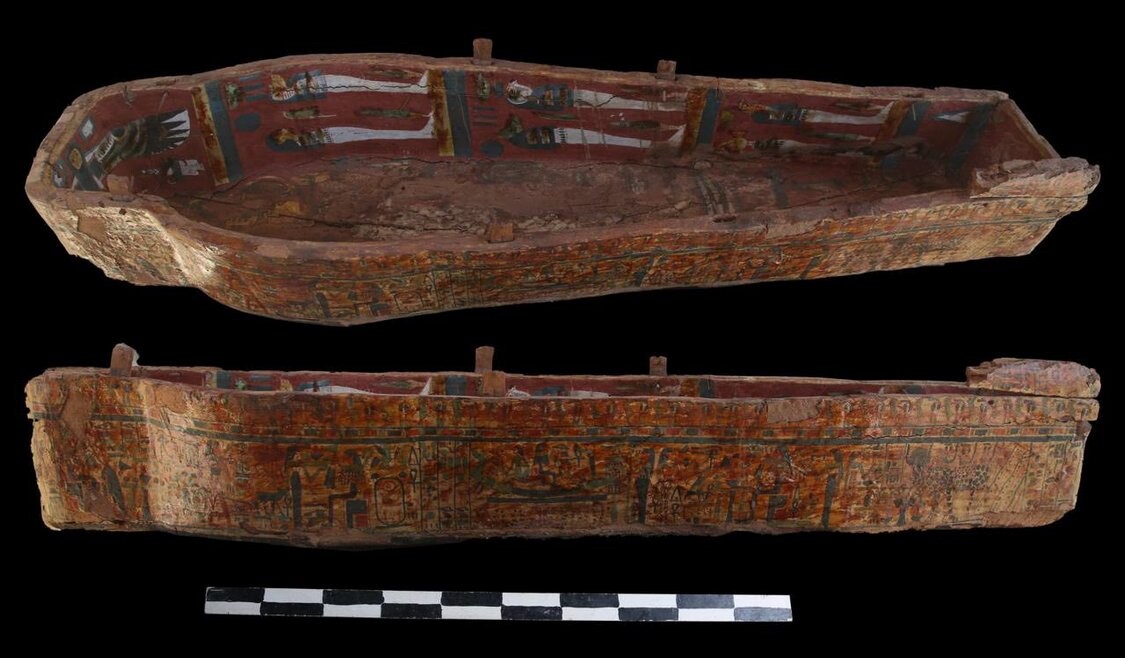
In the southwestern sector of Luxor's Asasif necropolis, archaeologists have unsealed a burial chamber that has lain undisturbed for at least 2,600 years, revealing a snapshot of a world that few of us know much about: the lives and deaths of ancient Egypt's female temple singers.
The discovery, made by teams from the Egyptian Ministry of Tourism and Antiquities and the Zahi Hawass Foundation for Archaeology and Heritage, speaks to a largely invisible chapter of ancient Egyptian society. These women, known as "Singers of Amun," held a unique and respected position in the religious hierarchy, performing sacred songs at festivals and during rituals at the temple of Karnak, where Amun was worshiped as a powerful deity. That they were buried together, deliberately and with ceremony, suggests they formed a distinct social caste—one whose rituals and relationships we've rarely been able to study directly.
Inside the tomb chamber, archaeologists found 22 coffins arranged methodically in 10 horizontal rows, along with 8 mummies. The words "Singer of Amun" were inscribed repeatedly on the coffins themselves, underscoring the identity and purpose of those entombed. The careful stacking suggests the coffins may have been moved there from their original locations, their arrangement designed to fit as many deceased as possible within the chamber carved directly into the bedrock. The mystery of why and when they were moved remains unknown.
What has archaeologists most excited, however, are eight sealed jars found within a large ceramic vessel, their clay seals still intact after nearly three millennia. These vessels may contain organic remains—funerary oils and resins, or potentially even biological material from the mummies themselves. Described by excavators as an "information goldmine," they are now undergoing state-of-the-art conservation and laboratory analysis that could reveal extraordinary detail about ritual practices, health, diet, and family relationships among these women.
Dating work, conducted urgently to protect the coffins' flaking pigments and splintering wood, has placed the burials across 400 years of Egypt's Third Intermediate Period, spanning roughly 1070 to 664 BCE. This long timespan suggests the tomb served successive generations, each adding to the collective memory of these sacred singers. The excavators emphasized that evidence of how female officials lived and died within Egypt's religious castes remains remarkably rare in the archaeological record—making this discovery particularly significant for understanding women's roles and agency in ancient religious life.
Minister of Tourism and Archaeology Sharif Fathi noted in a statement that the discovery represents another exceptional archaeological find in what continues to be one of the world's most prolific excavation sites. Luxor, sometimes called the world's largest open-air museum, yields new revelations with striking regularity. Yet this find stands out for offering direct, tangible evidence of women whose voices—quite literally—shaped the spiritual life of one of history's greatest civilizations. Their coffins, their names, and the sealed vessels waiting to be opened all point to a story that Egypt's ancient world kept hidden, and that modern science is only now beginning to tell.