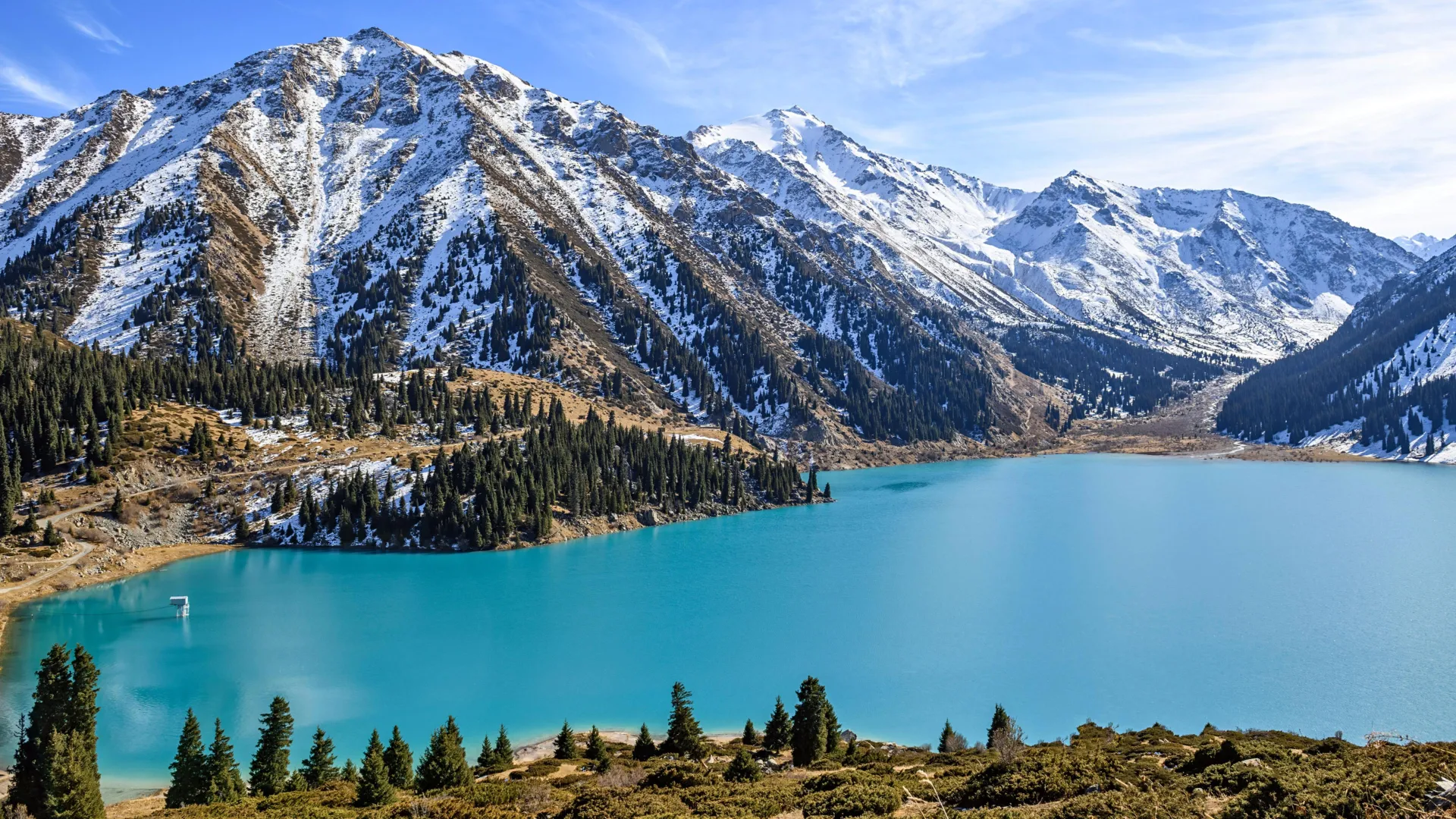
When dinosaurs roamed Central Asia during the Cretaceous period, they walked across a mountainous landscape shaped not by the forces that built today's Himalayas, but by the dynamics of a vanished ocean thousands of kilometers away. New research from Adelaide University has upended conventional understanding of how this ancient terrain formed, revealing that the Tethys Ocean—a vast seaway that once stretched across the planet—directly controlled periods of mountain building in the region far more powerfully than climate, mantle processes, or the plate collisions that dominate the landscape today.
The discovery emerged from an ambitious analysis that synthesized hundreds of thermal history models accumulated over more than 30 years of geological studies across Central Asia. This comprehensive data work revealed something surprising: while scientists have long attributed the region's dramatic topography to a blend of tectonic activity, climate shifts, and deep mantle convection over the past 250 million years, the ancient ocean's influence proved far more decisive than previously understood.
"We found that climate change and mantle processes had only little influence on the Central Asian landscape, which persisted in an arid climate for much of the last 250 million years," said Dr. Sam Boone, a post-doctoral researcher at Adelaide University when the research was conducted. "Instead, the dynamics of the distant Tethys Ocean can directly be correlated with short-lived periods of mountain building in Central Asia."
The Tethys Ocean gradually disappeared during the Meso-Cenozoic period, with the Mediterranean Sea standing today as its only surviving remnant. But during the Cretaceous, when dinosaurs inhabited Central Asia, the ocean's geology was actively reshaping the continent. Associate Professor Stijn Glorie, from Adelaide's School of Physics, Chemistry and Earth Sciences, explained the mechanism: the extension of the Tethys Ocean—triggered by the roll-back of subducting slabs of ocean crust—reactivated old suture zones in Central Asia, transforming them into a series of parallel ridges that stretched thousands of kilometers away from any plate boundary.
"During the Cretaceous periods, dinosaurs would have seen a mountainous landscape as well, similar to the present-day Basin-and-Range Province in the western USA," Glorie noted. The research demonstrates that geological activity linked to a distant ocean could trigger mountain formation far from where tectonic plates actually collide, a insight that challenges conventional models of how landscapes evolve.
The team's methodology centered on thermal history models—sophisticated reconstructions of how rocks cooled as they rose toward Earth's surface during periods of mountain uplift and erosion. By analyzing these models alongside plate-tectonic reconstructions of the Tethys Ocean's evolution, deep-time precipitation patterns, and mantle-convection simulations, researchers pieced together previously hidden chapters of Earth's geological history.
The findings, published in Nature Communications Earth and Environment, open new pathways for understanding mountain-building mysteries elsewhere on the planet. Glorie noted that the same analytical approach is now being applied to enigmas like Australia's separation from Antarctica roughly 80 million years ago—a dramatic geological event that leaves surprisingly faint traces in the thermal records of both continental margins. The technique that illuminated the Tethys Ocean's hidden role in Central Asia may yet reveal what shaped our planet's other forgotten histories.