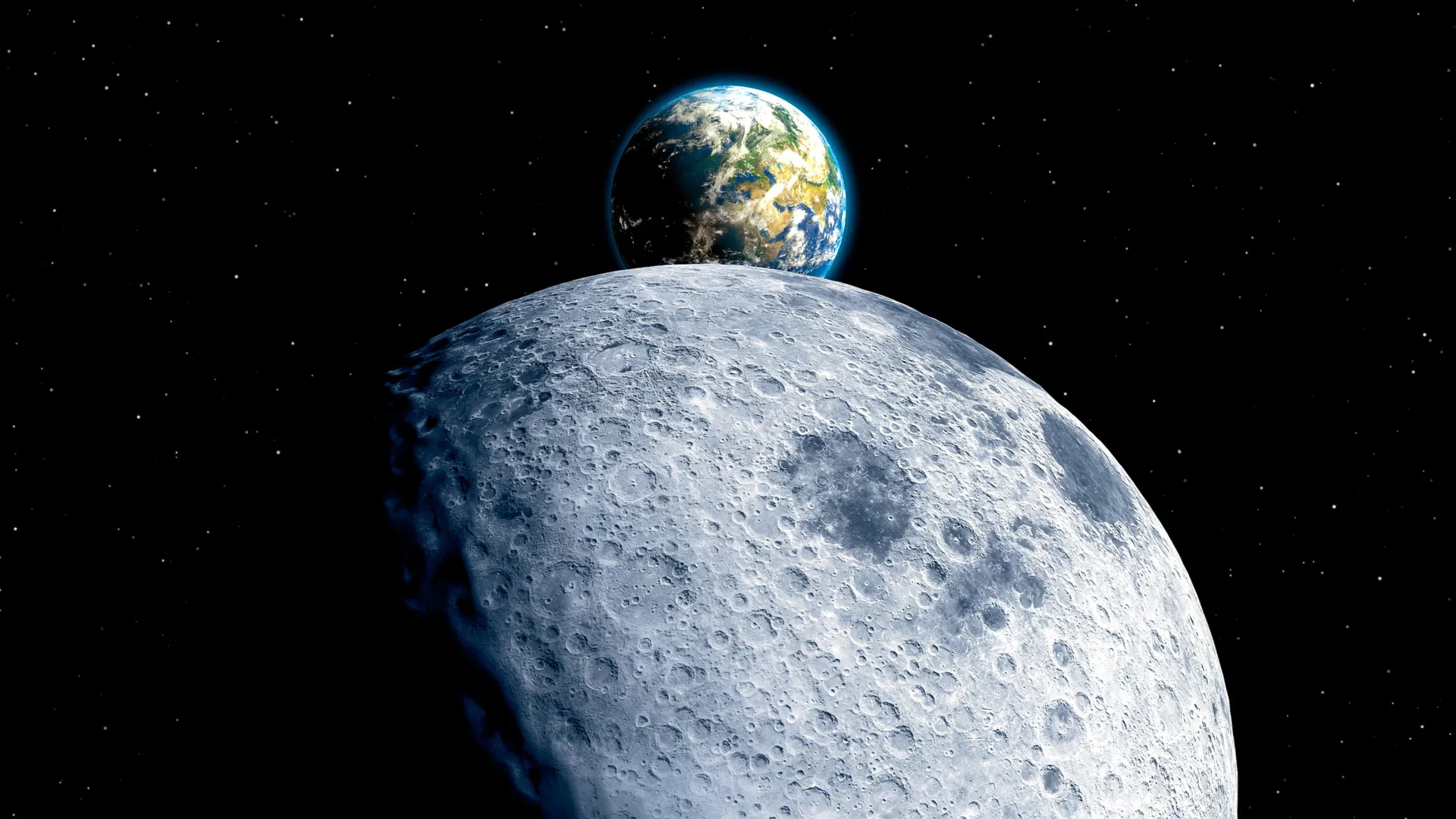
Tiny pieces of rock returned from the Moon’s far side record asteroid impacts stretching from about 4.33 billion to 1.13 billion years ago. Their story points to a long, gradual decline in collisions—not one brief, catastrophic barrage that battered the young Solar System all at once.
The finding challenges a theory that has shaped scientists’ picture of the Moon’s early history for decades. It also offers a rare window into Earth’s beginnings. Erosion, volcanic activity and the shifting of Earth’s crust have erased much of our planet’s oldest geological evidence. The Moon, by contrast, has kept traces of impacts from billions of years ago.
Researchers examined small fragments of lunar rock collected by China’s Chang’e-6 mission, the first mission to return samples from the Moon’s far side. The rocks preserve evidence of collisions over more than three billion years. Rather than showing a short-lived peak in impacts, the record suggests that asteroid strikes became less frequent over time.
That distinction matters because the Moon and Earth formed together and share a history. Major impacts recorded on the Moon can help researchers infer the conditions faced by the young Earth, whose own early impact record has largely vanished. Those events may have influenced the environments in which life eventually emerged, though the findings do not establish a direct link between any particular impact and the origin of life.
Dr. Fred Jourdan, a co-author affiliated with Curtin University’s School of Earth and Planetary Sciences and the John de Laeter Centre, said far-side samples let scientists compare two very different regions of the Moon. Until now, most lunar samples came from the side that faces Earth. The far side, he explained, was less affected by later geological events, so its rocks offer another view of the Moon’s ancient impacts.
The research was led by the State Key Laboratory of Deep Earth Processes and Resources at the Guangzhou Institute of Geochemistry, part of the Chinese Academy of Sciences. Its findings were published in Science Advances in a paper titled “The bombardment history on the lunar farside revealed by 40Ar/39Ar geochronology of Chang’e-6 impact melt rocks.” The method named in the title uses radioactive forms of argon to help estimate when rocks formed or were altered by impacts.
The new samples do not settle every question about the early Solar System. But they add a record from a part of the Moon that scientists could not directly sample before, making comparisons with near-side rocks possible. As lunar exploration brings back more material, researchers can test whether the gradual decline seen in these far-side rocks fits a wider pattern—and sharpen their picture of the ancient impacts that shaped both Earth and its neighbor.