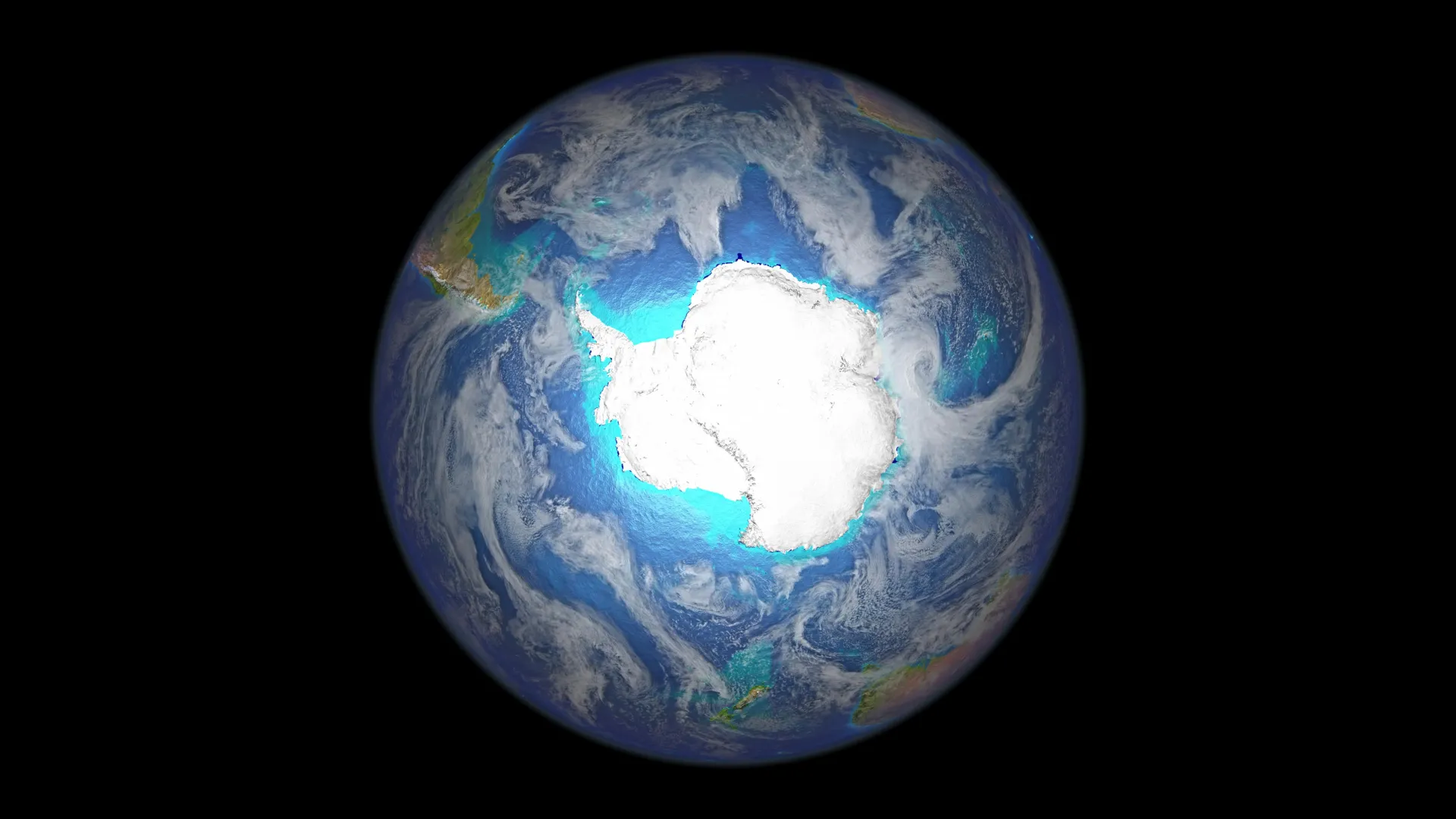
A million years ago, Antarctica's vast ice sheet crossed an invisible line and never looked back. Scientists at the IBS Center for Climate Physics in South Korea have discovered that around the time Earth's ice ages became longer and more intense—a period known as the Mid-Pleistocene Transition—Antarctica's ice began responding dramatically to even small shifts in global climate. What makes this discovery startling is not just what happened, but what it reveals about how ice sheets can suddenly flip into a hypersensitive state, potentially reshaping our understanding of future sea level rise.
Understanding how Antarctica reacted to ancient climate shifts has long puzzled researchers, mainly because reliable climate records spanning millions of years didn't exist. To solve this puzzle, Dr. Kyung-Sook Yun and her team at the IBS Center for Climate Physics used one of South Korea's most powerful supercomputers to reconstruct three million years of global climate patterns. They fed detailed temperature and precipitation data into an advanced ice-sheet model developed at Penn State University, which tracked ice movement, thickness, and behavior across both Antarctica and the Northern Hemisphere, including the floating ice shelves in the Ross and Weddell Seas.
The simulations revealed something unexpected: Antarctica hit a critical threshold around one million years ago when atmospheric carbon dioxide levels dropped below 240 parts per million. Once it crossed that mark, the ice sheet's behavior fundamentally changed. "After this transition, the Antarctic ice sheet reacts much more strongly to changes in climate forcing," explained Dr. Yun. The system didn't evolve gradually—it became dramatically more responsive.
The mechanisms behind this shift were surprisingly interconnected. As ocean temperatures plummeted during ice ages, less melting occurred beneath the underwater portions of the Antarctic ice sheet. Simultaneously, global sea levels were 50 to 100 meters lower than today, reducing the weight pressing down on bedrock beneath ice shelves. As that pressure eased, the land slowly rose—a process called isostatic uplift—which helped support thicker coastal ice. These processes fed into each other, enabling the larger, more persistent ice sheets that would later define Earth's ice age cycles for the next million years.
Prof. Axel Timmermann, director of the IBS Center for Climate Physics, emphasized the broader significance: "Our findings suggest that the Antarctic ice sheet was more sensitive to external forcings than previously assumed. This also raises important questions about its future response to global warming." The study underscores a sobering reality about climate systems—they don't always change smoothly and predictably. Instead, ice sheets can suddenly shift into far more sensitive states after crossing critical thresholds, responding violently to what might seem like modest climate perturbations.
For climate scientists working to forecast future sea level rise, this discovery cuts both ways. It means past models may have underestimated Antarctica's sensitivity to warming, a concern given that Antarctica contains the planet's largest mass of ice and plays an outsized role in regulating global sea levels. Yet understanding these abrupt transitions also offers a pathway to better predictions, helping researchers identify which thresholds matter most and how quickly ice could respond once the world crosses them.