When Michael Craton looks at the night sky, he sees more than stars. He sees a crowded battlefield—and he's working to make sure the right signals get through. Craton, a technical staff member at MIT Lincoln Laboratory, is part of a team that has built a new kind of antenna that could protect satellite communications from jamming, ensuring that people on the ground stay connected even when adversaries try to interfere.
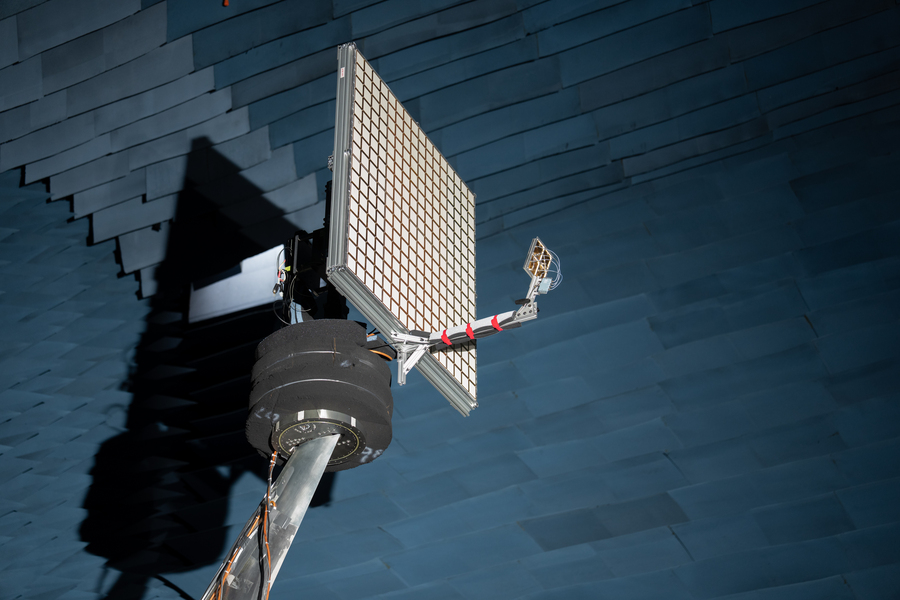
The challenge is real: in low Earth orbit, where thousands of satellites now orbit close to the planet, signals face constant threats from jamming and interception. Traditional adaptive antenna arrays—systems that can redirect their beams to avoid interference—have been too heavy, too power-hungry, and too expensive to deploy at scale across these orbital constellations. That's where the HoNi BAJR comes in. Short for Hosted Nimble Beamforming Anti-Jam Reflectarray, this prototype antenna uses a surface covered in individually controlled reflective elements. When a signal hits that surface, each element reflects it with a precise phase shift, sculpting the beam in real time to block interference and keep communications flowing.
The breakthrough is efficiency. Unlike conventional phased arrays, which require a power amplifier for every single antenna element, the HoNi BAJR reflects signals toward a single feed antenna, where they're combined in free space. That elegant design slashes power consumption by about 95 percent—enough to make the antenna practical for small satellites that need to keep weight and energy use minimal. The array is specifically sized to fit on compact satellite platforms, and testing at Lincoln Laboratory's RF Systems Testing Facility confirmed it can scan across a wide horizon and split its beam to reach multiple users simultaneously without signal loss.
Craton's team built on two earlier programs—DESRa (Deployable Electronically Scanning Reflectarray) and PhAB (Phase Analog Beamforming)—which had already proven that real-time jamming cancellation was possible. The next challenge was speed: in a dynamic, contested signal environment, there might not be enough time to individually null out every threat. The solution was to think bigger, creating entire regions of interference suppression by carefully shaping the antenna's side lobes rather than chasing each interference source one by one.
"We want to anticipate future threats and have an idea about how to deal with them before they become a problem," Craton said. That forward-looking mindset reflects a broader ambition: to build communications systems that remain reliable not just today, but as threats evolve in the years ahead. For ground users in contested environments—first responders, deployed personnel, anyone who depends on satellite links—this work points toward a future where staying connected isn't a luxury but a guarantee.