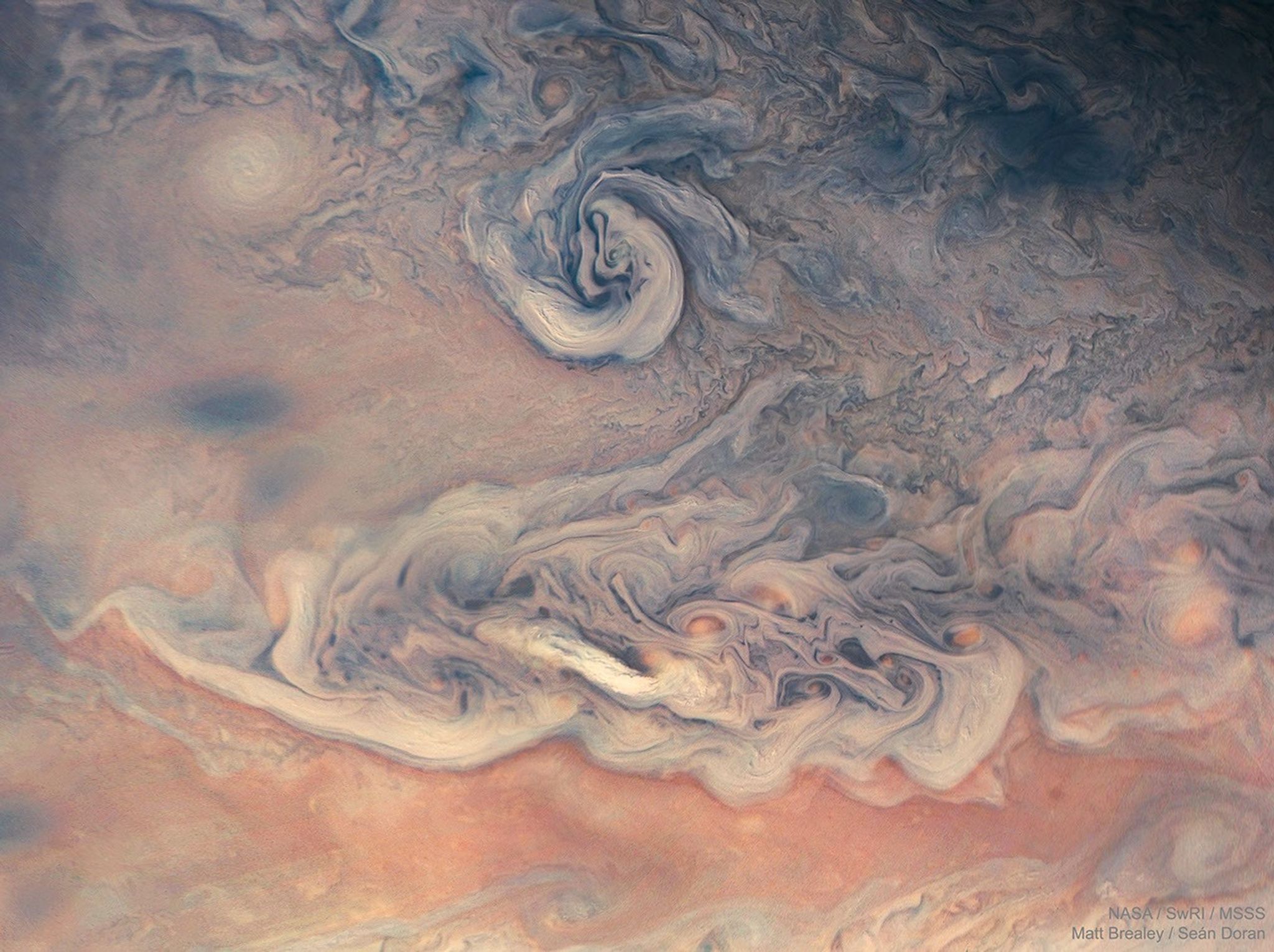
Jupiter’s cloud tops twist into bands of color in an image featured by NASA’s Astronomy Picture of the Day on November 22, 2026. The picture came from Juno, NASA’s spacecraft studying the giant planet, and offers a close look at the swirling patterns that shape its atmosphere.
Jupiter is wrapped in thick clouds, and its changing stripes and swirls are among the most recognizable sights in the solar system. Yet a striking view does not mean every part of the planet is understood. The source accompanying this image says scientists still do not know what creates the colors in Jupiter’s atmosphere. The unknown gives the scene a scientific puzzle as well as visual appeal: researchers can observe the patterns, but the reason for the colors remains unsettled.
The image credit names NASA, Juno, the Southwest Research Institute (SwRI), and the team behind the spacecraft’s camera, the JunoCam instrument (MSSS). Image processing and licensing are credited to Matt Brealey and Seán Doran. Their work presents the planet’s cloud patterns in a form that lets viewers take in the curves and contrasting shades across its atmosphere. The image was featured as part of Astronomy Picture of the Day, a service that shares a different image or photograph of the universe each day along with an explanation written by a professional astronomer.
Juno’s observations help bring Jupiter’s enormous atmosphere into view from a spacecraft at the planet. Each image is a record of what the camera saw, while the questions scientists ask about the clouds and colors require further study. The source does not give a specific explanation for the shades or name a confirmed cause, so the colors should be treated as an open question rather than a solved mystery.
That uncertainty is part of what makes the picture useful. A photograph can show details that are hard to grasp from a distance, and it can help people connect a planet’s grand scale with its shifting weather. The swirls also remind us that Jupiter is not a still, painted sphere: its atmosphere is active, layered, and full of patterns. Juno’s view turns those distant motions into something people can examine, while leaving room for new observations and better explanations.
The image’s publication also reflects a wider effort to make astronomy accessible. Astronomy Picture of the Day is provided by ASD at NASA’s Goddard Space Flight Center, NASA Science Activation, and Michigan Technological University. Its daily format brings professional context to images that might otherwise be seen only as beautiful scenes.
For now, the colors in Jupiter’s clouds remain an unanswered question. As Juno continues to provide views of the planet, scientists and the public alike can return to the same striking swirls with fresh questions: what gives them their shades, and what can their patterns reveal about the giant world below?