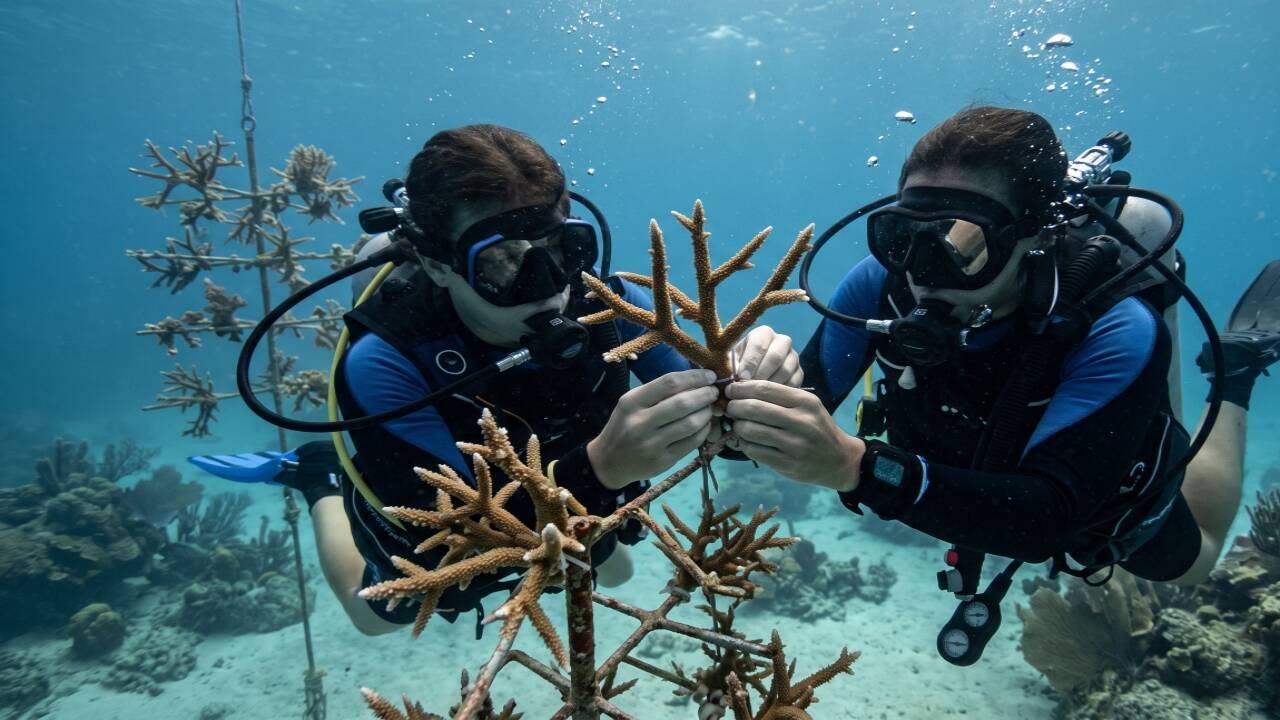
In the late 1990s, Ken Nedimyer used to dive the reefs of the Florida Keys and watch a quiet disaster unfold. Staghorn and elkhorn corals — so plentiful that divers once swam through dense underwater thickets — were dying from disease, bleaching and storm damage. In some places, their numbers had fallen by almost 90 percent. It took a backyard hobby, a father-daughter school project, and a few broken coral fragments to begin turning that around.
Around 2000, when Nedimyer's daughter needed a 4-H Youth Development project, the tropical-fish collector and aquaculture operator put his years of marine experience to work. Instead of letting staghorn fragments that had snapped off nearby reefs die on the seafloor, they kept them alive and helped them grow. The experiment worked so well that Nedimyer donated the corals to the Florida Keys National Marine Sanctuary, and a grant from The Nature Conservancy soon let him expand a dockside pastime into a real coral nursery.
The question became: if a few saved fragments could grow this well by chance, how many more could grow on purpose — and how fast? In 2007, Nedimyer founded the Coral Restoration Foundation in Key Largo and built offshore nurseries that hung coral fragments from structures called coral trees rather than letting them grow on the seafloor. The results were dramatic. Branching corals grew from finger-sized fragments to basketball-sized colonies in just six to nine months. Divers would then cut parts free and reattach them to damaged reefs nearby.
That speed changed everything. Instead of waiting years for reefs to recover on their own, teams could grow corals in nurseries and outplant them onto degraded sites. A PLOS ONE study tracking the foundation's work from 2007 to 2015 followed 2,419 coral colonies across the sanctuary, recording survival rates from as low as 4 percent to as high as 89 percent depending on the site. That real-world data gave restoration groups across the Caribbean and Pacific solid evidence about which techniques worked best, replacing guesswork with proof.
The movement kept growing. In 2012, CNN named Nedimyer a CNN Hero. By 2022, the foundation had planted more than 200,000 corals, and restored colonies at sites like Carysfort Reef had begun reproducing naturally — evidence that nursery-grown corals could become genuine parts of living reef communities, not isolated plots.
Today the operation is vast. The foundation runs four main nurseries across the Florida Keys holding nearly a thousand coral trees, with the flagship Tavernier nursery alone spanning an acre and a half of seafloor and housing more than 500 trees. Together they can produce over 50,000 reef-ready corals every year from a gene bank of more than 600 genotypes across twenty species. This matters beyond replacing individual colonies: staghorn and elkhorn corals create branching habitat that shelters fish and other reef animals. What began as one father and daughter hanging broken coral from underwater "trees" has become proof that a handful of saved fragments can help rebuild an entire underwater world.