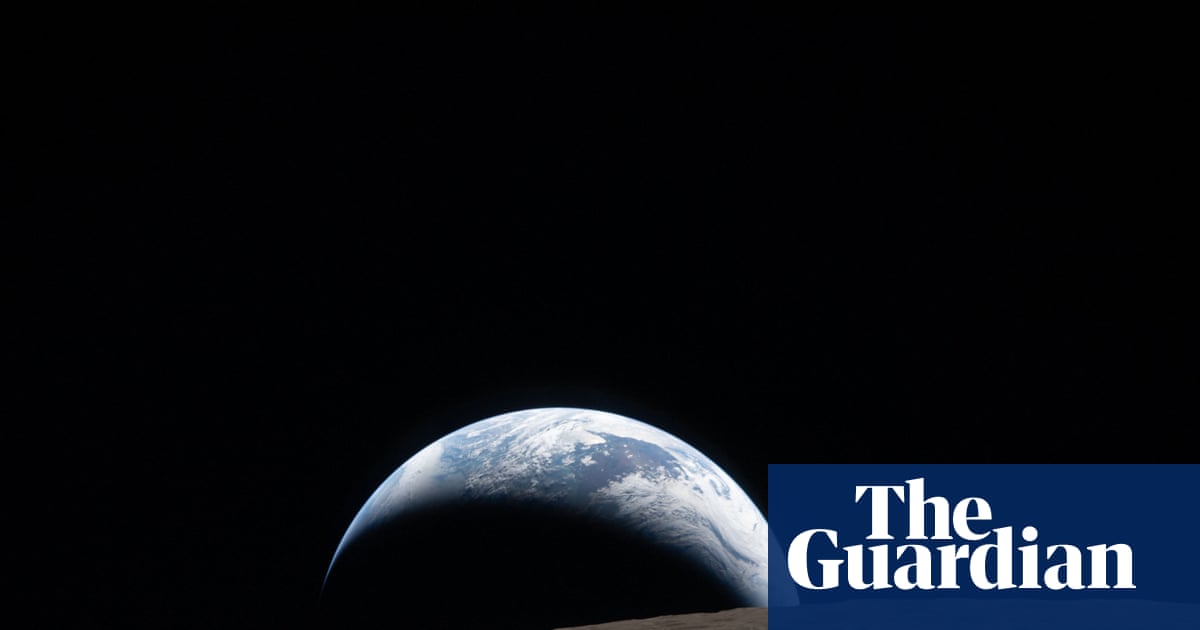
Four astronauts swung around the far side of the moon on Monday and saw something no human eyes had witnessed before: Earth rising from behind a lunar landscape rendered in browns, greens, and oranges they had never expected to see. NASA's Artemis II crew—Christina Koch, Victor Glover, Reid Wiseman, and Canadian astronaut Jeremy Hansen—became the farthest humans ever from Earth during their 252,756-mile journey, surpassing Apollo 13's 1970 record of 248,655 miles by more than 4,000 miles. But the data and records barely capture what the astronauts themselves struggled to express upon seeing the lunar surface at such breathtaking proximity.
Koch, the first woman to fly around the moon, described an emotion so sudden and powerful it caught her off guard. "I just had an overwhelming sense of being moved by looking at the moon," she told mission control. "Something just threw me in suddenly to the lunar landscape and it became real." What struck her most were the bright new impact craters scattered across the grey surface, shining like pinpricks of light in a lampshade—a detail so vivid it captures the scale of wonder that overcame her.
Glover, the first Black astronaut to travel beyond low Earth orbit, described an almost meditative response to the view. In those 40 minutes when the crew lost radio contact with Earth—the time when they were closest to the moon and farthest from home—he said a prayer, then got to work. "I was actually recording scientific observations of the far side of the moon," he explained. "That is actually the time when we were the farthest from Earth and the closest to the moon and so we were really able to make some of our most detailed observations of the far side of the moon up close."
Wiseman reported witnessing a solar eclipse from deep space, with the sun's corona visible and Mars aligned in the planet line from that vantage point. "All of us commented how excited we are to watch this nation, and this planet become a two-planet species," he said. Hansen, observing the differences between the moon's far and near sides, noted how Earth's gravitational pull had fundamentally shaped what we see from home: the dark mares visible from Earth are largely absent on the far side, replaced by smaller patches and deeper craters.
The crew captured unprecedented images—including photographs of the 590-mile-wide Orientale impact basin never before observed with the naked eye. Scientists are now working to understand those unexpected color variations in the lunar landscape. NASA's lunar science lead, Kelsey Young, noted that the crew also observed several impact flashes during a 30-minute observation period, largely during the eclipse.
Now hurtling back toward Earth at a quarter of a million miles away, the four astronauts are scheduled to splash down near San Diego on Friday at 8:07 p.m. Eastern time. The journey home marks the conclusion of humanity's first crewed lunar flyby in more than fifty years—a mission that has reminded us that some moments defy measurement.