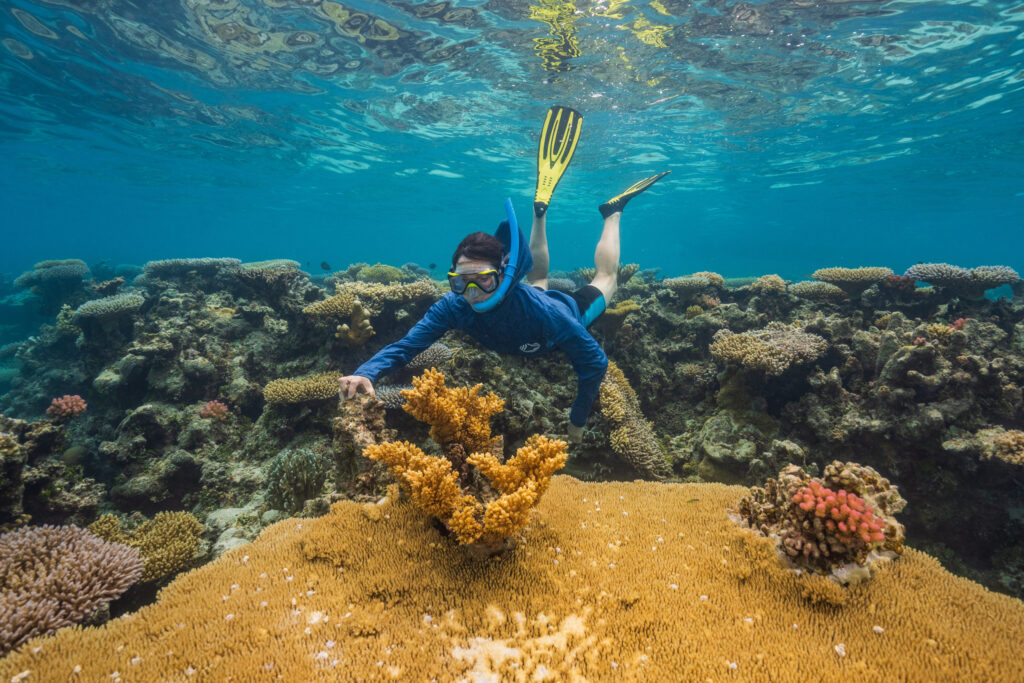
Anne Cohen leaned over the bow of an aluminum landing craft in Majuro Lagoon, watching her yellow robot guide her across the emerald waters of the Marshall Islands toward a patch of reef she'd been monitoring for years. When the unmanned vessel finally paused at the coordinates, the 62-year-old Woods Hole scientist grabbed her snorkel fins, slipped into the water—and let out a squeal of astonishment muffled by her mask.
Beneath her lay a wonderland. Towering pinnacles of chestnut-colored tabletop corals rose like trees from the sandy seafloor, their broad canopies sheltering fish. Dense thickets of staghorn corals stretched in every direction, their golden antler-like branches twisted across a sprawling reef bursting with mustard yellow, pink and lavender. In an ocean ravaged by record-breaking marine heat waves, this reef was thriving—alive, vibrant, impossibly colorful.
Since 2023, the most severe global coral bleaching event ever recorded has devastated marine ecosystems worldwide. More than 80 percent of the world's reefs have been impacted across at least 83 countries and territories. Extreme temperatures have forced corals to expel the tiny algae living in their tissues that provide both food and color, leaving them pale, ghostly, and struggling to survive. Many have not recovered. The outlook is grim: without significant intervention, more than 90 percent of tropical reefs could disappear within the next 25 years.
Yet some reefs defy the odds. For three decades, Cohen has studied coral resilience, and over the last decade she has focused on tracking down what she calls "super reefs"—communities that somehow thrive even while others nearby bleach or die. In 2018, she launched the Super Reefs project to identify and understand these heat-tolerant communities. "We saw these corals that were behaving as if there was no heat wave at all," Cohen recalled. "I kind of felt like there was Superman or Superwoman coming in there and flexing their muscles, being super, super strong."
Three years later, she launched a joint global initiative with The Nature Conservancy and Stanford University aimed at not only finding these reefs but protecting them. Unlocking the secrets of their resilience, Cohen believes, could one day help scientists and conservationists restore or even cultivate reefs better equipped to survive a warming planet.
But even the hardiest reefs face relentless threats beyond climate change. Coastal development projects requiring dredging bury corals beneath sediment. Agricultural runoff, sewage, and plastic pollution introduce pathogens and excess nutrients that spark disease and toxic algal blooms. Bottom trawling—nets dragged across the seafloor—crushes entire ecosystems. Dynamite fishing shatters centuries-old coral colonies in seconds. The world has already lost more than half of its coral reefs to the combined pressures of climate change and human activity.
For Cohen and her team, the mission is urgent. The reefs of Majuro have bleached repeatedly in recent years, yet some have shown remarkable capacity to recover or resist heat stress. By understanding how, by protecting these pockets of resilience, there may yet be a path forward—not just for the Marshall Islands, but for coral ecosystems clinging to survival across the warming seas.