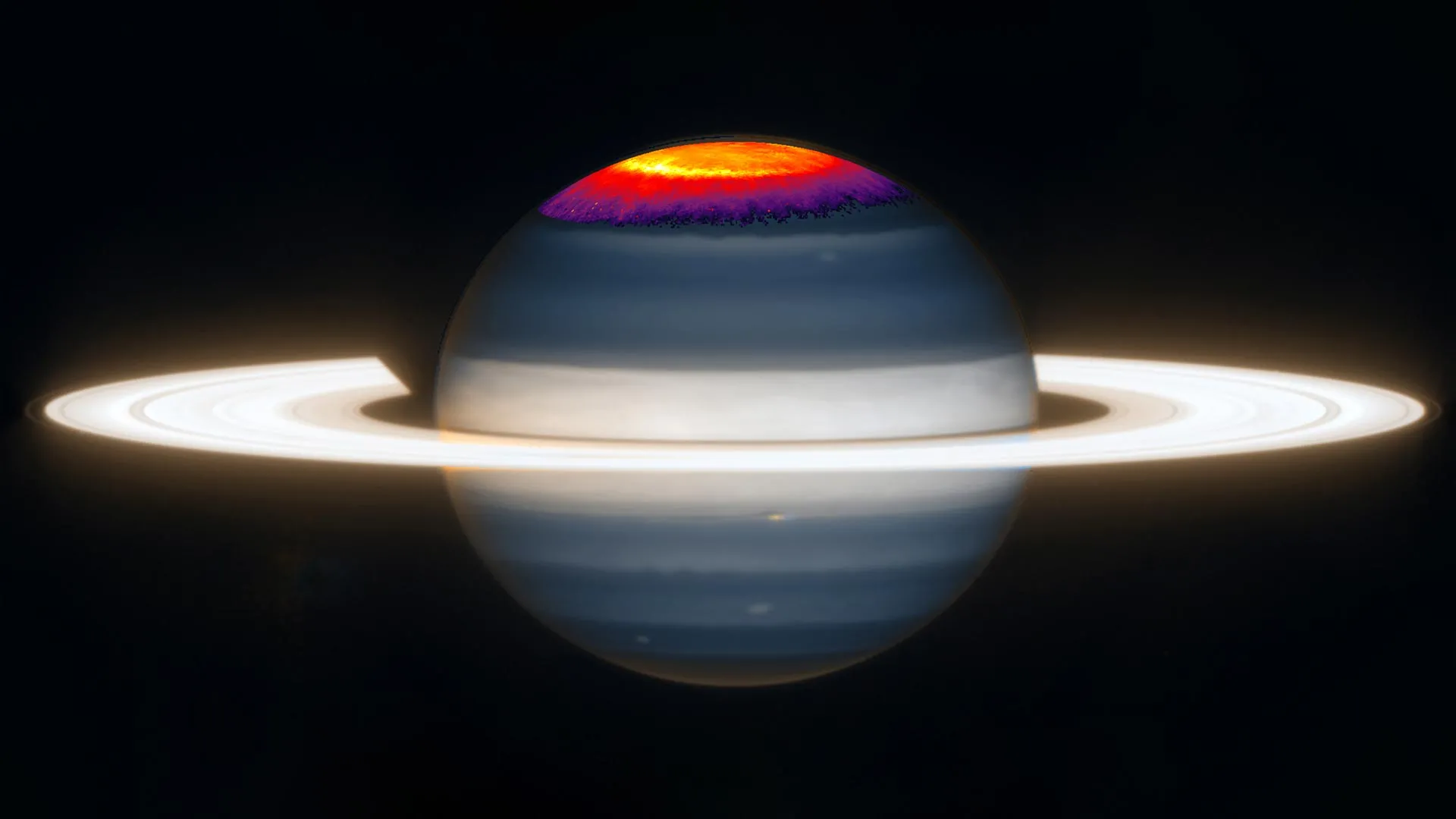
For decades, Saturn seemed to be breaking the laws of physics—its rotation rate appeared to be gradually changing, as if the ringed giant were somehow spinning faster or slower over time. The puzzle deepened with observations from NASA's Cassini spacecraft in 2004, which suggested Saturn's spin was genuinely shifting. Planets do not simply alter their rotation on short timescales, so the finding defied explanation. Now, researchers using the James Webb Space Telescope have finally cracked the case, revealing that Saturn's magnificent northern lights are the hidden architect of this cosmic illusion.
The mystery has deep roots, but the real breakthrough came in 2021 when Professor Tom Stallard of Northumbria University and his team proposed a radical reframing: Saturn's rotation was not actually changing at all. Instead, electrical signals linked to the planet's aurora were being scrambled by powerful winds in the upper atmosphere. Those winds generated electrical currents that distorted the auroral signal scientists relied on to measure the planet's spin. The explanation solved one puzzle but opened another: what was driving those atmospheric winds in the first place?
To find out, Stallard and colleagues turned to the James Webb Space Telescope, observing Saturn's northern auroral region continuously for an entire Saturnian day. The improvement in precision was staggering. Earlier measurements carried uncertainties of roughly 50 degrees Celsius, making it nearly impossible to detect subtle atmospheric changes. JWST's infrared observations were about ten times more precise, allowing the team to create the most detailed maps ever produced of temperatures and charged particle densities within Saturn's auroral region by analyzing light emitted by trihydrogen cation, a molecule that forms in Saturn's upper atmosphere and acts as a natural temperature indicator.
The data revealed something extraordinary: Saturn's aurora is far more than a stunning light show. It is, in essence, a self-sustaining planetary heat engine. Energy deposited by the aurora heats specific regions of the atmosphere. That heating generates winds, which then create electrical currents. Those currents help power the aurora itself, which continues heating the atmosphere and sustaining the entire cycle. "What we are seeing is essentially a planetary heat pump," Stallard explained. "Saturn's aurora heats its atmosphere, the atmosphere drives winds, the winds produce currents that power the aurora, and so it goes on. The system feeds itself."
The new observations, which matched predictions from computer models developed over a decade earlier, finally closed a loop that had baffled planetary scientists. The models only worked if the source of atmospheric heating was located exactly where the strongest auroral particles enter Saturn's atmosphere—and that is precisely what JWST confirmed.
The implications reach far beyond Saturn. Researchers found evidence that Saturn's atmosphere and magnetosphere are closely connected, with atmospheric activity influencing magnetospheric conditions while the magnetosphere feeds energy back into the atmosphere. This ongoing exchange may help explain why the process remains stable over long periods. Stallard sees broader significance: "If a planet's atmospheric conditions can drive currents out into the surrounding space environment, then understanding what is happening in the stratospheres of other worlds may reveal interactions we have not yet even imagined." The discovery reshapes how scientists think about planetary atmospheres across the solar system and beyond.