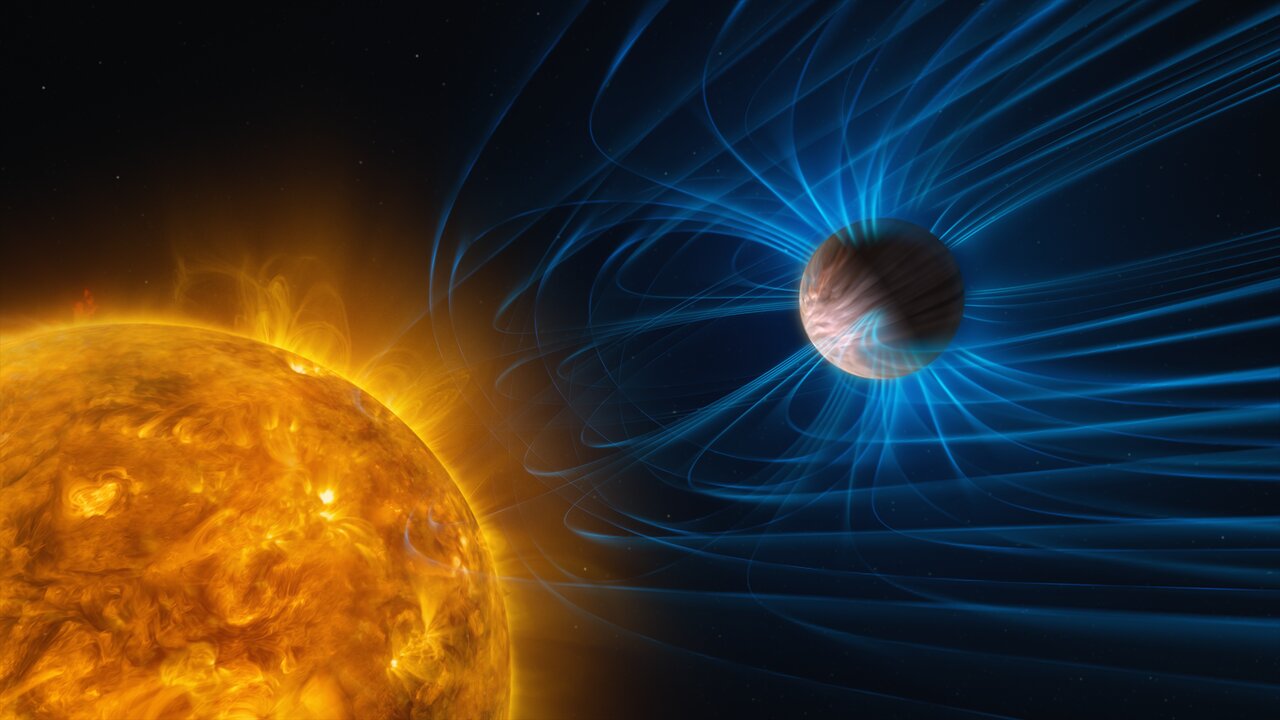
Julia Seidel was looking for wind speeds when she found something far more profound: the first direct evidence of magnetic fields around worlds beyond our solar system.
For billions of years, astronomers have wondered what separates a dead planet from one capable of harboring life. The answer, it turns out, begins with an invisible shield. Earth's magnetic field does far more than create shimmering auroras—it anchors our atmosphere itself, deflecting the solar wind that would otherwise strip it away. Mars lost its magnetosphere billions of years ago, and with it went most of its water and air. Understanding magnetism on distant worlds, therefore, is understanding which planets might one day remain alive.
That's what makes the discovery by Seidel's team at the Laboratoire Lagrange in France so significant. Using the European Southern Observatory's Very Large Telescope and the Gemini North telescope, the researchers observed seven scorching exoplanets—each a gas giant like Jupiter, tidally locked to its star so that one face perpetually bakes while the other freezes. These worlds should, by all logic, have had raging winds. Instead, something was slowing them down.
The wind speeds they measured ranged from around 7,200 kilometers per hour to over 25,000 kilometers per hour—speeds that dwarf anything Jupiter experiences, where the fastest winds top out at roughly 1,500 kilometers per hour. Yet as Seidel and her colleagues examined the pattern, they noticed something counterintuitive: the hotter the planet, the slower the wind. Vivien Parmentier, a co-author at the same laboratory, put it bluntly: "All things being equal, hot planets have more energy to accelerate the winds! Something must happen that slows down the wind speeds for hotter objects."
That something, the team concluded, had to be magnetic fields. Like invisible brakes on charged particles in the atmosphere, these planetary magnetospheres were constraining the winds. By measuring how much the winds were slowed, the researchers could calculate the strength of the magnetic fields doing the braking. The results were remarkable: the exoplanets' magnetic fields were comparable to those in our own solar system—approximately four times stronger than Saturn's or about half the strength of Jupiter's.
For the past fifteen years, no one had succeeded in directly measuring exoplanet magnetism. Now, suddenly, a window had opened. "This breakthrough opens a completely new window on exoplanet research," Seidel said in a statement published last week in Nature Astronomy. "It's the first time we can compare the magnetic environments of other worlds—a key step toward ultimately understanding which planets can stay alive, keep their water, and perhaps even, one day, host life as we know it."
What makes the discovery even more tantalizing is what it might reveal about these distant skies. Bibiana Prinoth, an astronomer at ESO's Garching station, notes that here on Earth, particles from the Sun collide with our magnetic field and cascade toward the poles, creating the green, pink, and purple dances of the northern and southern lights. On these exoplanets, magnetically driven auroras could be far more dramatic—a half-lit world perpetually caught between blazing day and frozen night, its sky potentially filled with colorful displays that dwarf anything in Earth's experience.
The team looks ahead to the arrival of ESO's Extremely Large Telescope, which will characterize not just gas giants but smaller, Earth-like worlds—possibly detecting the chemical signatures of auroras on distant worlds we've never seen, on planets we're only beginning to understand.