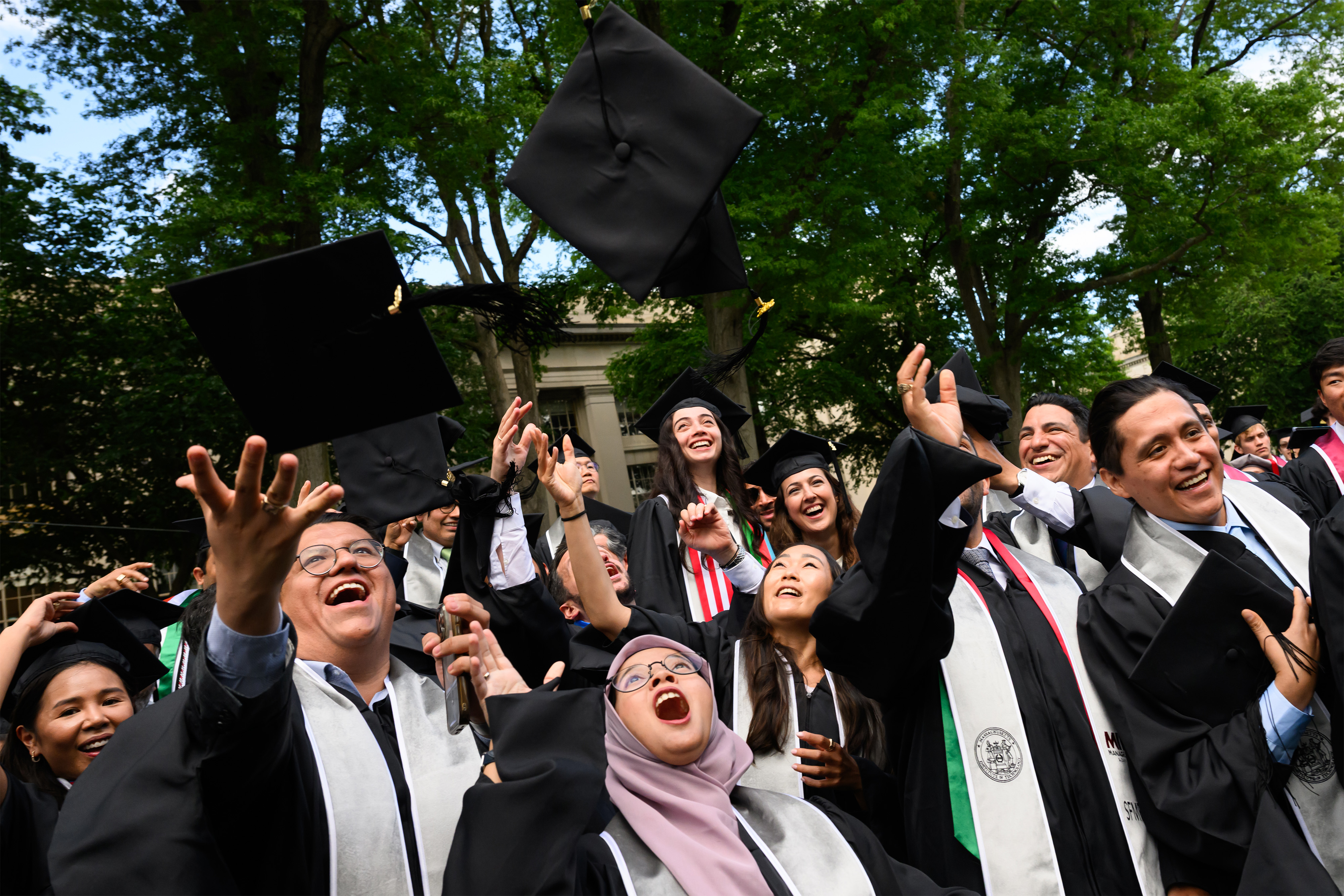
Lisa Su '90, SM '91, PhD '94 stood before MIT's Class of 2026 in Killian Court with a simple but transformative piece of advice: "Run toward the hardest problems." The chair and CEO of Advanced Micro Devices (AMD)—and a triple alumna of the Institute—spoke to graduates navigating one of the most uncertain moments in recent history, urging them to embrace difficulty not as an obstacle but as the truest teacher.
Su's charge to the 3,982 new graduates resonated because it came from lived experience. Her three degrees in electrical engineering from MIT shaped not her confidence that she would always have the answers, but rather her confidence that she could figure things out when she didn't. That distinction matters. In a world hungry for certainty, Su offered something more durable: the capacity to think through the unknown. Building 12, home of MIT's nano facility, bears her name—a 2022 honor that reflects decades of leadership at one of the world's most influential technology companies.
But Su's message extended beyond technical problem-solving. Speaking before a large audience on a spirited afternoon, she emphasized that the world needs more than people who know how to use powerful tools. "The world does not just need people who know how to use powerful tools," she said. "It needs people who know what to use them for. People with a sense of purpose. Judgment. Courage." It was a call to moral imagination, not merely technical prowess.
MIT President Sally A. Kornbluth reinforced this theme, framing curiosity as the institution's defining force and "intellectual rocket fuel" for society itself. She spoke of the Institute's commitment to merit-based excellence—notably rejecting legacy admissions and donor back-door placements—and described how curiosity-driven science becomes world-changing innovation. "Curiosity," she said, "is the force that transforms deadly cancers into treatable conditions. That turns fusion energy from a dream to a reality. That uncovers new ways to grow more food using less of every resource."
The Class of 2026 earned 1,165 undergraduate and 2,817 graduate degrees across MIT's five schools and its Schwarzman College of Computing. Their student leaders echoed the call to purposeful action. Teddy Warner, president of the Graduate Student Council, spoke of the responsibility MIT graduates carry "to work with others to generate, disseminate, and preserve knowledge to bear on the world's greatest challenges." Undergraduate class president Heba Hussein urged her peers to "continue to carry care"—for their work, for each other, and for the people whose lives will be shaped by the choices the Class of 2026 makes.
The ceremony itself honored continuity alongside transition. The alumni parade featured the undergraduate class of 1976 celebrating its 50th anniversary, a reminder that MIT's influence unfolds across decades. As graduates left Killian Court that afternoon, they carried with them not just diplomas but a shared understanding: that the hardest problems are not burdens to avoid, but invitations to discover what they're truly capable of becoming.