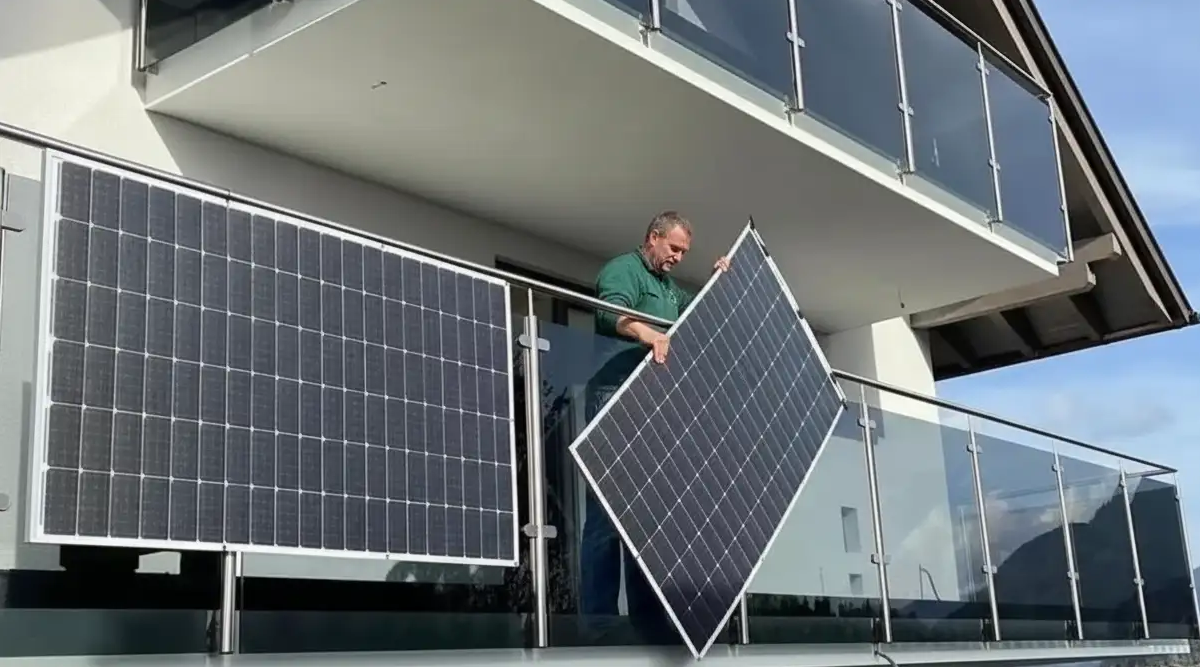
California is on the verge of making it radically simpler for people to tap into solar power from their own balconies—no permits, no installers, no months of waiting. SB 868, introduced by Senator Scott Wiener of San Francisco, just cleared the State Assembly's Committee on Utilities and Energy with an 18-0 vote, bringing the nation's most populous state closer to joining a growing movement across America that's making renewable energy accessible in ways that seemed impossible just a few years ago.
The appeal of plug-and-play balcony solar is straightforward: residents can buy compact solar panels, connect them directly to an outlet, and immediately begin generating their own clean electricity. It's a democratization of solar technology that sidesteps the traditional barriers—permitting delays, installation costs, and contractor availability—that have long kept rooftop systems out of reach for renters and homeowners alike. For a state like California, where nearly half the population rents, this matters enormously.
The timing is significant. California, which would rank as the world's fourth-largest economy if it were a country, has long been a leader in solar innovation, but recent cuts to net metering policies have damaged the industry significantly. The state lost approximately 17,000 solar jobs following those policy changes, and a recent California Supreme Court decision ended legal challenges to the Public Utilities Commission's net metering reductions. Against that backdrop, SB 868 represents a chance to reignite momentum in a sector that has driven both environmental progress and economic opportunity.
The path forward requires two more legislative hurdles. The bill must pass the Assembly Committee on Appropriations and then win approval from the full Assembly. The California Public Utilities Commission estimates the legislation will carry an annual cost between $200,000 and $500,000—modest figures for a state budget, but enough to place the bill on the Appropriations committee's suspense file for an August hearing. Even so, the momentum appears genuine; support has come from across the political spectrum.
California would be joining a wave of action that has surprised many observers in its speed and breadth. Since 2025, state legislatures have considered 34 plug-in solar bills. Utah's HB 340, signed into law this year, became the first such bill to take effect anywhere in the country and catalyzed immediate interest elsewhere. Today, balcony solar is already legal in Colorado, Connecticut, Maine, Maryland, and Virginia, with New Hampshire, New York, and Vermont close behind.
If California approves SB 868, the resulting deployment could dwarf efforts in other states. The state boasts abundant sunshine, the nation's highest population, electricity prices that make solar economically attractive, and existing cultural enthusiasm for renewable energy. Renters—a group that has historically been locked out of solar's benefits—make up 44 percent of California's population. That's a massive addressable market.
What makes this moment genuinely hopeful is how far this idea has traveled in a single year. Balcony solar lacks the glamour of rooftop installations or utility-scale solar farms. It doesn't require policy experts or environmental advocates to understand why it matters. People simply see panels on a neighbor's balcony, realize they can do the same, and move forward. Perhaps that's why the concept has caught fire well beyond typical solar enthusiast circles. As California's legislature advances this bill toward final passage, it's positioning the state to prove that sometimes the simplest ideas—plug it in, generate power—can spark the biggest changes.