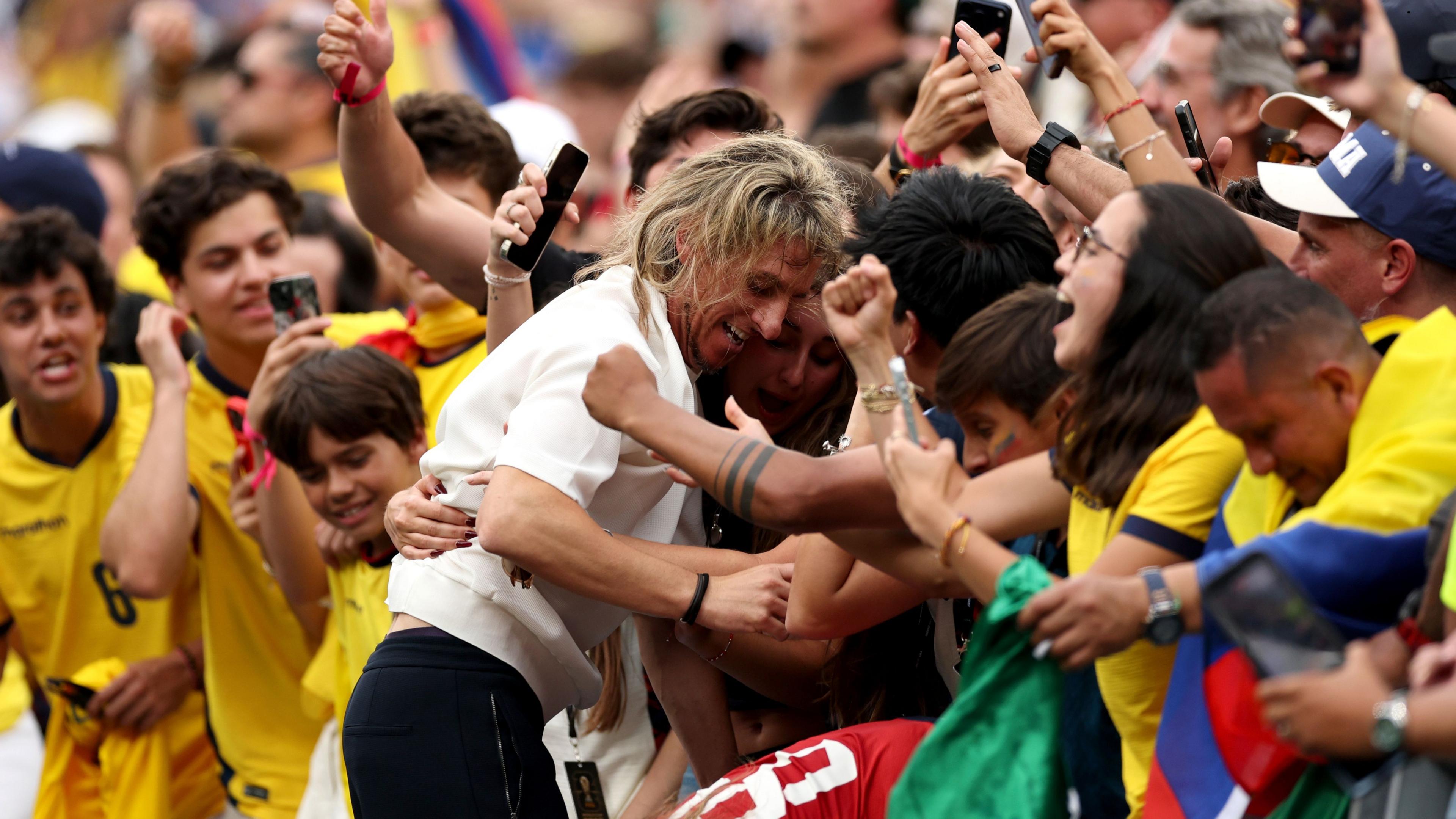
When referee Mary Victoria Penso blew the final whistle in New Jersey, Ecuador's Sebastian Beccacece clambered over the stadium barriers to embrace his family. The Argentine coach had everything riding on this moment — hours earlier, he had told reporters he expected to step down if his side failed to reach the World Cup knockout stages. Germany, the four-time champions, had been beaten 2-1, and Beccacece was weeping with relief.
"If Ecuador hadn't won this game, he wouldn't have been in the job," former England captain Alan Shearer observed on BBC One. "He was looking for a reaction from his players and boy has he got one."
The victory was historic. Ecuador has now reached the knockout stages for only the second time in their entire World Cup history — the first coming way back in 2006, when a team led by Ivan Hurtado advanced past the group phase before falling to David Beckham's famous free-kick against England. Twenty years of heartbreak and early exits had followed. This moment, then, represents something close to redemption for a nation that first graced the World Cup stage in 2002 and has spent two decades trying to prove they belong among football's elite.
Beccacece's journey to this point has been anything but smooth. Ecuador began their 2026 qualification campaign under a cloud — a three-point deduction in 2022 for fielding an allegedly ineligible player had cast doubt over their entire trajectory. They fired Felix Sanchez in July 2024, straight after a Copa America quarter-final defeat by Argentina. Beccacece took over, lost his first match to Brazil, then went unbeaten in his next eleven games, finishing runners-up in South American qualifying — ahead of Uruguay, Colombia, and Paraguay — to earn their place in the tournament.
Yet even as Ecuador arrived with a 19-game unbeaten streak, the tournament nearly broke them. A last-gasp 1-0 loss to Ivory Coast in the opener sent shockwaves through the squad. A goalless draw with tournament debutants Curacao turned fans against the coach, with reports of confrontations between Beccacece's family members and supporters. "I am very sorry I didn't make it to the heart of the Ecuadorean fan," he admitted.
But against Germany, everything changed. "Him and his players put a shift in — they gambled, they fought, they scrapped and they've come out on top," Shearer said. The fighting spirit Beccacece had demanded was finally there, embodied by veterans like 36-year-old Enner Valencia — who now has six career World Cup goals to his name — and defensive stalwarts Willian Pacho of Paris Saint-Germain, Arsenal's Piero Hincapie, and Chelsea's Moises Caicedo.
South American football expert Tim Vickery recalled watching Ecuador celebrate their first-ever World Cup qualification in 2002. "I woke up the next morning and the streets in Quito were ankle deep in broken glass," he said. "Tomorrow morning the streets in Quito will be knee-deep in broken glass as they're going to have a party."
For Beccacece, who built his reputation as Jorge Sampaoli's assistant during Chile's golden era, this may be the greatest achievement of his managerial career. "We never feel like we are in hell, nor do we feel like we are in heaven," he said after the Germany match. "We have our feet grounded on earth and we feel and think in the right manner." Now, with the knockout rounds ahead and a potential clash with England on the horizon, Ecuador has given their fans something to believe in.