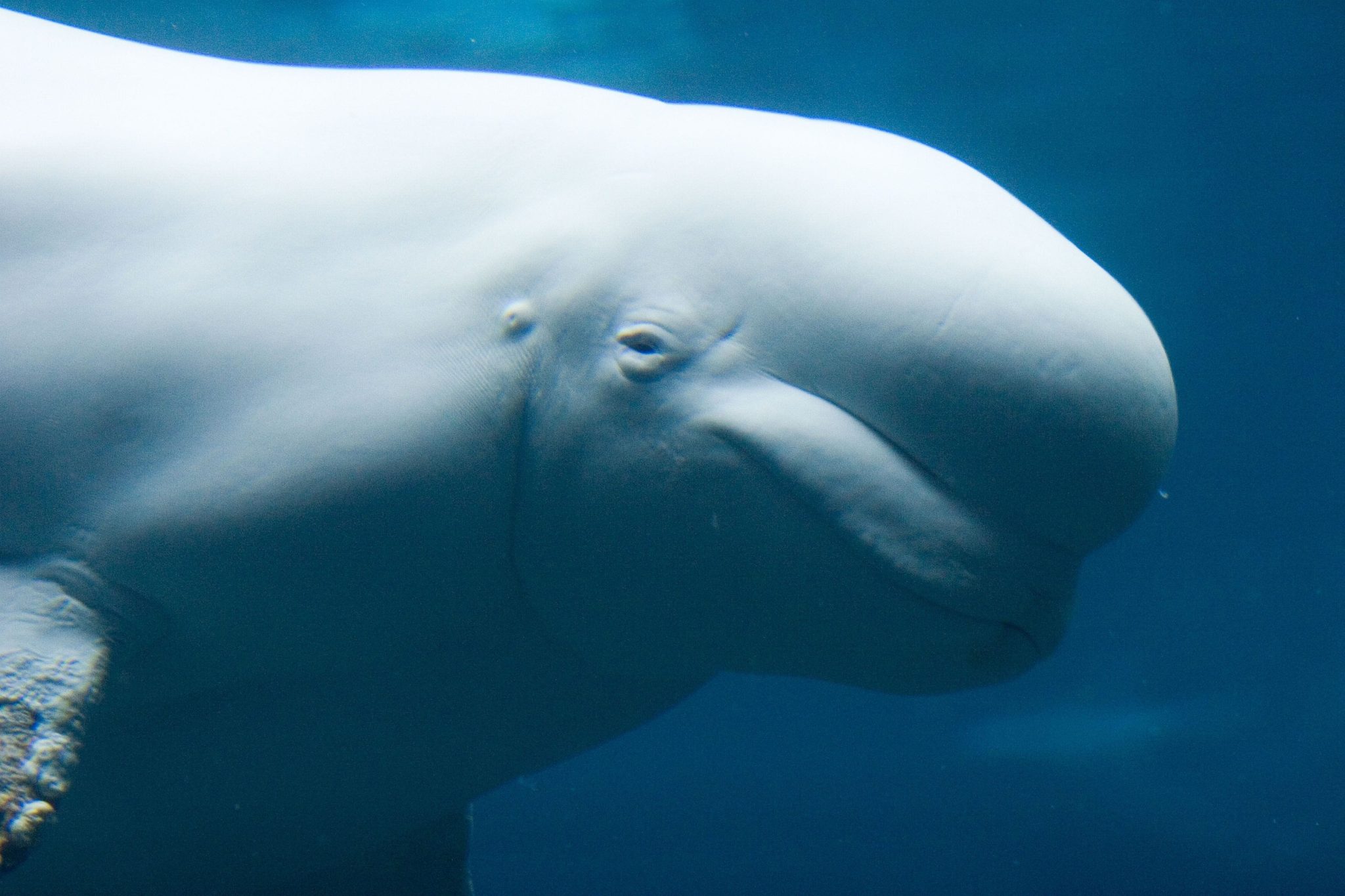
When Alexander Mildener pressed play on a grainy 2001 video during pandemic lockdown, he was watching the very belugas that had mesmerized him as a child at the New York Aquarium — and discovering they possessed something scientists rarely find in the animal kingdom: the ability to recognize themselves in a mirror.
The capacity for mirror self-recognition belongs to a strikingly short list. Chimpanzees have it. Bottlenose dolphins do. Asian elephants. A magpie or two. A small reef fish called the cleaner wrasse, which upended assumptions about brain size when it passed the test in 2023. Now belugas join this exclusive club, according to findings published in PLOS One that document two whales at the New York Aquarium demonstrating this rare cognitive ability.
The research traces back to Diana Reiss, a marine mammal scientist at Hunter College who had already documented mirror self-recognition in dolphins and elephants. In 2001, Reiss set up the same experiment for four captive belugas, affixing a mirror to a window in their shared pool for two-hour sessions while her team filmed the results. Then life intervened. The footage sat archived for nearly two decades until Mildener, who had grown up visiting the aquarium, enrolled in Reiss's program in 2020. With the pandemic limiting field research, he needed a thesis project. Reiss pulled out the old tapes, and Mildener spent lockdown carefully analyzing videos of "the very whales that inspired me to be in this field in the first place," as he describes them.
What he watched was a choreography of self-discovery. Animals testing mirror recognition follow a recognizable pattern. First comes a reaction to the mirror as something new — perhaps a rival. Then contingency testing: repetitive movements designed to check whether the image responds to them. Reiss compares this to watching yourself on a security monitor in a store: you might move your head or raise your hand to confirm "Is that me?" For animals who pass, that moment seems to be where understanding dawns.
Two of the whales, Natasha and Maris, went through the full sequence. In their first session, both clapped their jaws at their reflections — a behavior belugas use for intimidation with each other. Then the testing began. Natasha nodded at the mirror while Maris waggled her head in multiple directions. By their second session, both were using the mirror to watch themselves barrel-roll and peer inside their own mouths. Maris performed what researchers called a "pec shimmy," rearing up and flapping her pectoral fins. Both whales blew bubbles and bit them — behaviors that vanish when the mirror is absent. Natasha went on to pass the mark test, where researchers draw a mark on an animal's body in a spot it cannot see without a mirror. Maris did not, a pattern consistent with mirror-recognition studies across species, where some individuals succeed while others do not.
Each addition to the mirror self-recognition list dismantles a prior certainty. "We have this list of the things that only humans do," Reiss says, "and over time we've been checking them off." The cleaner wrasse finding proved that sophisticated brains aren't the threshold researchers once assumed. What does seem consistent is that species passing the test tend to be highly social and capable of recognizing individuals of their own kind.
The implications extend beyond science. When humpback whale research expanded in the 1970s, it helped build public support for the Endangered Species Act and the Marine Mammal Protection Act. Reiss sees the same potential in this work. "Finding these shared capabilities and shared levels of consciousness and self-awareness in other species seem to engender more empathy for them," she says. For Mildener, who spent lockdown watching the animals that first drew him to marine science, the whales that inspired his path had also become his first major discovery.