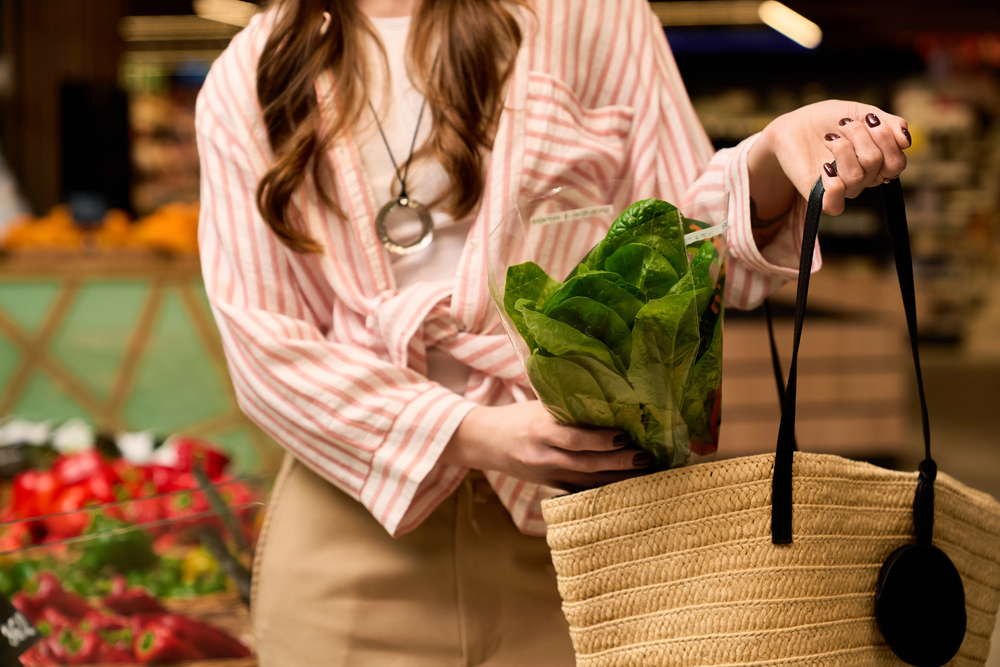
The lettuce in the REWE store in Berlin's Lankwitz neighborhood has had a very short morning. It was grown on the rooftop farm directly above the shop, cut, packed by hand, and carried one flight of stairs down to the shelves — all before most shoppers walk through the doors. The whole trip from farm to shelf is measured not in miles but in flights of stairs.
The store was built with the farm in mind. Skylights throughout the grocery floor let shoppers look up into what's growing above their heads. The greenhouse runs year-round using hydroponics, a method that needs very little soil and grows plants in about three weeks. It's heated by the waste heat from the store's own refrigerators, watered mostly by rain that falls on the roof, and partly powered by solar panels. When the greens are ready, they come straight downstairs. Nothing leaves the building that the building doesn't immediately use again. The supply chain here is a staircase.
"This way we don't even have an extra truck on the road that is usually necessary to transport the goods from the producer to the central distribution," said Leschke, the REWE project lead. The rooftops feed a real demand, and the greens aren't only sold in this one store — they also reach other REWE locations across Berlin and the surrounding region.
Prajal Pradhan, an associate professor at the University of Groningen, recently published a study on urban agriculture in Europe. He sees projects like this as a way to close the gap between growers and eaters. "There is a disconnection between producers and consumers," he said. "This is a way to go forward, because you can provide fresh vegetables to urban consumers on site." His research suggests the potential is enormous: rooftop and ground-based urban farming could supply up to 20 million metric tons of vegetables a year — around 28 percent of Europe's total demand.
But Pradhan wants people not to take the wrong lesson from all this. Supermarket rooftop farms are not a replacement for community gardens, he says. Urban agriculture should be inclusive and bring the whole neighborhood in, not just serve as a selling point for a retail chain. His co-author, Berlin-based remote sensing expert Stepan Svintsov, put it simply: "Getting people together from a dense city and sharing agricultural knowledge among them helps bring the community together." For now, REWE offers outside tours of the Lankwitz facility, though no one enters the production rooms.
Leschke has bigger plans. He wants to build at least 20 supermarket rooftop farms over the next 10 years, with at least one in every REWE region within five. "If we can produce in Germany year-round, we should," he said. The draw for him is being less dependent on supply chains that stretch across the world.
Back at the display, a customer reaches for two bags of Lankwitz lettuce. Another heads for the local variety, planning a tomato-and-mozzarella salad. She likes using the greenhouse greens, she says. After all, it came from the roof. And the roof is right there.