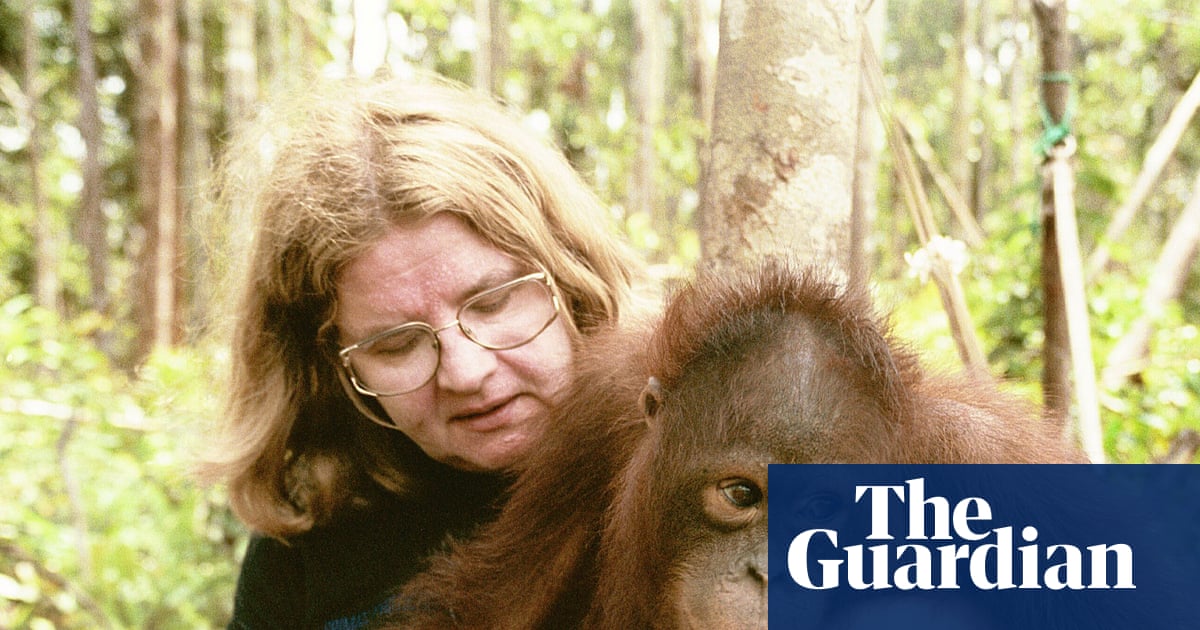
Biruté Galdikas chose a life that few could endure: pushing through brush and wading through swamps thick with insects, snakes, and crocodiles, all to follow orangutans swinging effortlessly through the canopy of Borneo's rainforests. For nearly five decades, the pioneering primatologist—who has died at 79—did exactly that, fundamentally transforming our understanding of these critically endangered "people of the forest" and proving that the most profound discoveries often come from the simple act of patient observation.
When Galdikas began her fieldwork in 1971, the scientific picture of orangutans was remarkably flat. They were thought to be strictly solitary, simple omnivores living largely solitary lives. Through meticulous study, Galdikas revealed a far richer reality. Orangutans have the longest birth interval of any land mammal, with females producing just one infant every seven or eight years and investing themselves intensively in rearing. Rather than random foragers, they emerged as deliberate "gardeners of the forest"—the only animals large enough to distribute seeds of bigger plants through digestion, and the only ones able to break branches in the canopy to let in light and encourage new growth.
Most strikingly, Galdikas's work shattered the myth of orangutan solitude. Males were indeed largely solitary, but females lived in loose matrilineal groups, a social pattern that would later be recognized across all great apes. Following her example, other fieldworkers documented tool use among orangutans—a discovery that challenged what had long been considered exclusively human. They found that different orangutan populations developed distinct tools for different tasks, evidence of culture itself being transmitted across generations and groups.
Galdikas's discoveries mattered not just for science, but for conservation. By revealing the remarkable strength of orangutans' social bonds, their individual personalities, and their emotional depth, she made them impossible to dismiss as mere animals. She joined her colleagues Jane Goodall and Dian Fossey—affectionately known as the "trimates"—in dedicating their careers to protecting the apes they studied. Goodall, who died last year, worked with chimpanzees; Fossey, murdered in Rwanda in 1985, studied mountain gorillas. Together, these three women added something revolutionary to primatology: the female perspective.
Galdikas became deeply committed to rescuing and rehabilitating orphaned orangutans, serving as a surrogate mother to hundreds. This work drew criticism from colleagues who argued that her emotional closeness to the animals compromised her objectivity and posed disease transmission risks. Yet researchers defending her legacy note that in her era, disease risks were far less understood, and human surrogate mothers remain often the only option for orphans who would normally spend their first seven years inseparable from their real mothers. As primatologist Gillian Forrester of the University of Sussex observed, "Those women worked in an age of discovery. Now we're moving into an age of responsibility."
Born in Wiesbaden, Germany, to Lithuanian parents—her father a house painter, her mother a nurse—Galdikas emigrated to Toronto as a child, where she developed a fascination with human evolution. As a student, she became captivated by orangutans, the only great ape native to Asia, and by their haunting eyes: "Their eyes have whites around the iris … just like humans," she explained in a 2011 interview. In following them through the forest, she followed something deeper—a thread connecting us to our closest living relatives, and a reminder of what we stand to lose.