When Xin "Cindy" Xiang examines a distant galaxy, she's essentially reading the mood swings of a black hole. Xiang, a doctoral student at the University of Michigan, has been using data from the X-Ray Imaging and Spectroscopy Mission (XRISM) to study how supermassive black holes influence the galaxies around them—and her findings reveal a surprising cosmic relationship The challenge is that the universe's most massive galaxies contain far fewer stars than current models predict. Something, it turns out, has been holding them back. Now, Xiang may have identified the culprit.
"Before XRISM, we could only see broad features of the outflows," Xiang said. "But we needed to be able to resolve features to answer important questions. What is their structure and geometry? How are the winds launched and when?"
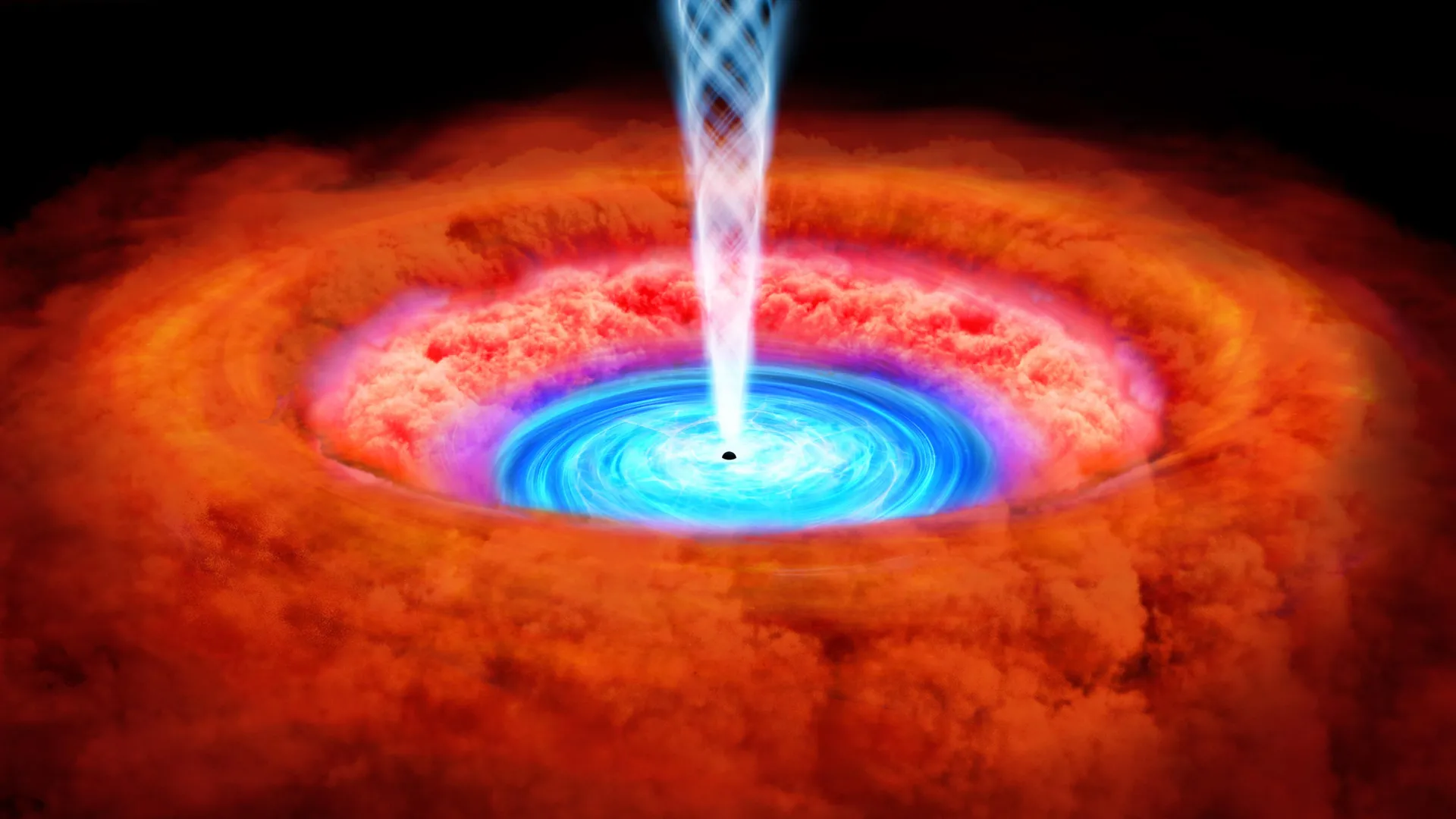
Most people know black holes as objects whose gravity is so strong that nothing escapes once it crosses the boundary. But black holes can also create intensely luminous regions around themselves. As gas and dust spiral inward, they form an accretion disk that emits enormous amounts of energy, including powerful X-rays. These disks launch powerful winds that can be strong enough to sweep gas out of a galaxy—and gas is the raw material needed to make new stars.
Launched in 2023 through a partnership between the Japanese Aerospace Exploration Agency, NASA, and the European Space Agency, XRISM began scientific observations in fall 2024. Its energy resolution is roughly 10 times better than its predecessor, giving astronomers an unprecedented view of these extreme environments.
Xiang and University of Michigan astronomy professor Jon Miller focused on NGC 4151, a bright galaxy located just over 50 million light-years from Earth. At its center lies an active galactic nucleus where a supermassive black hole is actively consuming material and generating a luminous accretion disk—making it an ideal laboratory for studying black hole-driven outflows.
Working with this sharper data, Xiang showed that winds from NGC 4151's accretion disk can reach speeds high enough to eject material from the system. She also identified the likely mechanism driving these outflows: something called magnetocentrifugal driving, similar to what sets off solar flares.
At the 248th meeting of the American Astronomical Society in Pasadena, Xiang unveiled a new method for determining when these powerful winds are active. Analyzing hundreds of days of XRISM observations, she developed a metric called "cindicity"—partly because her name is Cindy—that combines X-ray brightness and hardness measurements.
"In the future, you could tell me the cindicity of your source at this moment, and I can tell you the probability that you're seeing a fast outflow," Xiang said.
The analysis revealed a striking pattern. In NGC 4151, the strongest fast winds appeared when X-rays were hard but relatively faint. More remarkably, the fastest outflows didn't occur during X-ray flares themselves—they typically appeared about 10,000 seconds, or just under three hours, later.
This finding provides the first direct timing connection between X-ray activity and the powerful winds flowing from a black hole's accretion disk. By learning to predict when these outflows occur, astronomers now have a valuable new tool for understanding how black holes shape the growth and evolution of galaxies across the cosmos.