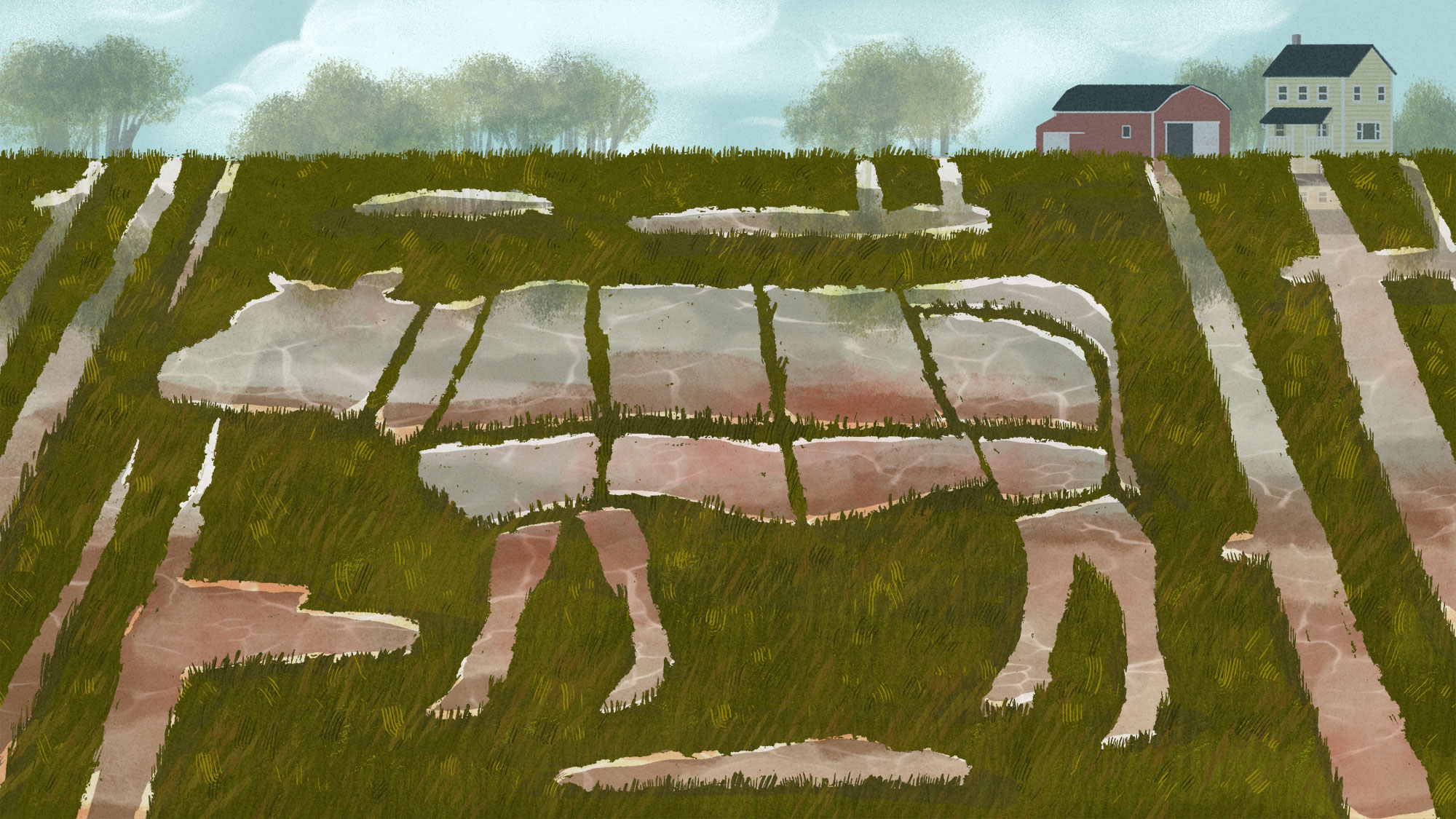
When Trish Leigey's kitchen taps began running brown in late 2019, she knew something was terribly wrong. Tests soon revealed the unsettling truth: bovine DNA had infiltrated the drinking water supply in rural Loganton, Pennsylvania—a direct result of Nicholas Meat's practice of spreading liquefied slaughterhouse waste across nearby farmland. For Leigey, a single mother working three jobs, the contamination became a breaking point. While her neighbors had grown accustomed to the sight of desiccated animal parts scattered along local roads and trucks spraying a cocktail of blood, urine, and slaughterhouse refuse over fields, few dared speak up against the company that employed 425 people—nearly as many as lived in the entire town. Leigey decided to fight anyway.
"I just want a simple life," she said at the time. "I don't feel like I should have to be emotionally, mentally, financially, and physically exhausted because some millionaire wants to dump blood on fields because it's a cheap way to dispose of it."
In December, a jury validated her courage. They held Nicholas Meat liable for causing a nuisance and trespassing on neighboring properties by fouling their air and water. Leigey and three other residents who sued the company were awarded $145,000—a striking victory in Pennsylvania, where lenient right-to-farm laws have historically made such cases nearly impossible to win.
The case illuminates a collision between industrial agriculture and community survival. Nicholas Meat, which began in 1987 as a small family operation, has grown to slaughter approximately 1,000 cattle daily, supplying chains like Giant supermarkets and Burger King. That industrial scale generates at least 200,000 gallons of waste per day, with capacity to store 1 million gallons on-site and another 4.3 million elsewhere. Unlike small butcher shops handling dozens of animals daily, operations of this magnitude produce waste at a fundamentally different level.
The practice of spreading "food processing residuals"—a euphemism for slaughterhouse waste and similar byproducts—is legal, lightly regulated, and cheaper than proper treatment and disposal. Across Pennsylvania, at least 900 farms and food-processing operations participate in the practice. Michael Kovach, president of the Pennsylvania Farmers Union, acknowledges its legitimate uses: "There is a place for it, especially as a replacement for synthetic fertilizers." But scale matters. While small operations can manage the environmental burden, industrial-scale slaughterhouses cannot.
What makes this case remarkable is not just the verdict—it's that it happened at all. Pennsylvania requires no permit to spread food processing residuals. The practice is governed by guidelines published in 1994 that do little more than suggest farmers avoid dumping near waterways or drinking sources. Waste receives no treatment beyond mixing and aerating before being injected or spread on fields that the Nicholas family owns or leases across Clinton County and beyond. State regulators investigate only complaints of unbearable odors or polluted runoff, creating a regulatory vacuum where industrial profit can flourish at community expense.
Yet even this victory may not bend the arc of industrial meat production. The economics remain stacked toward companies like Nicholas Meat. Without mandatory permits, treatment requirements, or accountability mechanisms, there is little reason for similar operations to change their practices. Leigey's win represents something precious but fragile: a single community's refusal to accept contamination as the price of economic convenience. Whether it signals a shift in how Pennsylvania governs industrial agriculture remains to be seen.