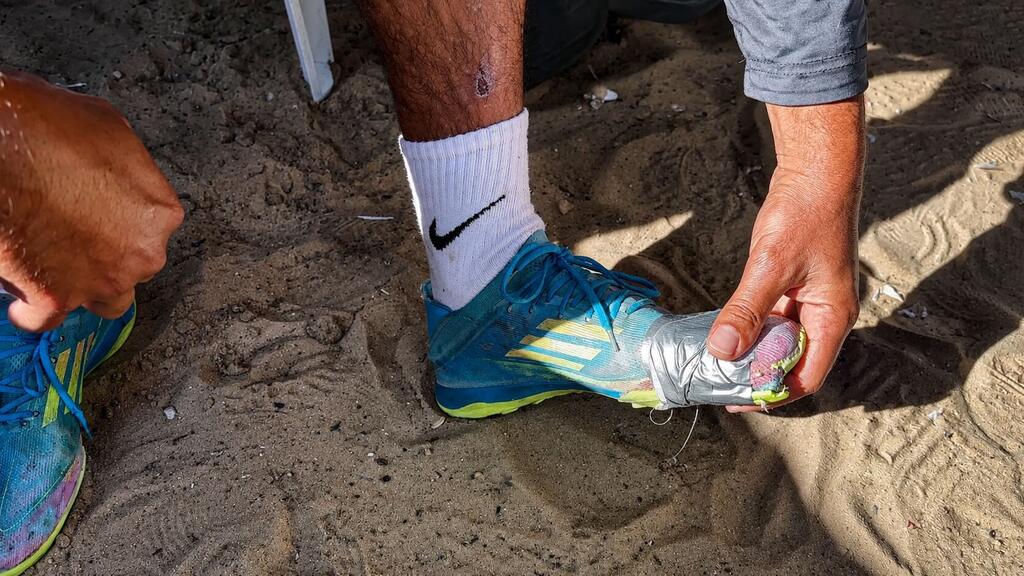
In the Al-Mawasi area west of Khan Younis, Asaad Al-Azzabi stands on a sandy pitch amid displacement tents, boots held together with plastic tape, preparing to lead his team onto a field that once hosted basketball and volleyball. Before the war, he played for Al-Tajammu Club in Rafah with access to proper pitches, training halls, and equipment—a world that feels impossibly distant now. Today, he lives alone in a tent in Al-Rahma Camp after his wife left for Jordan with their son, who is undergoing cancer treatment. Yet here he is, about to play a match that matters far more than the score.
Around 1.7 million people are living in roughly 1,600 displacement sites across the Gaza Strip, most in temporary or informal locations with limited access to clean water and sanitation. Residents rely on water brought in by truck and must cope with severe restrictions on equipment, fuel, and repair materials. In this landscape of scarcity, football has become something unexpected: a lifeline. "With the most limited resources, we try to play," says Alaa Abu Taha, a referee with the Palestinian Football Association and a displaced resident of Rafah himself. "Now there is no sports infrastructure. The pitch we are standing on now was originally prepared for basketball and volleyball, but our people create everything out of nothing."
Gaza's sports sector has been decimated. According to the Palestinian Football Association, hundreds of athletes have been killed, many of them footballers, while hundreds of sports facilities have been damaged or destroyed—pitches, club headquarters, training halls, all gone. Yet in the camps, players like Al-Azzabi refuse to let the sport disappear. He sketches plays in the sand for his teammates before they walk together toward the field. Children and young men gather as spectators, some arriving after spending hours queuing for food, water, or a chance to charge a battery. For a brief window, their focus shifts entirely: to the ball, to the team, to the rhythm of the game.
When the final whistle blows, Al-Rahma Camp has defeated Sheikh Al-Eid Camp 2–1. The reaction is immediate and joyful—young men hoist the players onto their shoulders while children and teenagers celebrate among the tents. The sound of the camps, usually filled with the weight of displacement and loss, recedes. Football emerges as something rare and precious: a space for unguarded happiness. Abu Taha captures the essence of what this moment means: "Football has become the only outlet for many people in Gaza."
For Al-Azzabi, the victory carries a deeper meaning. As his teammates celebrate, he dedicates the championship to his wife and son in Jordan, wishing his son a speedy recovery. The match is a message across distance, an attempt to hold onto who he was before everything changed. In the borrowed boots and the improvised pitch, he chases something more than a ball—a connection to his former life, preserved through the simple, defiant act of play.