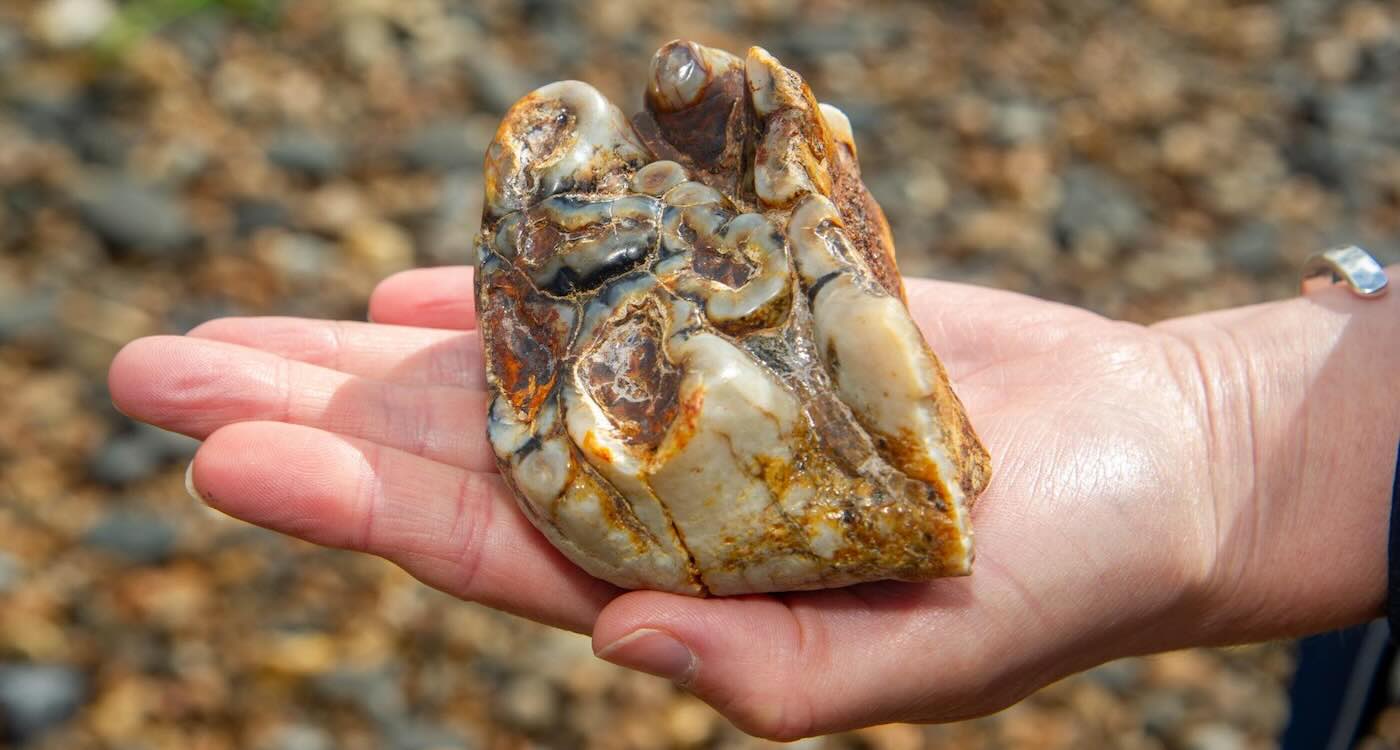
Charlie Orchard-Lisle was walking along the edge of the North Sea on a breezy May morning when something the color of dried clay caught his eye—partly submerged in the surf, half-buried in shingle, a hunk of earth history weighing nearly a pound. The 11-year-old from Suffolk wasn’t searching for fossils, but when he picked up the four-inch-wide object on East Lane beach in Bawdsey, he had no idea he was holding a molar from a creature that roamed Europe two million years ago. The tooth, confirmed by the Natural History Museum in London, belonged to Anancus arvernensis—a six-ton, tusked giant standing eight feet at the shoulder, a distant cousin of today’s African bush elephant. It’s a rare and remarkable find, one that turns a quiet coastal stroll into a window millions of years deep into Earth’s story.
Fossils of Anancus arvernensis are seldom found in the UK, making Charlie’s discovery especially significant. The species lived during the Late Miocene to Early Pleistocene epochs, a time when Britain’s climate was warmer and its landscape dotted with forests and grasslands teeming with megafauna. Unlike the curved tusks of modern elephants, Anancus had long, straight tusks—so distinctive they once led scientists to misclassify the animal as a mastodon when it was first described in 1828. The tooth likely eroded from the nearby red crag cliffs, layers of sediment laid down over millions of years and now slowly surrendering their ancient secrets to the sea.
Charlie’s mother, Eleanor Orchard-Lisle, recalled the moment with awe: “We were walking along and, ten minutes before, my son Charlie was saying how much he loves elephants.” Then, as the waves receded, the fossil emerged—unmistakable in texture and shape. “It must have been quite distinctive because it caught both our eyes,” she said. She sent a photo to Professor Adrian Lister, a leading paleontologist at the Natural History Museum, who confirmed the identification. “It’s quite incredible,” Eleanor added. “I can’t believe you can find something so old on the beach.”
The discovery underscores how accessible science can be—even on a family walk, even to a child. While professional excavations uncover fossils in controlled digs, chance finds like Charlie’s remind us that history isn’t locked in museums; it’s scattered in plain sight, waiting for curious eyes. The tooth may now contribute to scientific understanding of Anancus’s range and habitat in prehistoric Europe. And for Charlie, it’s a personal milestone: a tangible connection to a lost world, sparked by a moment of attention and wonder.
As coastal erosion increases, more fossils may wash free from ancient strata. For now, Charlie’s find stands as a quiet testament to the deep time beneath our feet—and the joy of looking down.