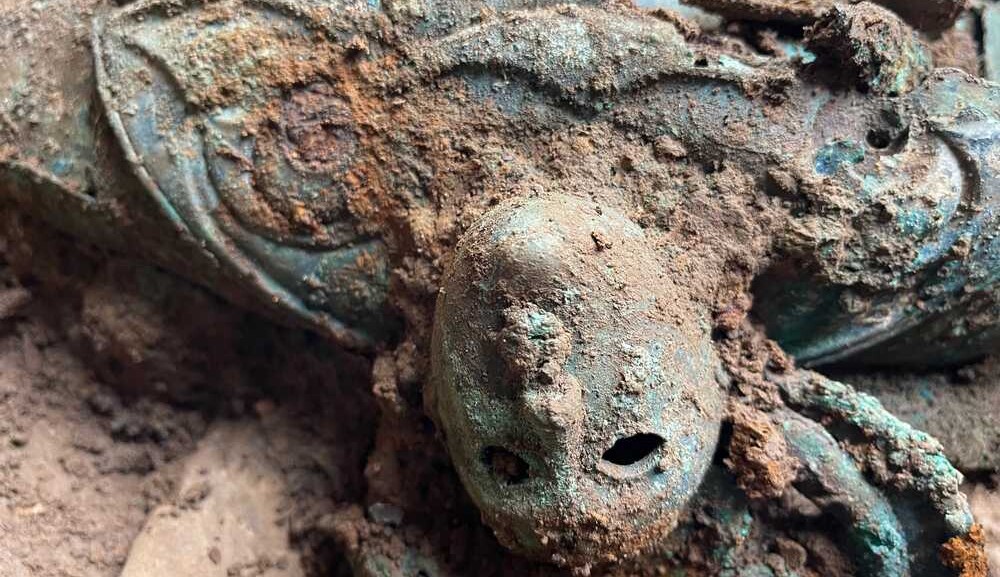
Five years of secrets buried in a Yorkshire field are finally emerging. In 2021, a metal detector user in the rural landscape near Melsonby uncovered something that would rewrite understanding of Iron Age Britain: the largest hoard of Iron Age artifacts ever found in the country, now revealing its treasures to the public for the first time at the Yorkshire Museum in an exhibition called "Chariots, Treasure and Power: Secrets of the Melsonby Hoard."
The discovery matters because it shatters a stubborn assumption that wealth, power, and advanced technology in Iron Age Britain belonged exclusively to the south. What lies within this hoard—carefully excavated by archaeologists who arrived within moments of the metal detector's alert—proves that northern Britain, long dismissed as a "rural backwater," was thriving, connected, and sophisticated.
The hoard itself comprises two distinct groups. The first consists of meticulously stacked chariot components and horse tackle: 28 iron wagon tire bands layered atop one another, along with bridles, bits, lynchpins, yokes, and reins. These pieces point to something unprecedented in the archaeological record of Iron Age Britain—evidence of a 4-horse-drawn carriage. The bridles and bits, remarkably, look nearly identical to those used in carriages today, a detail that makes the continuity of design across millennia almost tangible.
The second group, called "the Block," remains partially mysterious even now. It's essentially a mass of iron and copper-alloy artifacts fused together, likely thrown into a pit fire, pulled out, and then buried. Conservators at the University of Durham brought this dense lump to Southampton for a detailed CT scan, but its interior contents remain largely unknown—a puzzle waiting to be solved.
Yet it is the objects pointing to far-flung trade networks that hint most compellingly at the hoard's owner. A large ornamental cauldron, a wine-mixing bowl, blue glass beads, and a mirror suggest connections stretching across Europe and possibly into the Roman world itself. "The bowl is really interesting because it is a very unusual type: not something you'd find in Northern Britain," said Tom Moore, Durham's head of archaeology. "Its decoration combines both Mediterranean and British Iron Age styles. It also has elaborate decoration of coral, so whoever owned something like that has probably got a network across Britain and across into Europe and even the Roman world."
The closest contemporary settlement was the fort called Stanwick, home to the Brigantes tribe. This region was eventually ruled by Cartimandua, the first documented female sovereign in British history—a figure whose era and connections now take on new significance in light of this hoard's wealth and reach.
The hoard's emergence challenges the long-held narrative that power and prosperity flowed only from Britain's south to its margins. The 4-horse carriage, the Mediterranean-influenced metalwork, the international trade goods—all buried in Yorkshire—fundamentally reshape how archaeologists understand pre-Roman Britain. The exhibition marks only the initial stages of research, with deeper questions still unfolding: Why was the hoard buried? Why were some objects burned and destroyed? Who possessed the influence and resources to amass such lavish items? After five years hidden in northern English soil, these artifacts are ready to offer their answers.