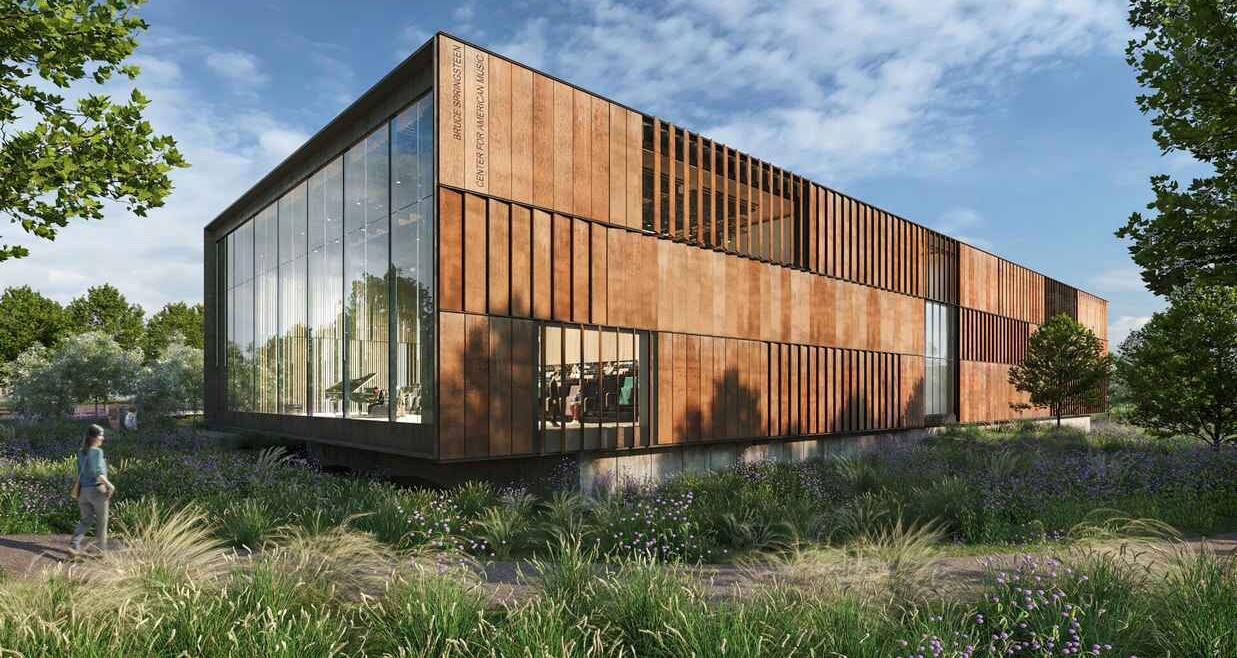
On the same campus where Bruce Springsteen played his earliest shows between 1969 and 1974, Monmouth University in West Long Branch, New Jersey, is now home to nearly 48,000 items documenting not just the Boss's career, but American music itself—the Bruce Springsteen Archives and Center for American Music, opening June 7 with a celebration that feels equal parts homecoming and national reckoning with the role music plays in who we are.
The 30,000 square-foot center, designed by acclaimed New York architecture firm CookFox, stands as a physical embodiment of Springsteen's artistic DNA: its weathered steel facades echo New Jersey's industrial heritage, while end-grain wood block flooring—a material once common in factories a century ago—invites visitors into a 240-seat auditorium that reveals the growth rings within each plank. It's a building that doesn't just hold objects; it holds meaning. The Archives contain oral histories, concert memorabilia, and promotional materials drawn from 47 countries, creating what executive director Robert Santell described as "an academic gold mine" for students, journalists, and historians seeking to understand Springsteen's music and its place in American cultural history.
But this is not a museum frozen in time. The center functions as a living classroom, with lesson plans, teaching strategies, and online programs designed to bring American music into schools nationwide. Monmouth will partner with Stevie Van Zandt's non-profit TeachRock—Van Zandt himself is the E-Street Band guitarist—to organize educational activities with local schools, ensuring that what the Archives contain doesn't remain locked behind glass.
The June 4 and 5 concerts—called Music America: The Songs that Shaped Us—will precede the June 7 opening with a lineup that reads like a roll call of American music itself: Jon Bon Jovi, Jackson Browne, Rosanne Cash, Kenny Chesney, Gary Clark Jr., Dion, the Dropkick Murphys, Shemekia Copeland, Valerie June, Jimmie Vaughan, Keb' Mo', and Nils Lofgren, all delivering their uniquely American music across blues, bluegrass, rock, hip-hop, Americana, jazz, country, and gospel. The concerts, held at the OceanFirst Bank Center on campus, will need that larger venue; the center's 240-seat auditorium, while intimate, will serve as the heart for ongoing academic lectures, presentations, and video screenings once the celebration concludes.
When Springsteen announced the center in 2023, standing on steps where he'd played at nineteen, he spoke of being "quite humbling" about becoming "a presence here on this campus." That presence—50 years after those earliest performances—transforms Monmouth University into something larger: a repository for understanding how one artist's voice connected to the broader American story, and how American music, in all its forms, continues to shape the nation's conscience. The Archives and Center for American Music suggests that this work—of preservation, education, and public access—is just beginning.