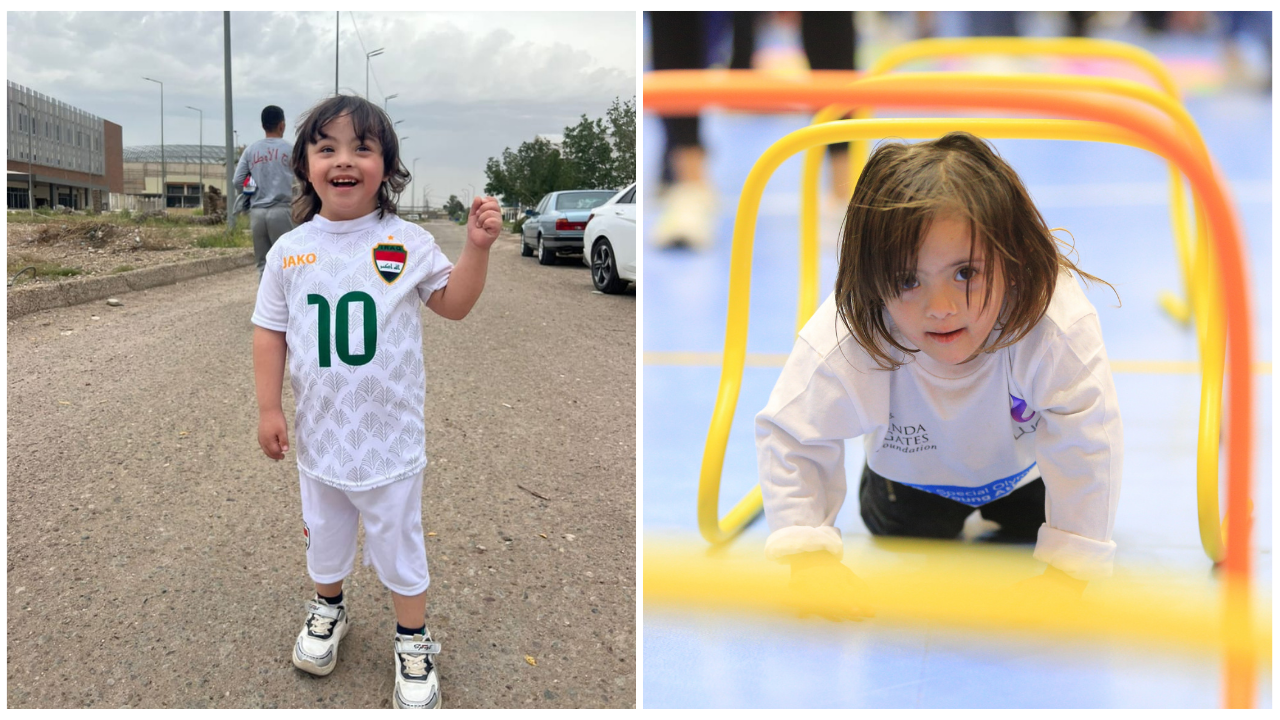
Four-and-a-half-year-old Abbas Khalil Ibrahim fills his home with energy and joy, but it wasn't until he joined the Special Olympics Young Athletes program in Iraq that his family saw him truly flourish. What began as simple play—running, kicking, throwing—became the cornerstone of his transformation: he grew more confident, more willing to try new things, more able to follow instructions. His parents watched as Abbas became less dependent on them and more eager to interact with other children, discovering the world through movement and play.
Abbas and his counterpart across the border, eight-year-old Karma Ahmed Abdel-Khaleq in the Helwan district of Cairo, are part of a quiet revolution unfolding across Iraq and Egypt. Young Athletes is an early childhood play program for children ages 2 to 7 with and without intellectual and developmental disabilities (IDD). The program introduces basic motor skills while creating spaces where children of all abilities learn together—no hierarchy, no separation, just shared joy and growth.
The science behind the program is striking. Studies show that after just two months of participation, children with intellectual disabilities experience a seven-month gain in motor skills, improving at twice the rate of children who don't participate. This isn't abstract developmental psychology—it's concrete change that families witness in their own homes. Abbas's parents noticed his communication and interaction skills visibly improve. Karma's family emphasizes that play gave her the space to express herself, discover her abilities, and build friendships, while also supporting her development alongside her brother who has Down syndrome and her sister.
What makes Young Athletes distinctive isn't only the activity itself but the philosophy it embeds in families and communities. The program invites families, teachers, caregivers, and neighbors into the joy of movement and play, fundamentally shifting how children with and without disabilities are seen—not as separate groups requiring different treatment, but as children with shared developmental needs and equal rights to participate. This matters deeply in contexts like Iraq and Egypt, where children with intellectual disabilities have historically faced systemic barriers to inclusion.
Play, celebrated globally each June 11 on International Day of Play, is far more than recreation. It's where children build confidence, communication skills, physical coordination, and the emotional resilience that carries them through life. Yet for children with developmental disabilities, access to quality early play programming has long been limited. Young Athletes changes that calculus by bringing evidence-based, inclusive play into homes, schools, and communities where these children actually live.
The stories of Abbas and Karma illuminate something essential: that play is a window through which children look out at the world. When Abbas laughs while playing with peers, when Karma discovers her talents in joyful moments with family and friends, they're not just having fun. They're building the neurological, social, and emotional foundation for lifelong learning and well-being. They're experiencing childhood as a right, not a privilege reserved for some.
Through apps, training programs, and community partnerships, Special Olympics is scaling this model—offering families everywhere the tools to turn play into development, inclusion into lived experience. In Iraq, in Egypt, and beyond, children with all abilities are discovering that play isn't just an activity. It's a bridge to connection, confidence, and a brighter future.