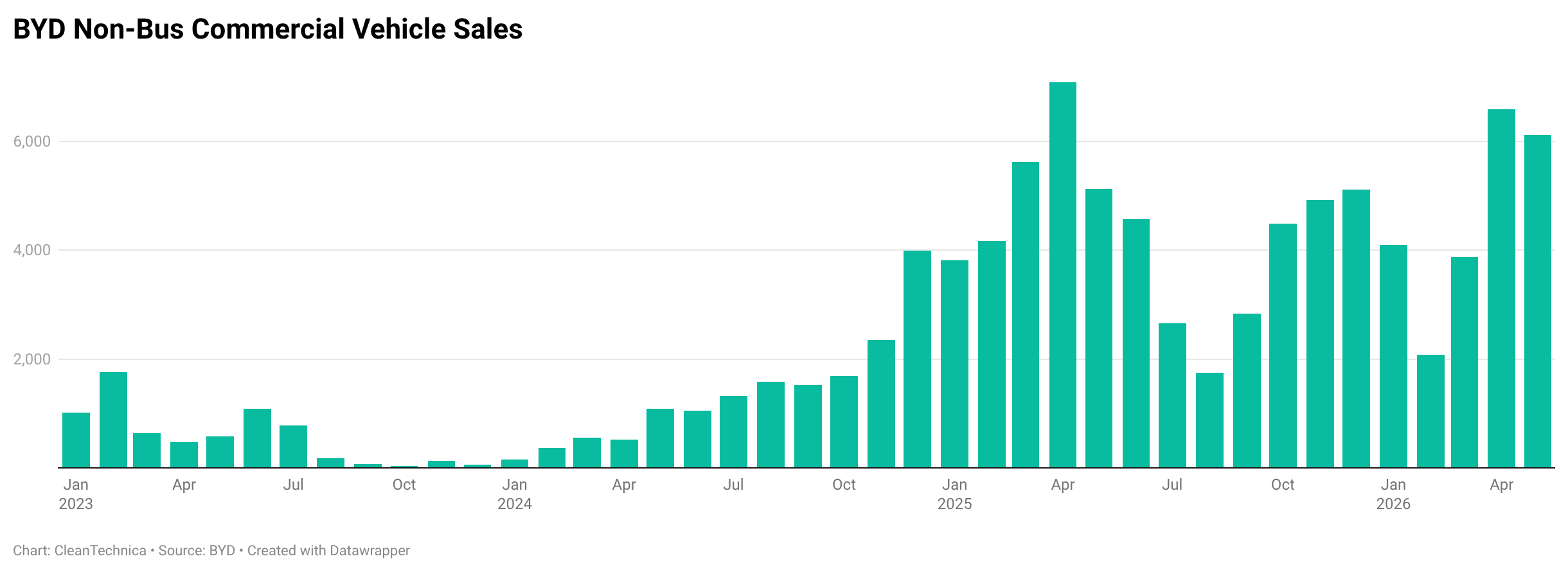
In May 2026, BYD's commercial vehicle division recorded a striking reversal: while bus sales plummeted 19.6%, the company's non-bus electric vehicles surged by exactly the same percentage, lifting overall commercial sales 16.5% year-over-year. The numbers tell a story of shifting demand in China's electrified transportation market, one where smaller commercial EVs are gaining decisive momentum.
The contrast reveals how quickly market preferences can reshape a company's fortunes. BYD sold 345 buses in May—down from 429 the previous year—but delivered 6,118 non-bus commercial vehicles, up from 5,117. That 1,001-vehicle swing in non-bus sales more than compensated for the 84-bus decline, pushing total May commercial sales to 6,463 units compared to 5,546 in May 2025. For context, BYD's entire commercial vehicle fleet consists entirely of electric vehicles, making this growth a significant marker of electrification momentum in China's commercial transport sector.
What makes this story particularly striking is how the monthly and year-to-date pictures diverge. Through January to May 2026, BYD's bus sales actually rose 14% compared to the same period last year—generating 12,451 units versus 10,932—while non-bus commercial sales fell 12%. Year-to-date, the company shipped 24,956 commercial vehicles against 27,726 in the first five months of 2025, representing a 9.99% decline overall. This means May's 16.5% monthly jump represents a potential turning point for a division that has struggled through the first third of 2026.
The divergence between buses and non-bus commercial vehicles reflects broader shifts in how Chinese businesses are adopting electric transportation. Non-bus commercial EVs—including light and medium-duty trucks, vans, and specialized vehicles—appear to be winning over fleet operators and small business owners in ways that contradict the year-to-date slide. The 19.6% surge in May suggests that either purchasing decisions delayed earlier in the year are materializing, or that the second half of 2026 is attracting new customers to BYD's lighter commercial vehicles.
BYD's position as a fully electric commercial vehicle manufacturer gives these numbers particular weight. The company isn't managing a transition between fossil fuels and batteries across its fleet—it's entirely electric. This means the sales fluctuations reflect pure market demand rather than production constraints between competing technologies. May's momentum suggests that demand for smaller electric commercial vehicles is stronger than earlier months indicated, though whether this becomes a sustained trend remains to be seen.
For a company that has already electrified its entire commercial vehicle portfolio, the challenge now is expanding that market. The 9.99% year-to-date decline underscores that growth isn't guaranteed, even in an electrification-forward market. Yet May's 16.5% jump offers real cause for optimism. If non-bus commercial vehicle sales can sustain this momentum through the remaining months of 2026, BYD's commercial division could recover ground lost in the year's first quarter and potentially accelerate China's shift toward electric fleets for light and medium-duty transportation. The May numbers suggest that shift may be closer than the year-to-date figures alone would indicate.