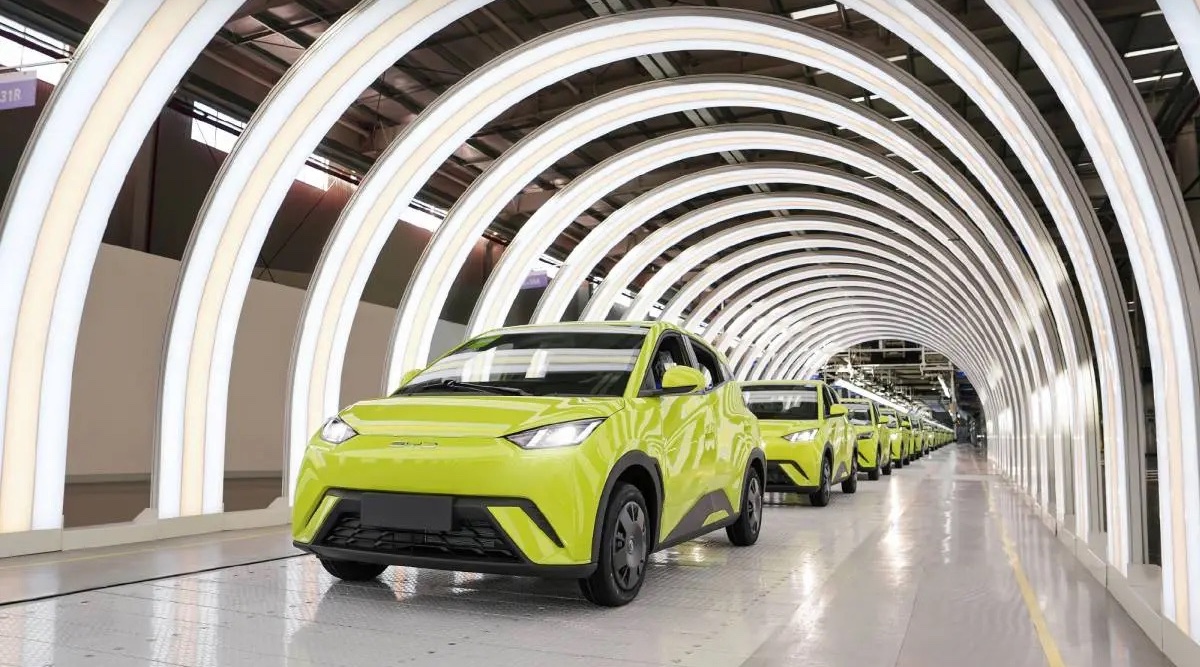
BYD, the world's largest plug-in vehicle producer, is in active talks with Stellantis and other European automakers about acquiring or leasing underused factories across the continent—a move that could reshape the future of car manufacturing in Europe. Speaking at an auto conference in London this week, BYD vice president Stella Li was direct about the company's ambitions: "We are talking to not only Stellantis, we're talking to other companies too. We are looking for any available plant in Europe because we do want to utilize this kind of spare capacity."
The stakes are enormous. BYD's dominance in the global electric vehicle market is staggering. In 2025, the Chinese automaker sold roughly twice as many plug-in vehicles as Geely and nearly three times as many as Tesla. When looking at fully electric vehicles alone, BYD surpassed Tesla and now commands a market share that, combined with Tesla's, accounts for roughly 30 percent of all cumulative global battery electric vehicle sales. While Tesla's sales have stalled for years, BYD's trajectory has been explosive—and the company expects significant growth moving forward even after recent headwinds.
This is not merely speculation. BYD already has European expansion underway, with new factories under construction in Hungary and Turkey slated to open in 2026 and 2027. The company's market share in Europe has been climbing steadily, yet leadership clearly sees far more runway for growth. One powerful incentive drives urgency: the European Union's 17 to 35 percent tariffs on Chinese-made electric vehicles. Manufacturing inside Europe would allow BYD to bypass these costs entirely.
Stellantis, which owns more than a dozen automotive brands including Fiat, Peugeot, Jeep, Alfa Romeo, and Opel, sits at the center of these discussions. Several of its brands are struggling, and spare factory capacity has become a liability rather than an asset. Other potential partners include Renault and Nissan. Stella Li emphasized that BYD has no interest in joint ventures or partnerships for manufacturing. "It's very hard to partner and ask permission from another person. We prefer to run everything on our own," she said, though BYD does collaborate with automakers on battery supply and other non-manufacturing aspects.
The prospect of Chinese automakers establishing deep roots in European car production may seem shocking, but history offers a parallel. Japanese automakers experienced a similar transition in the 1980s and 1990s, moving from exporters to European manufacturers. The difference now is that Chinese companies are arriving with superior electric vehicle technology and production capabilities—making their competitive advantage even sharper.
Whether European workers and communities will benefit from new investment or whether jobs and economic control will ultimately shift eastward remains hotly debated. What seems clear is that if European automakers cannot use their factory space profitably, selling or leasing to high-demand Chinese producers could keep those facilities operating and producing clean vehicles. The blueprint for this transition already exists. BYD's next move will likely be securing one or two factories—or at minimum, production agreements—that give it the European foothold it's actively pursuing.