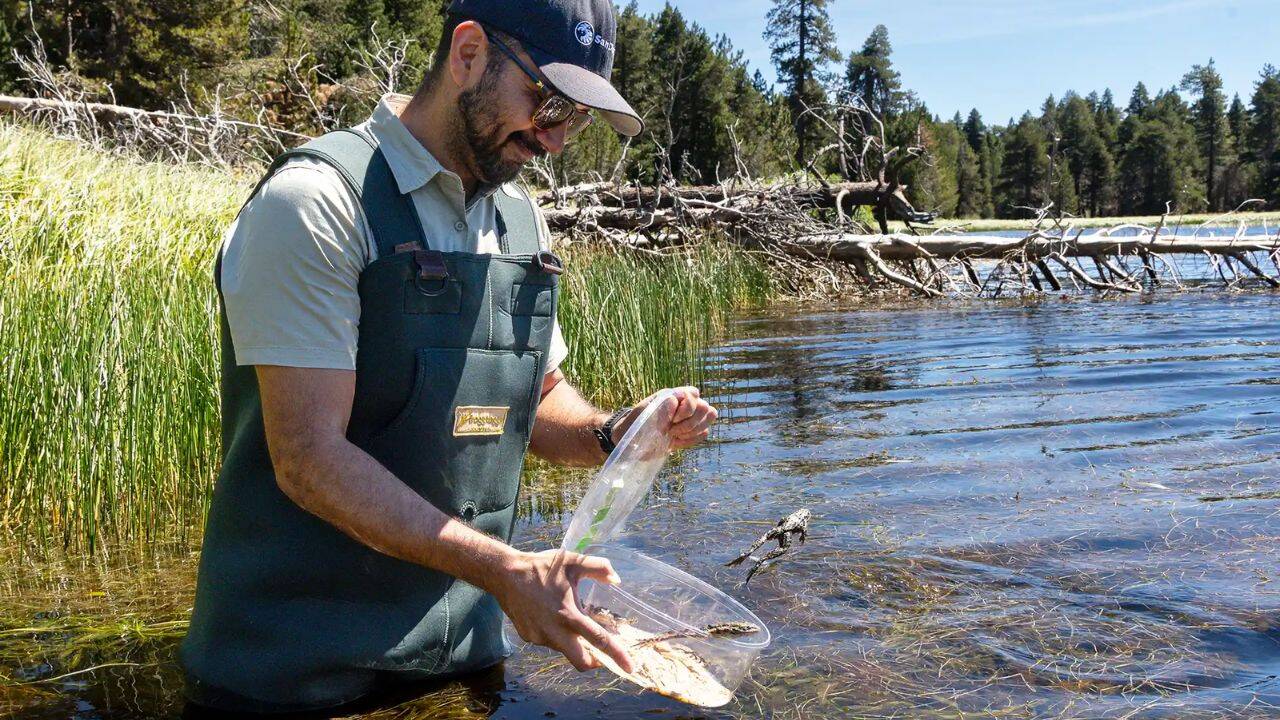
This year, more than 3,000 tiny mountain yellow-legged frogs and tadpoles were carried back up into California's high country and set free — a small, squirming army returning to a home most of their kind no longer has.
The release, led by the San Diego Zoo Wildlife Alliance, took place in the San Bernardino and San Jacinto mountains, including the chilly waters of Bluff Lake in the Big Bear Valley. It is the latest chapter in a rescue effort that began back in 2006 and has now put more than 10,000 frogs back into the wild.
These frogs once ruled the high meadows of the Sierra Nevada. According to the National Park Service, they were the most numerous amphibians in the whole range, hopping through naturally fishless lakes, ponds and streams. But they have vanished from a staggering 92% of their historic territory — enough that the species now carries legal protection.
Two things drove them to the edge. Trout were introduced into high-elevation lakes to please anglers, and the fish quietly feasted on tadpoles and young frogs while competing with them for insects. A deadly fungal disease called chytridiomycosis added a second blow, attacking frogs' skin and killing animals already weakened by those pressures.
So the zoo became a kind of frog nursery. Scientists at the Beckman Center for Conservation Research bred the animals, carefully recreating the natural rhythms of mountain life — seasonal shifts and cold snaps that prompt hibernation — while fine-tuning light cycles and diets. Because natural breeding is hard to coax, the team even turned to hormone treatments and in-vitro fertilisation, wading into cutting-edge science so more healthy young frogs could be born. Sperm is preserved in the organisation's "Frozen Zoo" to safeguard genetic diversity for the future.
The returns are being measured frog by frog. Released animals are monitored to see whether they stay healthy, survive, and truly settle back into their native habitats. And there is reason to be hopeful. In Sequoia and Kings Canyon National Parks, staff began removing introduced trout from chosen lakes and streams in 2001, using large nets and equipment that briefly stuns fish. By 2011 they had pulled nearly 44,000 fish from 19 lakes, clearing nine completely. The results were dramatic: in three Upper LeConte Canyon lakes, frog and tadpole numbers jumped from about 190 in 2001 to more than 18,800 in 2004 — a nearly hundredfold surge once the fish were gone.
The work shows that when humans step back and give nature a hand, wildlife can come roaring back. Each frog returned to a mountain lake is a small act of restoration — and a reminder that a species that lost 92% of its home is being invited home, one tadpole at a time.