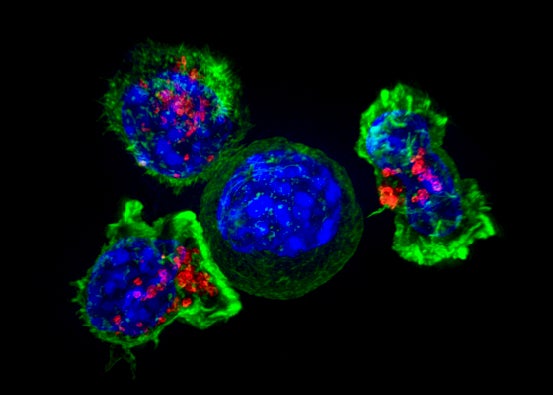
For years, CAR T cell therapy has been a game-changer for blood cancers. The treatment works by taking a patient's own immune cells, supercharging them in a lab, and Infusing them back into the body to hunt down cancer. It's helped people with leukemia and lymphoma when other treatments failed. But solid tumors—like those in the breast, lung, and prostate—have been a different story. These are some of the most common and deadly cancers, affecting millions of people every year. Roughly two million Americans are expected to be diagnosed with cancer in 2026, and over 600,000 will likely die from the disease.
The problem is that solid tumors are molecular patchworks. Unlike blood cancers, which share easy-to-spot targets, solid tumors cells can look completely different from one another. Some might carry a target protein while others have almost none at all. That means CAR T cells can miss entire groups of cancer cells, allowing the tumor to survive and grow back. On top of that, solid tumors build a protective fortress around themselves—a sticky, toxic environment that actually hijacks immune cells and uses them to fight off treatment.
Now, two independent research teams may have found a way through that fortress. Both groups landed on the same promising target: a protein called GPNMB. In one study, researchers at McMaster University in Hamilton, Ontario, led by cancer researcher Sheila Singh, engineered CAR T cells to recognize GPNMB on glioblastoma—a deadly brain cancer. In tests on donated patient tissue and in mice, the modified cells rapidly destroyed tumors and extended survival. But the team noticed something surprising: GPNMB also appeared on the very immune cells that tumors use to shield themselves. That meant the CAR T cells were attacking two enemies at once—the cancer and its bodyguards.
"Our approach attacks both the tumor and the environment that allows it to thrive," Singh said. "We're going beyond targeting the cancer alone and eliminating the immune cells that help shield it from treatment."
A second team used a similar GPNMB strategy against alveolar soft-part sarcoma, a rare soft-tissue cancer that often spreads to the lungs, brain, and bones before it's even diagnosed. In an early clinical trial with just one participant, a single infusion stabilized the disease for three months without serious side effects.
Researchers say this dual-attack method could overcome one of solid tumors' most stubborn defenses. Most existing approaches focus only on killing cancer cells themselves, leaving the tumor's immune support system intact. The new findings suggest that dismantling that support system may be just as important.
"Most approaches have focused on killing cancer cells alone," said Shan Grewal, a co-author on the McMaster study. "Our work suggests we may also need to dismantle the immune support system that helps the tumor survive."
Human trials are still needed to confirm whether the approach works in actual patients. But for cancers that have long resisted one of medicine's most powerful tools, the discovery offers genuine hope that the walls are finally coming down.