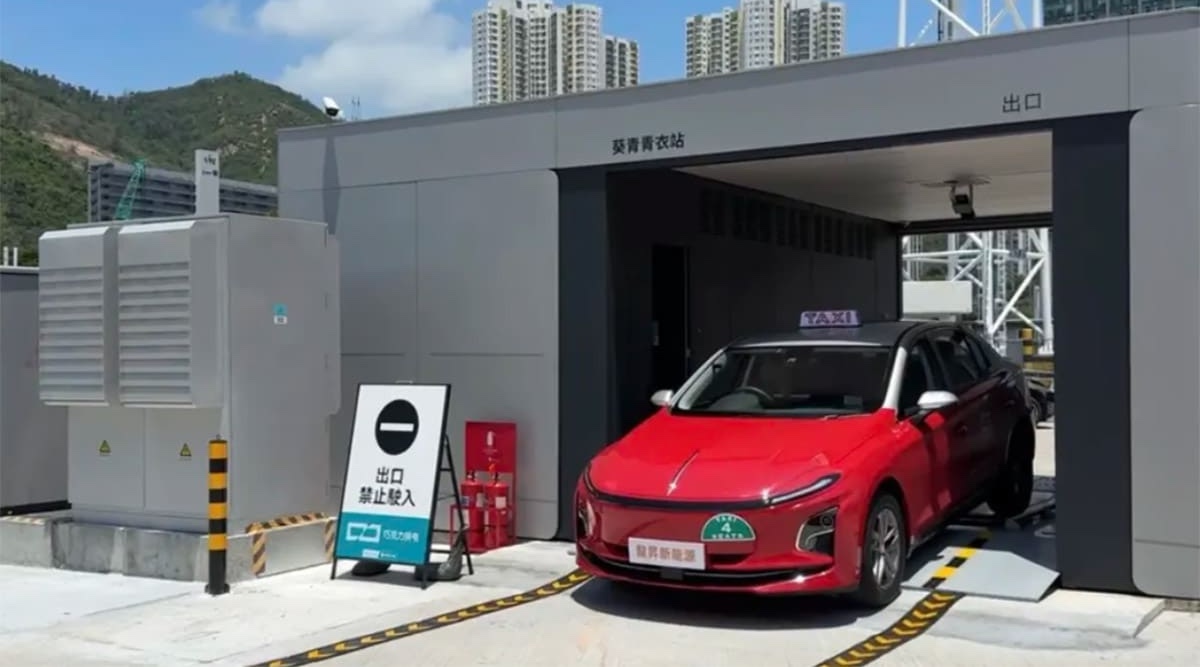
On a warm June day in Hong Kong, Chief Executive John Lee Ka-chiu slid into a Hongqi E-QM5 taxi, experienced a lightning-fast battery swap, and stepped out again in under two minutes. It wasn't a stunt — it was a glimpse of a future where electric vehicles never have to wait hours at a charging station. China's CATL, the world's largest EV battery manufacturer, has just fired up its first two Choco-SEB battery swap stations in the city, with plans to expand that network to 36 stations by 2030.
The technology is striking in its simplicity: drivers pull into a swap station, and in just 99 seconds, a depleted battery is exchanged for a fully charged one. No plugging in, no waiting. For Hong Kong's legions of taxi drivers and logistics operators who clock hundreds of kilometers daily — often grinding up the territory's steep mountain roads that drain EV range faster than flat terrain — this could be transformative.
"Battery swapping has been the industry's best-kept secret," the article notes. While competitors have poured resources into faster wired charging, CATL has quietly built out an alternative infrastructure that could make electric vehicles viable for anyone who lacks a home charger or dedicated parking.
The numbers behind the rollout are ambitious but grounded in real progress. CATL currently operates more than 50 stations each in Chongqing, Guangzhou, and Beijing. Globally, the company has set its sights on reaching 3,000 swap stations across 190 cities by 2026. The Hong Kong launch marks the technology's debut in a major international financial hub — a proving ground that could convince other dense urban centers to follow suit.
The Hongqi E-QM5 sedans deployed for the pilot program were built specifically to work with CATL's Choco-SEB swap architecture, meaning the batteries are standardized, swappable, and designed for high turnover. That standardization is key: it transforms batteries from proprietary burdens into a shared resource, cutting costs for fleets and giving individual drivers the freedom to swap and go.
For a city like Hong Kong, where apartment towers dominate and private parking is scarce, removing the home-charging requirement could accelerate EV adoption dramatically. The mountainous terrain that makes driving exhausting for EVs with limited range becomes a non-issue when a fresh battery is 99 seconds away. If CATL's vision holds, Hong Kong may become a blueprint for how megacities everywhere can go electric — without forcing drivers to reorganize their lives around charging schedules.