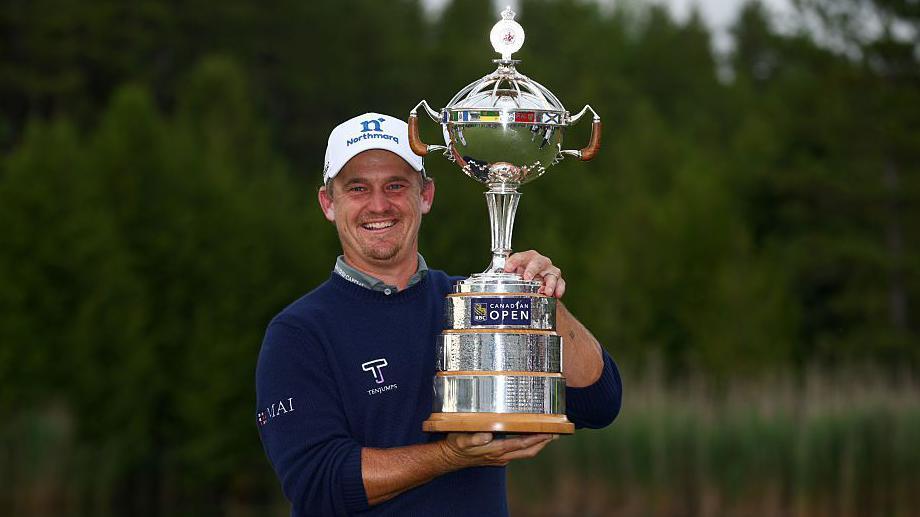
Bud Cauley rolled in his final putt on the 18th green at Caledon, Ontario, and stood for a moment in quiet disbelief—his hands on his hips, his eyes closed, the weight of eight long years lifting with one perfect stroke. The 36-year-old American had just shot a five-under 65 in the final round of the Canadian Open, finishing at 17-under 263 to claim his first PGA Tour title, a victory not just over the field but over pain, doubt, and a body that once refused to cooperate. This wasn’t just a win; it was a resurrection.
Cauley’s journey back to the top was anything but certain. In June 2018, he was a passenger in a car accident that left him with six broken ribs, a collapsed lung, and a fractured left leg. Though he returned to competition four months later, complications in 2020 sidelined him completely, keeping him off the professional tour until 2024. Over those years, he played in 238 PGA Tour events without a win—a testament to persistence, but not proof of progress. Until now.
Starting the final day just one stroke behind leader Jackson Suber, Cauley seized control on the back nine with four birdies in five holes, including a pinpoint birdie chip on the 12th that shifted momentum irrevocably. By the time he reached the 16th tee, he held a three-shot lead. England’s Matt Fitzpatrick, who climbed 10 spots with a final-round 64, briefly threatened but stumbled with a bogey on 17, finishing two strokes back at 15 under. Norway’s Viktor Hovland claimed third at 14 under.
"There were times when I was hurt that we weren’t really sure if I was going to be able to play again," Cauley said, voice steady but eyes glistening. "So many people helped me get here. Once I got the opportunity to start playing again, I just told myself that I was going to try and do everything the right way and give myself the best chance."
His wife, Kristi, stood nearby as he spoke—her presence a quiet acknowledgment of the private battles fought far from fairways and leaderboards. "I put my wife, Kristi, through so much during those dark times," he added. "It’s just nice to have a little success as a kind of thank you."
In an era where triumph is often measured in rankings and prize money, Cauley’s win resonates differently. It’s a reminder that resilience isn’t always loud, that comebacks aren’t always swift, and that sometimes, the most powerful victories are the ones that take years to unfold. As the sun dipped behind the trees of Caledon, Cauley raised his arms not in triumph, but in gratitude—proof that even in silence, hope can roar.