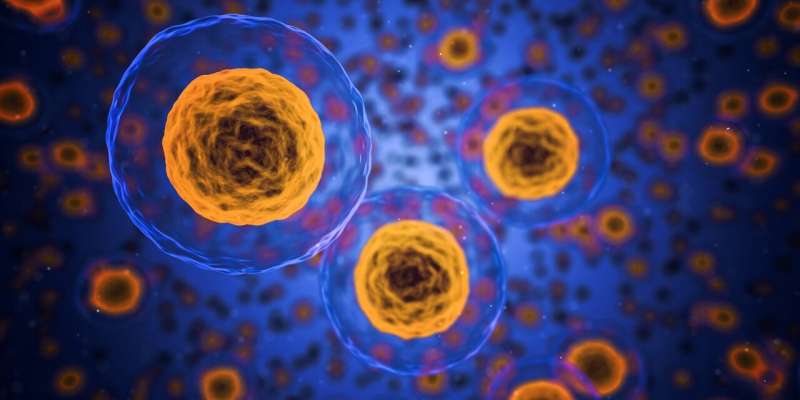
When epithelial cells are suddenly dunked in water, they have mere minutes to deploy their cellular crash protection—a ring of protein that cinches around the nucleus like a seatbelt, shielding it from rupture. Researchers at the University of Science and Technology of China have just discovered this rapid defense mechanism in a study published in the Biophysical Journal, revealing a fundamental way that cells guard themselves against physical catastrophe.
The implications are profound. Our skin cells are constantly stretched—posture changes alone can pull epithelial cells by up to 25 percent—while the cells lining our intestines endure a twentyfold increase in osmotic pressure after we drink water. These mechanical stresses can rupture the cell nucleus and snap DNA strands, setting off a cascade of aging and cell death. Until now, scientists understood that cells could form protective actin structures over their nuclei, but those took hours to assemble. Hongyuan Jiang's team wanted to know whether cells had something faster.
They exposed epithelial cells to sudden hypotonic shock—essentially, dropping them into water where osmotic pressure forced water rushing into the cells. Within minutes, a ring-like structure composed mainly of actin appeared around the nucleus. Within about half an hour, once the cells adapted, the ring dissolved. The team replicated the effect by mechanically pushing on cells to mimic physical pressure. Crucially, when they applied force slowly or gently, no ring appeared. The mechanism only activated under acute stress—just like a seatbelt deploys in a crash, not during a smooth drive. Tests on mouse embryonic cells exposed to the same shock confirmed the mechanism exists in living organisms, not just isolated lab specimens.
The protection works through a two-step process. The actin ring confines and stabilizes the nucleus, and simultaneously, the ring increases expression of lamin A/C, a structural protein around the nuclear membrane that stiffens it and makes rupture less likely. When researchers blocked ring formation in some cells, those cells suffered twice as many severely damaged DNA strands and underwent cell death far more frequently than cells with intact protective rings after three rounds of osmotic shock.
The aging connection offers the most tantalizing prospect. Older cells tend to have lower actin levels, meaning they may produce these protective rings far less effectively than their healthier counterparts. This vulnerability at the cellular level might be a missing piece in understanding how aging accelerates at the molecular scale. Jiang sees a pathway forward: "In the future, we want to explore whether we can prevent DNA damage and slow cell aging by modulating actin dynamics in cells." Such therapies could theoretically boost the actin available to aging cells, restoring their ability to mount rapid defenses against everyday physical stress—stress that compounds over decades into the cellular wear we experience as aging.
This discovery reframes how scientists think about cellular resilience. Rather than focusing solely on the biological pathways that activate after DNA damage has already occurred, Jiang's work illuminates how cells armor themselves from the beginning, mounting a defense in the seconds when danger strikes.