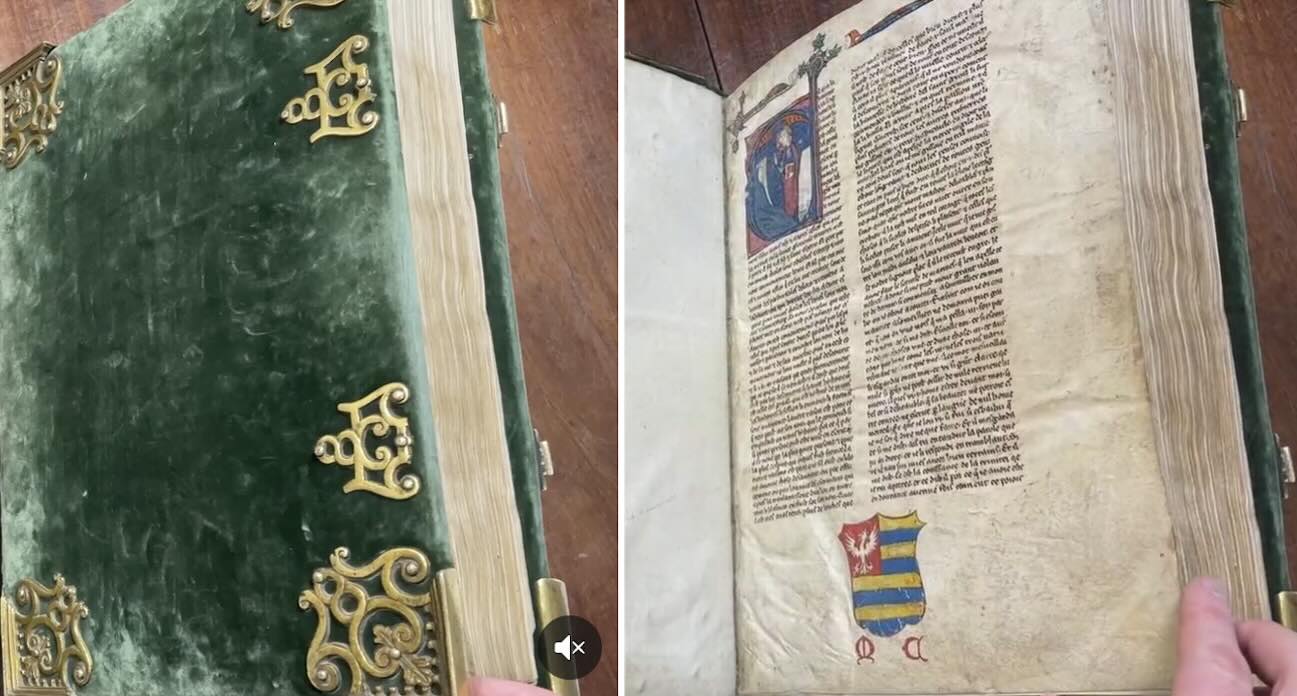
Christie's auction house in London is about to offer the world a rare chance to rescue one of medieval Europe's most glittering treasures from private ownership. The Lebaudy Manuscript, a 750-year-old codex bound in emerald-green leather and graced with 126 gold-embossed illustrations, represents one of only three known copies of the complete King Arthur legend—and the only ones still in private hands. For scholars and cultural institutions eager to unlock its secrets, the auction feels less like commerce and more like a race against time.
The stakes matter because this manuscript has never been fully documented by scholars. Inside its exquisitely preserved pages lie the sprawling Arthurian tales that have captivated Western imagination for centuries: the quests of Gawain, Lancelot, and Galahad; the adventures of the Knights of the Round Table; the enchantments of Merlin, including a particularly rare narrative in which the wizard disguises himself as a stag. And of course, the eternal hunt for the Holy Grail threads through its narrative. Dr. Irene Fabry-Tehranchi, a specialist in French medieval manuscripts at Cambridge University Library, describes it plainly: "It's a beautifully illuminated manuscript, which contains wonderful Arthurian stories depicted in exquisite miniatures." What makes the Lebaudy Manuscript exceptional is not just its age or rarity, but the sheer artistry embedded in every page—the gold leaf still shines as brightly as when it was applied centuries ago.
The illustrations themselves offer an art historical puzzle that scholars are eager to solve. The unnamed artist is believed to be the "Master of the Liege Apocalypse," a Low Country master now identifiable by a distinctive signature of tiny red dots placed on the cheeks of male figures throughout his work. Originally commissioned for aristocratic patrons—likely women with a taste for Arthurian romance, according to scholars—the manuscript bears witness to a specific moment in medieval culture when these legendary tales held sway over European nobility. Jean Lebaudy, the French industrialist and war hero from whose collection the manuscript takes its name, is just the most recent in a long line of owners who understood its value.
But here lies the tension: the emerald-green book is expected to fetch at least $2 million at auction, likely far more. That price tag places it beyond the reach of most public institutions without significant fundraising. Yet scholars and librarians see the auction as a rare window of opportunity. If a museum or historic library can secure the endowment backing, this manuscript could finally be studied comprehensively and exhibited where researchers and the general public alike could encounter its medieval artistry and storytelling. Historic libraries recognize something else too: visitors drawn to see an authentic, gold-leaf illuminated King Arthur manuscript—one that has survived seven and a half centuries largely intact—would experience something no photograph or digital reproduction can quite convey.
The question now hangs over the auction block: will a public collection claim what has remained hidden in private hands for generations? For those who believe that our shared cultural inheritance belongs in shared spaces, the Lebaudy Manuscript represents a once-in-a-generation chance to bring a masterpiece home.