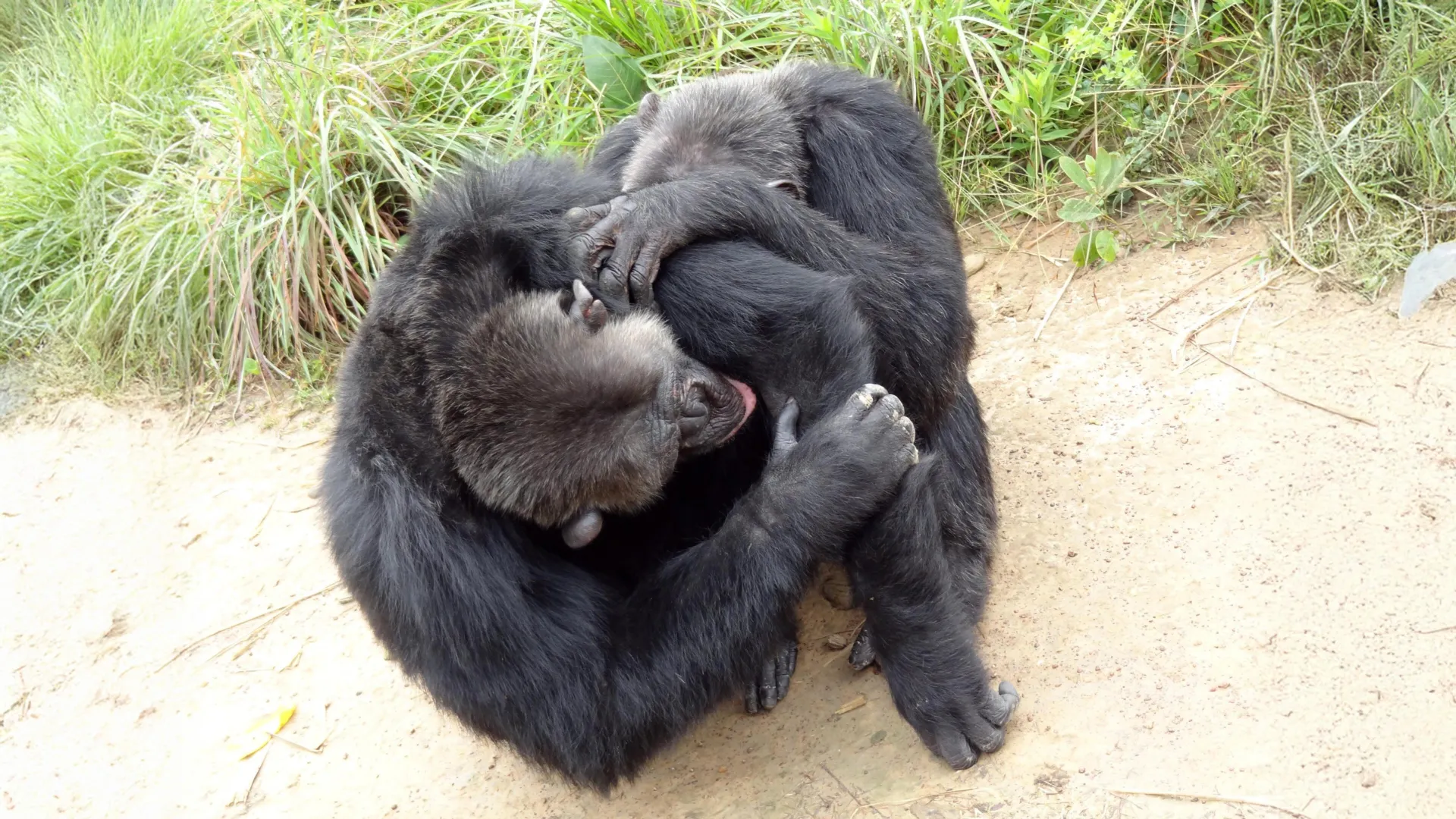
When researchers at Utrecht University and Universidad Carlos III de Madrid watched chimpanzees and bonobos groom each other, they noticed something that might feel oddly familiar: the apes weren't spreading their attention evenly across their groups. Instead, they were building friendship circles that look remarkably like the ones humans create.
For years, scientists have known that humans organize their social lives in layers — a small inner circle of close friends and family, then wider rings of acquaintances we see less often. But this pattern isn't as unique to our species as we might assume. A new international study examining social grooming behavior in 24 groups of chimpanzees and bonobos reveals that our closest living relatives do the same thing.
Grooming is one of the most important social activities among apes, strengthening bonds and maintaining relationships. Using a mathematical model to analyze how individuals distributed their limited time and social effort among group members, the researchers discovered a striking parallel to human social networks. Most apes devoted a large share of their grooming time to a small number of preferred partners while maintaining less intensive relationships with many others. The pattern held across both species, and it also revealed something researchers have seen in humans: apes living in larger groups tended to be more selective about where they invested their social attention.
But the two species didn't approach their social lives identically. Bonobos distributed their grooming time more evenly among group members, creating a more egalitarian social network. Chimpanzees, by contrast, concentrated more of their effort on a smaller number of favored companions — a tighter, more hierarchical approach.
The research also uncovered a striking parallel with human aging. People often become more selective about their relationships as they grow older, focusing more attention on a smaller inner circle of close connections. The researchers found the same pattern among chimpanzees. As they aged, chimpanzees increasingly invested in fewer social partners. Bonobos, however, did not show the same narrowing of their social circles over time. According to lead author Edwin van Leeuwen, this difference likely reflects broader distinctions in how the two species organize their societies. "Possibly, this is due to their more egalitarian social systems," van Leeuwen explained. "Bonobos appear to live together in more fluid relationships, with social bonds that transcend group boundaries, something we rarely see in chimpanzees."
The findings suggest something profound: the fundamental rules that guide how individuals allocate social effort may apply across multiple species. "Our findings suggest that the fundamental rules that guide how individuals allocate social effort apply across multiple species," van Leeuwen said. "This reveals deep evolutionary continuity in how complex societies are organized."
Yet the differences between the two ape species also hint at a broader truth — there is more than one evolutionary strategy for managing social connections. Understanding these patterns could reshape how scientists think about cooperation, social learning, and emotional well-being in both humans and other animals, offering clues not just to where we came from, but to the many ways social life can be organized across the animal kingdom.