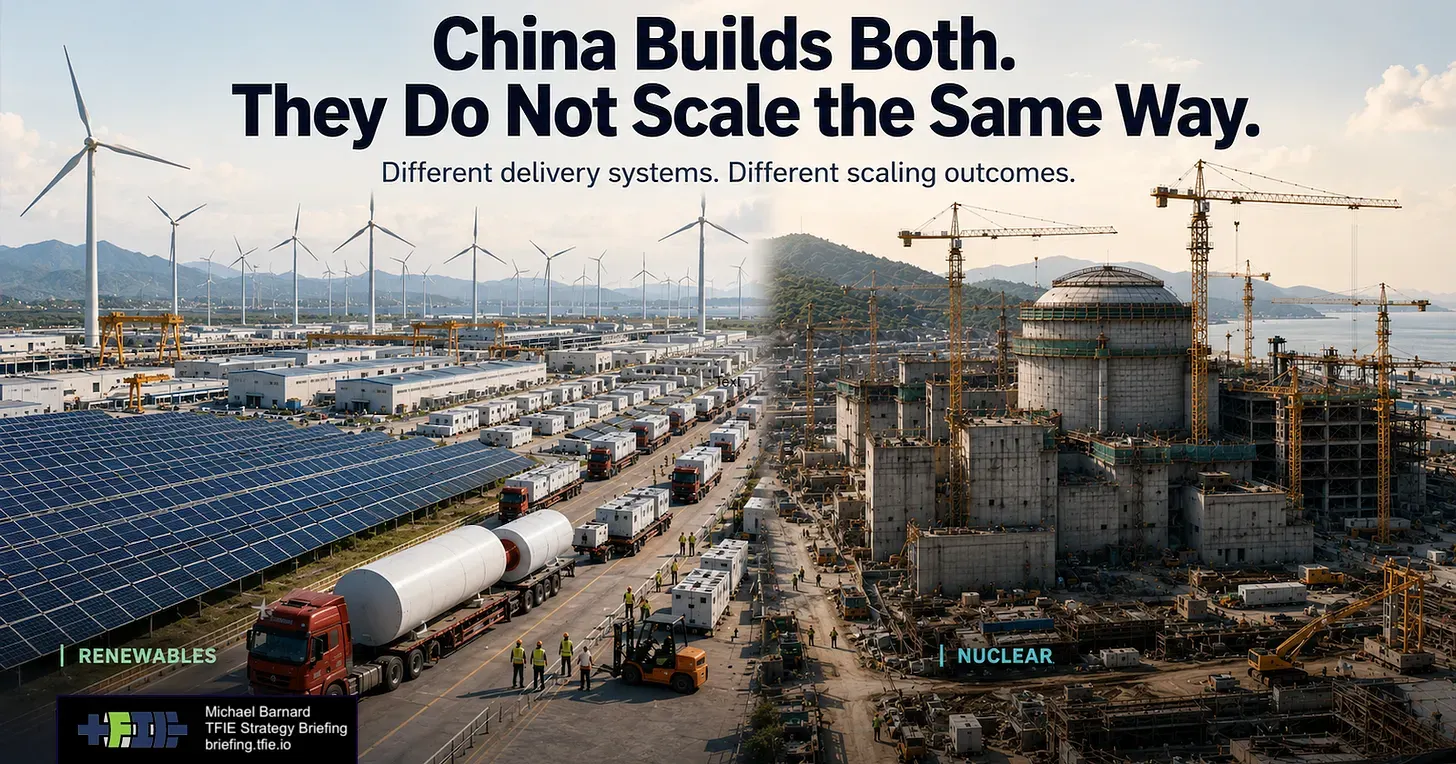
When engineers set a target, usually some gap remains between the goal and what actually gets built. But in China, the gap between ambition and reality runs in a surprising direction when it comes to wind and solar power.
China has become a clean energy powerhouse, regularly surpassing the goals it sets for renewable energy years ahead of schedule. The country set a target to reach at least 1,200 gigawatts of combined wind and solar capacity by 2030. A gigawatt is a unit of power — enough to supply hundreds of thousands of homes. China crossed that mark in 2024, six years early. By the end of 2025, the country had amassed roughly 1,842 gigawatts of wind and solar capacity combined, with 640 gigawatts from wind farms and 1,202 gigawatts from solar panels.
The contrast with nuclear power is stark. China aims to reach 110 gigawatts of nuclear capacity by 2030, but the nation had only about 62 gigawatts operating by 2025 — falling short of its 70 gigawatt target. This pattern stretches back years. In 2020, China targeted 58 gigawatts of nuclear capacity but finished with around 50 gigawatts. Meanwhile, it blew past its wind goal of 210 gigawatts, reaching about 282 gigawatts, and its solar target of 110 gigawatts, hitting roughly 253 gigawatts.
The gap comes down to how each technology gets built. Wind and solar arrive through factories, assembly lines, and crews that move continuously from one project to the next. Delays at one site don't stop the whole program. Nuclear plants, by contrast, are built one by one, with each project needing years to complete steps like construction, testing, fuel loading, and grid connection. A problem at one plant can delay a significant portion of the program.
The numbers show this difference clearly. In 2025 alone, China's new wind and solar capacity represented assets capable of producing roughly 696 terawatt-hours of electricity per year. A terawatt-hour is a million megawatt-hours — enough to power millions of homes. That same year's new nuclear capacity represented only about 13 terawatt-hours. That means renewables added roughly 54 times more generation capability than nuclear in a single year. Looking at the full span from 2022 through 2025, new wind and solar represented about 1,912 terawatt-hours against roughly 73 terawatt-hours from nuclear — a ratio of 26 to one.
This does not mean China has given up on nuclear. The country still operates the world's largest reactor construction program, continues approving new units, and is building a domestic supply chain around designs like Hualong One. The real story is that one technology scales through industrial repetition while the other advances project by project. And when renewables blow past targets, China sets bigger ones next time. When nuclear misses, the targets stay the same.
For the rest of the world watching China's energy transition, the lesson may not be about choosing one technology over another. It is about understanding which systems can deliver at the pace the climate crisis demands.