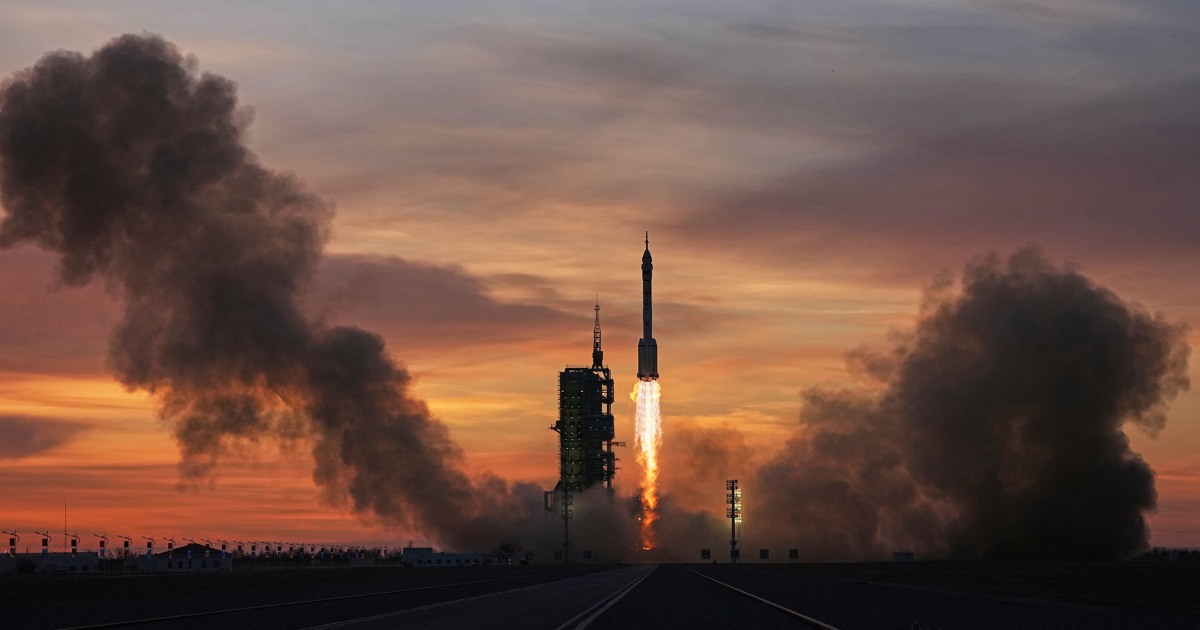
At Jiuquan Satellite Launch Center, Pakistani astronaut Muhammad Zeeshan Ali climbed into orbit alongside two Chinese crewmates, carrying his country’s flag on his uniform and a milestone for China’s space program. The Shenzhou 24 spacecraft launched Wednesday morning from northwestern China with Ali, 40, and Chinese astronauts Tang Hongbo, 51, and Wu Yi, 39, aboard.
The mission marks the first time a foreign astronaut has flown to China’s space station and the first joint flight with Chinese and foreign crew members in the country’s crewed space program. After launch, the craft separated from its rocket and reached its planned orbit. The astronauts later entered the station, where they joined three crew members from the Shenzhou 23 mission and posed for group photos.
The flight grew out of an agreement China and Pakistan signed in February 2025. China’s official Xinhua News Agency reported that the crew will carry out more than 90 scientific experiments and technology tests. During his short-term mission, Ali is set to work on an experiment involving photosynthetic cyanobacteria, tiny organisms that use light to make energy. He is expected to return to Earth aboard the Shenzhou 23 spacecraft.
The launch was also a public celebration in Pakistan. Families watched on television from thousands of miles away, while customers in restaurants followed the broadcast and cheered. Scientists at Pakistan’s space agency headquarters watched as well. Pakistan’s Prime Minister Shehbaz Sharif called the mission a source of national pride and an inspiration for young people. “This is not just one astronaut’s journey, but the journey of 240 million Pakistanis,” he wrote on X.
Pakistan’s planning minister, Ahsan Iqbal, attended the launch and thanked China’s leaders, scientists and engineers. He said he hoped the flight would open the way to greater cooperation. Asked whether Pakistan could one day send astronauts independently, he replied, “Certainly that day will come.” He described Ali as carrying the country’s hopes and technological ambitions into orbit, and said the mission could encourage young Pakistanis to study science and technology.
The countries’ presidents also exchanged congratulatory letters. Chinese state broadcaster CCTV said Xi Jinping described China’s space station as a “boat” for peace, friendship and cooperation, and said China was willing to work with other countries on the peaceful use of space.
For the crew, building trust took work. Tang, who has flown twice before and is the first astronaut to visit China’s Tiangong station three times, said language, culture and different ways of thinking made cooperation more challenging. Ali showed his progress by speaking Mandarin and quoting a Chinese poem about climbing higher to see farther. He said the daily training felt like “day after day, reaching new heights.”
Ali said he hoped the partnership would grow from one astronaut on one flight to multiple joint missions, and eventually reach the Moon and Mars. China is preparing for its first crewed lunar landing by 2030. For now, the Shenzhou 24 crew’s experiments and shared work offer a concrete first step toward a wider space partnership.