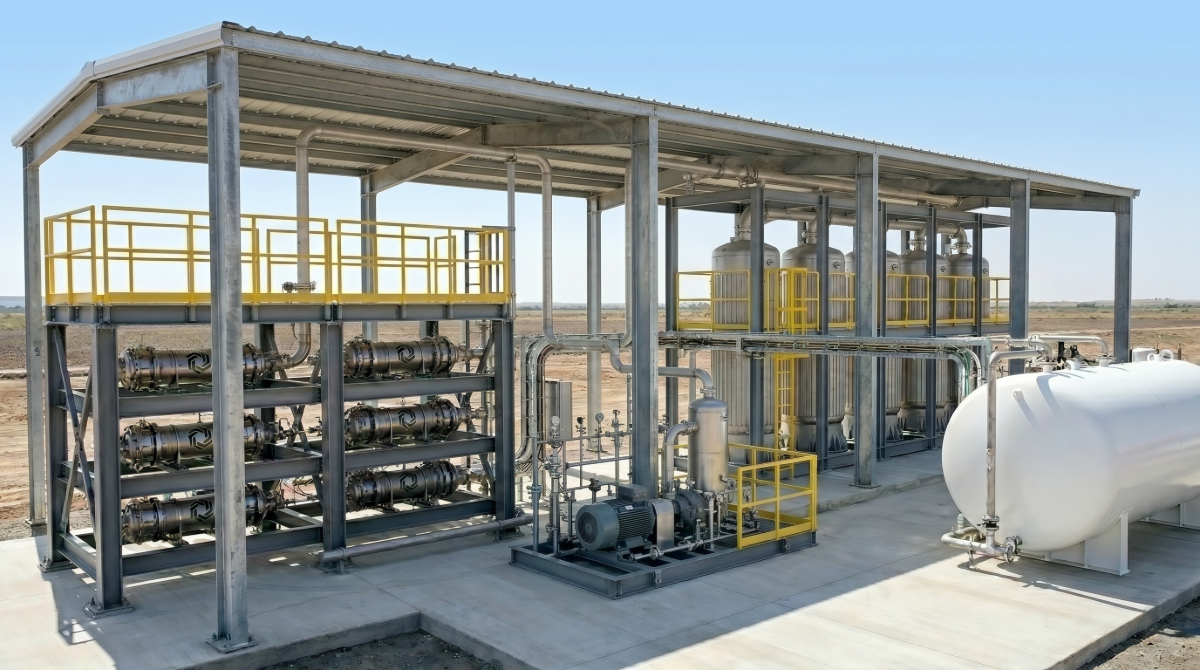
At a dairy farm in California, more than 5,000 cows produce enough manure to generate a steady stream of raw biogas—65% methane, 35% carbon dioxide—most of which once vanished into the atmosphere, unseen but damaging. Now, thanks to a breakthrough from Circularity Fuels, that methane is being transformed into sustainable aviation fuel (SAF) that meets strict international standards, without costly preprocessing or pipeline access. Over six months, the company ran a fully integrated, modular system on unrefined biogas straight from the digester, proving that waste from cows can power jets—and do it affordably.
This trial matters because the aviation industry burns through 300 million gallons of jet fuel every day, and while SAF is seen as a critical path to decarbonization, less than 1% of global demand is currently met. Most SAF today relies on feedstocks like used cooking oil, often imported and limited in supply. E-fuels, meanwhile, face economic headwinds due to rising electricity costs. Circularity’s approach sidesteps these constraints by tapping into an abundant, local, and overlooked resource: the biogas already being produced on thousands of dairy farms.
The company’s two-reactor system—the Ouro and Aion—operated continuously for thousands of hours, achieving over 98% methane conversion and more than 90% CO₂ conversion in a single electrified step. Crucially, it did so without the need to remove CO₂ first, a costly hurdle that has long made biogas-to-fuel projects uneconomical. The resulting SAF meets ASTM D7566 Annex A1 standards, meaning it can be blended up to 50% with conventional jet fuel and used in commercial flights today. Even more striking, internal life-cycle analysis under California’s regulatory framework shows the fuel has a carbon intensity of -350.7 gCO₂e/MJ—deeply net carbon-negative. Every gallon produced is equivalent to removing roughly 100 pounds of CO₂e from the atmosphere, thanks to the avoided methane emissions.
The economic case is just as compelling. Circularity claims its modular, skid-mounted reactors allow for SAF facilities that cost just 20% of comparable European plants. That kind of cost reduction could finally close the price gap between sustainable and fossil jet fuel. “We’ve now done that,” said Stephen Beaton, founder and CEO of Circularity Fuels. “The full stack works end-to-end on real feedstock from a real dairy farm, and the economics put commercial SAF from dairy waste within reach of fossil jet fuel.”
With this pilot success, the path opens to scale across California and beyond, turning thousands of dairy farms into clean fuel producers. The technology doesn’t just offer a new feedstock—it reimagines how and where fuel is made, proving that the future of flight might be powered by something as humble as cow manure.