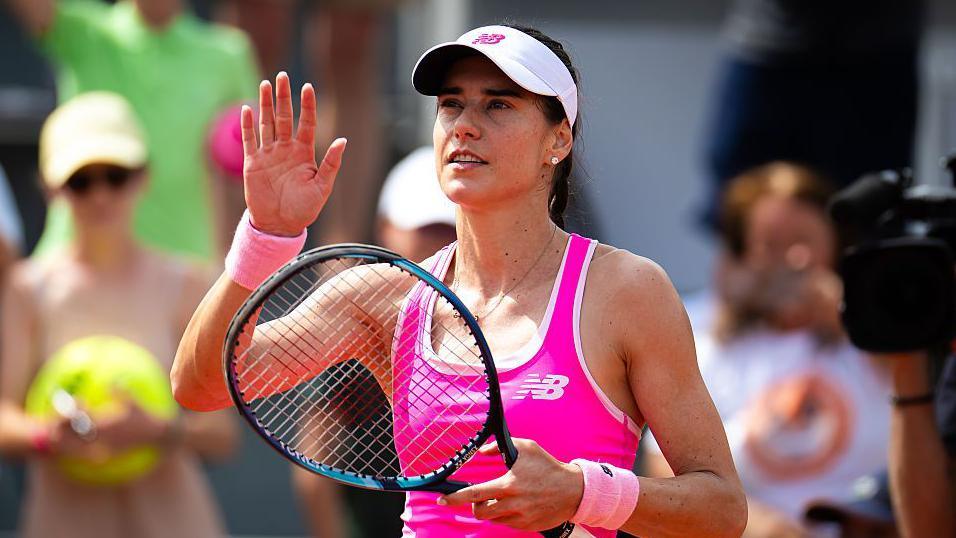
Sorana Cirstea dismantled Solana Sierra 6-0 6-0 at Roland Garros, becoming the oldest player in the Open era to claim a "double bagel" victory at a Grand Slam, a feat that stands as a testament to her improbable resurgence in her 36th year.
The Romanian champion's dominance was nearly total—Sierra, just 21 years old, never reached game point in the entire match, a stark illustration of the gulf between the two players. With this victory, Cirstea advanced to the French Open fourth round and secured her status as the oldest woman to reach the last-16 at Roland Garros since Serena Williams accomplished the same in 2021. The achievement marks a significant milestone for an athlete who has spent two decades grinding through the professional ranks, often appearing around the world number 20 ranking without reaching the sport's pinnacle.
What makes Cirstea's run remarkable is its context: this is her first Grand Slam advance beyond the second round since the 2022 US Open, a gap that underscores just how rare and unexpected this moment truly is. Earlier this month, she reached the Italian Open semi-finals, a result that included a victory over world number one Aryna Sabalenka—a win that seemed to unlock something in her game heading into Paris.
The path forward is tantalizing. Her next opponent is China's Wang Xiyu, and should Cirstea prevail, she will reach the quarter-finals at Roland Garros for the first time in 17 years—a feat that would equal her best-ever run at a Grand Slam, which came at the 2022 US Open. The possibility of another quarter-final appearance carries weight precisely because it felt impossible just months ago.
What distinguishes this moment in Cirstea's career is not mystery or luck, but the kind of relentless discipline that often goes unremarked in the headlines. When asked about her sudden consistency and depth of play, she credited nothing mystical or new. "I don't feel I'm doing anything different," she said after the victory over Sierra. "I feel I am still working the same—the same discipline and professionalism." The real shift, she explained, lay not in method but in consistency itself. "I've always been there the last couple of years around [world number] 20, but I feel what's different this season is the consistency."
That consistency has allowed her to approach each match with the hunger of a player who still has unfinished business. "Every time I step on court I feel I have a lot of things to improve. I have goals I want to improve and that keeps me alive," she reflected, a sentiment that speaks to an athlete who has never accepted decline as inevitable.
Cirstea has announced that she will retire at the end of 2026, giving her roughly 18 months to chase the dreams that have eluded her across two decades of competition. In the context of that timeline, every match carries urgency, and performances like the 6-0 6-0 demolition of Sierra feel less like a surprise upset and more like the manifestation of a career's worth of deferred potential finally finding expression. The French Open's clay courts have become her stage for a narrative few saw coming: the twilight victory lap of a champion who refused to fade.