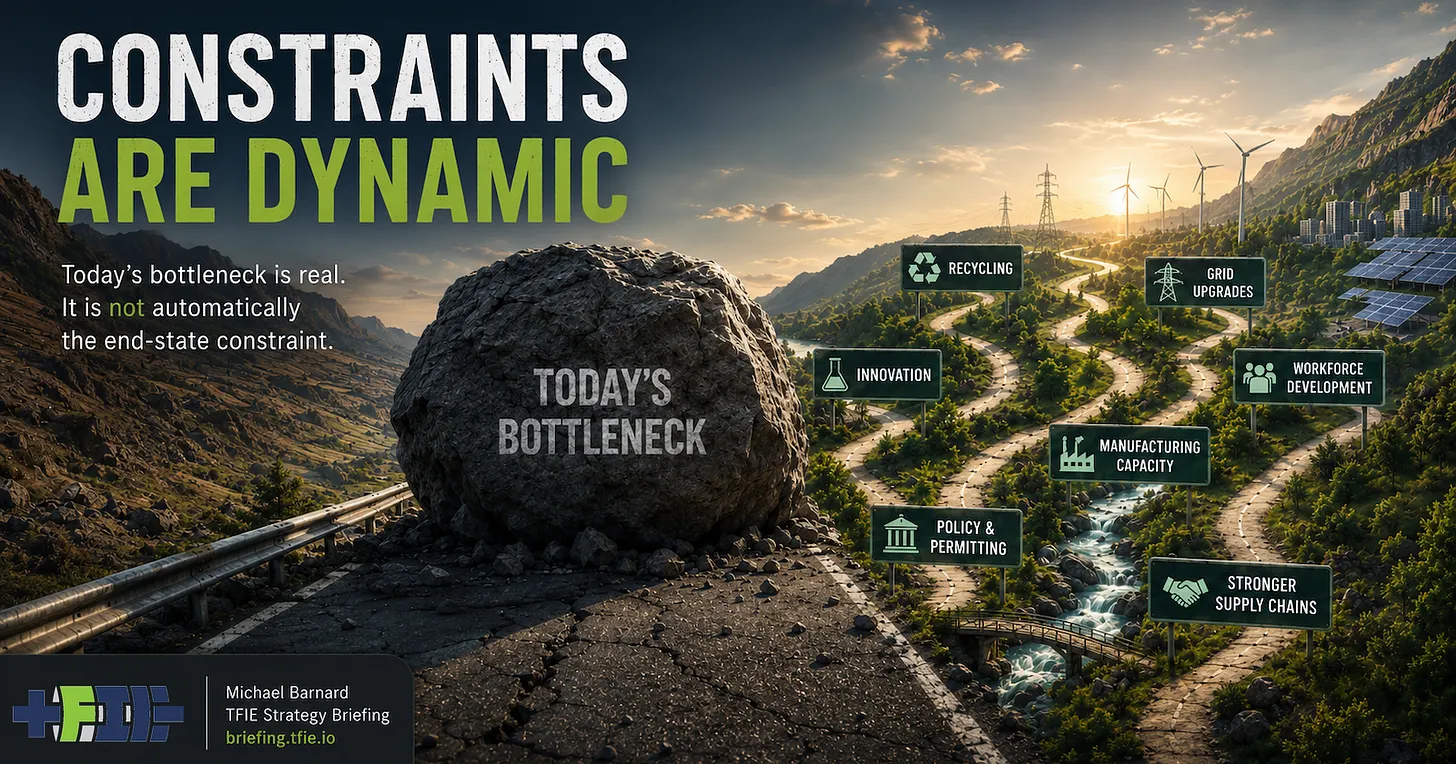
When the first sodium-ion batteries began rolling off production lines in Hefei last year, few outside China noticed — but they should have. These batteries, made by CATL, don’t rely on lithium, cobalt, or nickel, and they’re already powering electric buses and grid storage systems. This isn’t a lab experiment; it’s a signal that the energy transition’s toughest bottlenecks are not fixed walls, but shifting terrain. For too long, debates about clean energy have been trapped in binary thinking: either the transition will proceed smoothly, or it will stall completely. Reality is far more dynamic. Constraints like grid delays, mineral shortages, and permitting backlogs are real — but they are not permanent.
The truth is, when a bottleneck becomes critical, it triggers adaptation. Take critical minerals: lithium, cobalt, and nickel were once seen as non-negotiable for batteries. Today, lithium iron phosphate (LFP) batteries now make up over 60% of China’s EV battery market, up from just 20% in 2019, precisely because they avoid supply risks. Sodium-ion batteries are entering mass production, and by 2025, BloombergNEF projects they could capture 10% of the low-cost EV and stationary storage market. Meanwhile, recycling is scaling — by 2030, up to 12% of global lithium demand could be met by recovered materials, according to the International Energy Agency.
The same logic applies to grids. In the U.S., over 2,000 gigawatts of clean energy sit in interconnection queues — more than double the current coal fleet. But the response isn’t just about building more transmission lines, though that’s essential. Grid-enhancing technologies like dynamic line rating and advanced power flow controls can boost capacity on existing lines by 20–40%. In Texas, ERCOT has reduced curtailment of wind and solar by 35% since 2020 through better grid management and battery co-location. Distributed energy resources — rooftop solar, smart thermostats, EV charging controls — are turning passive consumers into active participants, easing pressure on infrastructure.
China’s approach offers a stark contrast to Western paralysis. It doesn’t wish away constraints; it industrializes around them. When batteries became strategic, China built the entire supply chain: from refining 60% of the world’s lithium to producing 75% of global solar panels. It standardized battery formats, trained thousands of engineers, and created domestic demand through electrified buses and high-speed rail. The result? Battery costs fell by 89% between 2010 and 2022, not by accident, but by design.
The lesson isn’t that constraints don’t matter — they do. But they evolve. A shortage today can become an innovation engine tomorrow. The real question isn’t whether clean energy faces hurdles, but whether we’re building the systems to overcome them. And increasingly, the answer is yes.