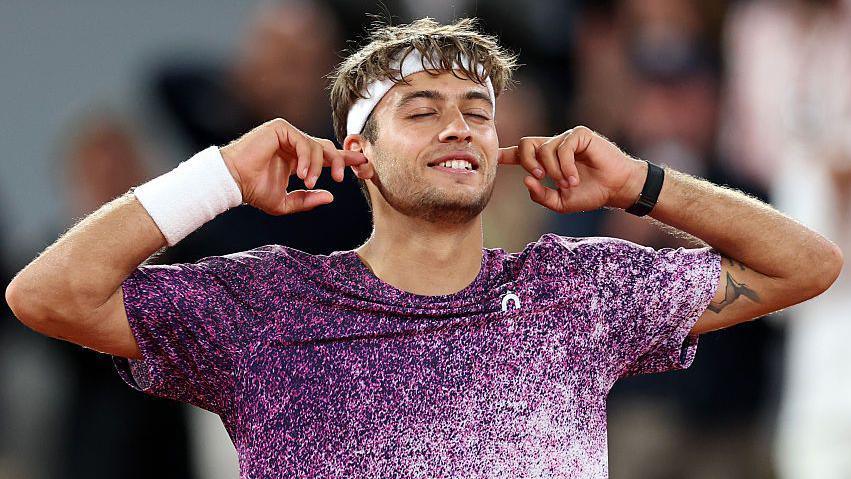
On Court Philippe Chatrier, as wind whipped across Roland-Garros and threw both players into early struggle, Italian tennis player Flavio Cobolli discovered something that would transform his tournament: a belief that he belonged there. After dropping the opening set to Canada's Felix Auger-Aliassime in blustery conditions, Cobolli retreated to reset his mindset. When he returned, with the roof closed and conditions steadied, he was a different competitor entirely—and by the time he walked off court after three hours and 24 minutes, he had secured his first Grand Slam semi-final appearance.
This is a rare milestone in professional tennis. The sport's majors test not just physical prowess but mental resilience, especially for players climbing toward its highest stages for the first time. For Cobolli, the breakthrough comes at a moment when Italian tennis finds itself in an unexpected position at the French Open: he will meet another Italian in the semi-finals, creating the kind of all-national matchup that reminds us how excellence can cluster in unexpected ways.
Cobolli's path to this moment reveals the small shifts that separate contention from victory. Down early in the second set, he found himself broken and seemingly adrift. But he rallied decisively, winning four consecutive games to level the match. That momentum carried him through the third and fourth sets, where single breaks in each proved decisive. There was no desperate comeback, no edge-of-the-seat drama in the final frame—just clean, methodical tennis from a player who had found his rhythm and refused to relinquish it.
His own words captured the turning point. "I went to the toilet to think a bit. I tried to change something. I thought 'this is the best court I've played on in my life, because I can show my best tennis,'" Cobolli reflected after the match. The simplicity of that observation—that sometimes permission to play freely is itself the breakthrough—speaks to what mental resilience looks like in elite sport. "I said to myself to fight, this is the chance of my life and I must give everything in all my matches."
The significance of Cobolli's advance extends beyond his personal achievement. With Auger-Aliassime's exit, only two top-10 seeds remain in the men's draw: Cobolli and second seed Alexander Zverev. It's a reminder that Grand Slams, for all their seeding systems and rankings, are ultimately about who shows up on the day—who believes they belong, who adjusts when circumstances shift, who finds the mental fortitude to reset and return stronger.
For Italian tennis, this moment is particularly resonant. The nation's success at the French Open speaks to something deeper: a tradition of resilience, a willingness to compete at sport's highest level, and now, the joy of watching homegrown talent challenge one another on one of tennis's greatest stages. Cobolli's semi-final berth is his own achievement, earned through four sets of rising play—but it is also a moment that belongs to his entire tennis community.