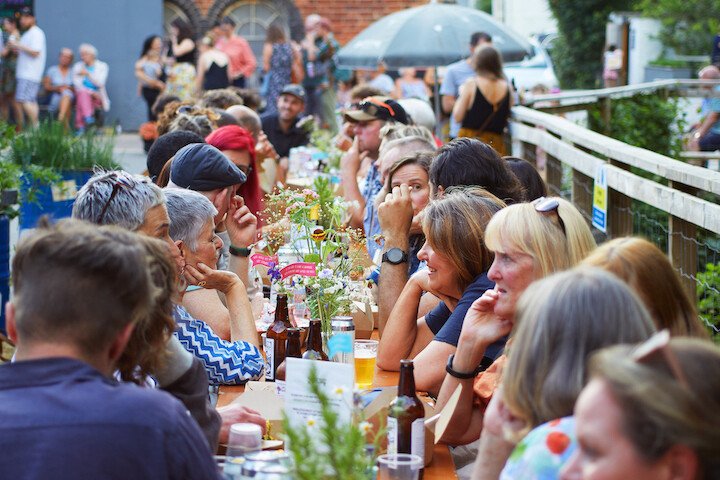
Inside Brimscombe Mill, a crumbling industrial building in Stroud's heart, the smell of fresh pesto mingles with music from a local band tuning fiddles at one end of a vast hall. Children weave between long wooden benches. Cutlery clinks. A roaring fire throws steady warmth across the space. This is The Long Table, a pay-as-you-can restaurant that has quietly become something rare in Britain: a place where strangers sit shoulder to shoulder without regard for class or income, united by good food and what its founders call "radical hospitality."
The concept is deceptively simple. There are one or two dishes on the menu. You sit wherever there is space. You pay what you can afford—no proof required, no questions asked. On any given night, the suggested base price might be £10.30 to cover costs, but that is merely an invitation. Those who can pay more are welcomed to do so. Those who cannot, or who have nothing, are equally welcome. In the midst of a cost of living crisis when eating out has become a luxury for many, that flexibility changes everything.
Emma Hurrell, the restaurant's food resilience lead, is careful not to frame The Long Table as charity. They function as a business, built for long-term resilience rather than short-term thrills or the whims of funding. Last year, the numbers prove it: 38,305 meals were served. Around half were paid for below cost price. One in ten were "community meals" served free. Those with more money effectively underwrite those with less, creating an economy of generosity that holds.
The social result is visible the moment you walk in. Imad Hussein, a regular, puts it plainly: "I come here because everyone can eat here—so you don't just find one class of people. A lot of people sitting here are paying nothing, but I have just seen people in front of me paying double." There is no separate queue, no visible distinction between who has paid what. You sit where there is room, and the person beside you might be a student, a retiree, a family with children, or someone with no fixed address. In most restaurants, privacy is part of what you pay for. Here, the long tables gently nudge people into conversation. Someone passes the bread. Someone recommends the homemade pesto. By the time plates are cleared, new connections have been made.
Tom Freer, a regular, values that openness. "Here, you sit with everyone," he says. "I usually come with a few friends but end up chatting to at least a few other people. You can really make connections here."
Yet none of this would matter if the food felt like an afterthought. On the evening visited, the menu offered panzerotti—the golden, deep-fried southern Italian cousin of a calzone—served with caper-jewelled caponata, peppery rocket, and a bright green oil. Homemade pesto arrived ready to spoon as generously as anyone liked. The care was evident in the seasoning, the balance of textures, the confidence of the kitchen. Paying what you can does not mean lowering the bar. If anything, the standard reinforces the dignity at the heart of the model. The Long Table's ethos rests on five pillars: championing local farmers, building relationships with schools and businesses, cooking nutritious food from scratch, seating people together at long tables, and training young people through apprenticeships. It is a model that extends far beyond a single meal, proving that radical hospitality and excellence need not be strangers to each other.