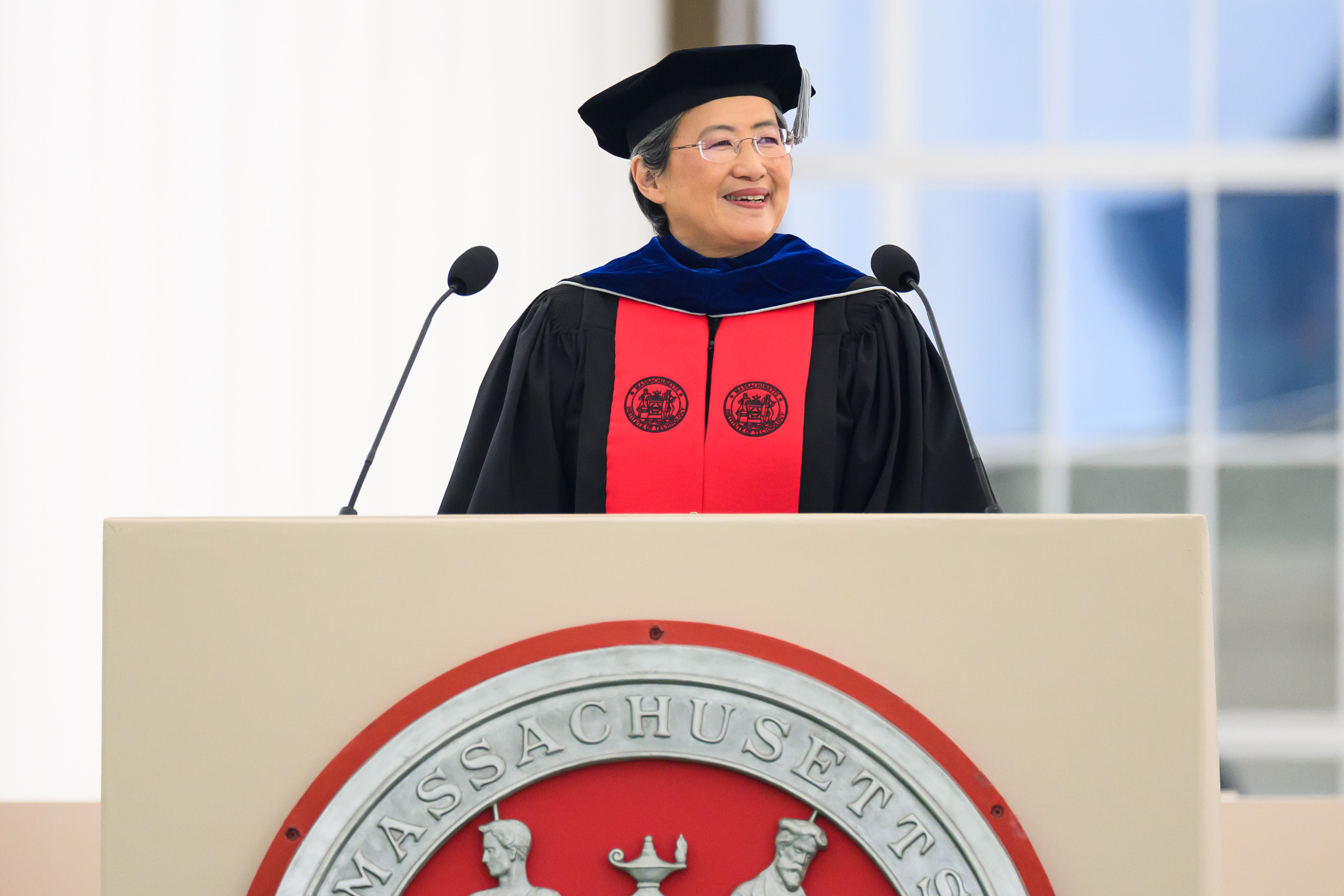
AMD CEO Lisa Su returned to the place that shaped her on Commencement day, her voice still rough from the week but her message crystal clear: MIT teaches you to believe you can solve problems that once felt impossible. Su, who arrived at MIT's Next House as a 17-year-old from Queens in the fall of 1986, delivered the address to the Class of 2026 in Cambridge with the particular weight of someone who has lived the trajectory she describes—from uncertain freshman staring down problem sets in 6.001 and 6.002, to leading one of the world's most influential semiconductor companies.
Her story matters because it illustrates something essential about what MIT actually does: it doesn't just teach you to think. It teaches you to build, to fail, to adjust, and to try again until the thing works. Su remembers the moment this clicked. As an undergraduate in Professor Hank Smith's lab in Building 39, she put on her first bunny suit, walked into the clean room, and began fabricating devices on 2-inch wafers for X-ray lithography mask blanks. Most experiments didn't work the way expected. So she adjusted and tried again. For the first time, she wasn't just learning about technology in a classroom—she was part of a team discovering something new, realizing that things tiny enough to fit on a die the size of a coin could be powerful enough to change the world. That was when she fell in love with semiconductors.
The transformation deepened under her PhD advisor, Dimitri Antoniadis. Week after week in the clean room, fabricating devices, bringing wafers to the test lab, discovering they behaved nothing like expected. Back to Antoniadis's office. What experiment should we try next? This cycle, repeated dozens of times, became the crucible where she learned to trust her own problem-solving. She grew from a graduate student learning the field to a researcher contributing something genuinely new. More importantly, she developed a specific kind of confidence—not the false certainty that she'd always know the answer, but the unshakeable belief that she could figure it out.
MIT's motto, Mens et Manus—mind and hand—captures this exactly. The Institute teaches you to think deeply, but also to build, to test ideas, to persist when the first experiment fails, and especially when the fifth one fails. That lesson carried Su long after she left campus. At IBM, she learned another principle that would define her career: run toward the hardest problems. Hard problems teach you what you're capable of. Twelve years ago, when AMD was struggling but brimming with potential, Su took that lesson to its ultimate test. Some mentors thought the job was risky. For her, it was the dream—the opportunity to work at the bleeding edge on problems that mattered. She and her team made a long-term bet that high-performance computing would become the most important technology of the future.
Su's message to the Class of 2026 was not that MIT guarantees success. It was that MIT trains you in a way of being: curious, persistent, and increasingly confident that the hard things you cannot yet do are precisely where your growth lives. That's a promise worth carrying forward.