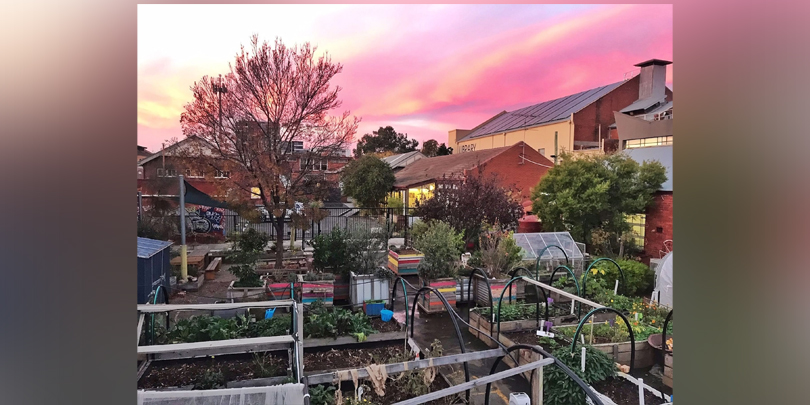
On a converted basketball court at an old primary school in Brunswick, rows of raised garden beds sit directly on asphalt, their green abundance transforming what was once a place for sport into a place for healing and growth. This is Jesuit Social Services' Ecological Justice Hub, where care for the planet and care for the poor are no longer separate ideals but lived practice.
Every Tuesday, boxes of fresh garden greens travel from these beds to the kitchen at the Uniting Church, where they feed rough sleepers and lonely people in the neighbourhood. It's a simple rhythm, but it answers a profound need. The hub grows food seasonally, supplying one or two boxes of vegetables each week to people who rarely have access to fresh produce. The greens arrive with seasonal variety — a gift that nourishes both body and spirit.
Senior project adviser Mick McGarvie describes the hub's philosophy with clarity: "Jesuit Social Services generally deals with addressing disadvantage in the community through social means, but it also wanted to find ways of addressing disadvantage through environmental or ecological means." What began several years ago as a response to ecological injustice — lack of access, lack of knowledge, lack of resources — has become a teaching operation and a place of demonstration where sustainability and social care intertwine.
The operation's ingenuity lies in its closed-loop approach. Compost is made on-site from carefully shredded green waste, coffee grounds, and sawdust donated by a local furniture maker. Seedlings grow in an on-site greenhouse before being transplanted into beds. Neighbours contribute food scraps, which are finely chopped with sawdust and fed either into a worm farm or into a biodigester connected to a small biogas plant. This system uses bacteria in food waste and water slurry to produce methane gas that collects in a tough canvas bag. At full expansion, the biogas plant holds 60 litres of gas, enough to power a low flame for about eight hours — perfect for cooking a soup or casserole. The hub uses it to fuel a kettle for volunteer gardeners.
The constant digging-in of rich compost and careful mulching counteracts the harshness of the asphalt below, while the greenery cools the space and emits a fresh, clean scent throughout the hub. It is an unlikely garden in an unlikely place, yet it has become a gathering point — a place of social interaction where environmental stewardship serves human dignity.
McGarvey's description captures something essential: "This is a teaching operation, it's a place of demonstration, a place of social interaction. And it's a place that recognises others performing social services as well." In that recognition lies the hub's deeper significance. By connecting food production, waste reduction, energy generation, and community care, the Ecological Justice Hub demonstrates that environmental justice and social justice are inseparable. It shows what happens when a community chooses to live out Pope Francis' call in Laudato Si' — not in theory, but in practice, one Tuesday delivery at a time.