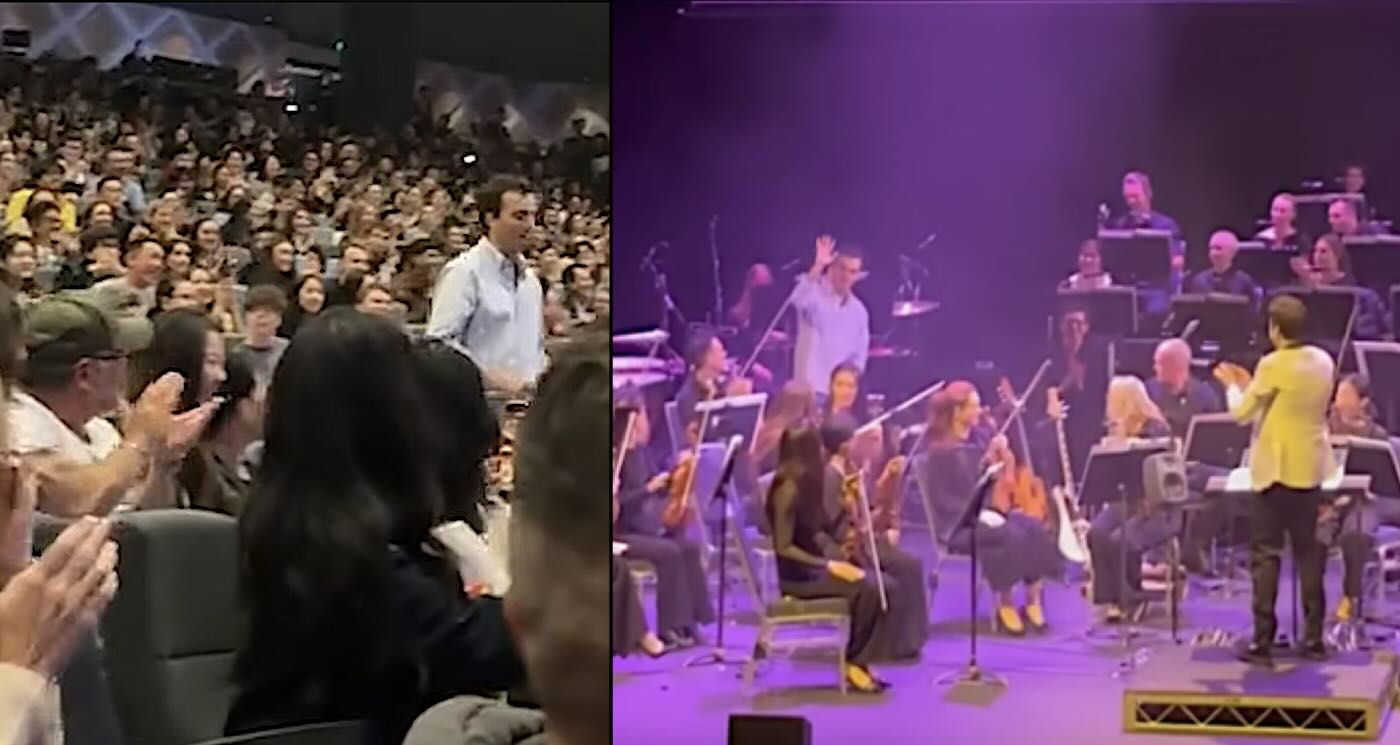
Sterling Nasa was sitting in the audience at Sydney's Darling Harbor Theatre, watching the La La Land orchestra perform beneath a projection of the film, when something unexpected began to unfold—not on screen, but backstage. By the interval, the atmosphere had shifted. Twenty minutes of silence became thirty, then forty, as the orchestra stood waiting and the audience grew restless. The scheduled pianist had fallen ill, and there was no understudy waiting in the wings.
This moment of crisis mattered because La La Land, with its Oscar-winning score by conductor Justin Hurwitz, demands precision and artistry from every musician on stage. The film itself celebrates the dream of making it in Hollywood, and here, in a 2,500-seat theatre in Sydney, that dream was momentarily suspended. Hurwitz faced a decision that could either save the evening or derail it entirely.
Rather than cancel, Hurwitz did something bold. He walked out alone to address the audience and asked a direct question: Was there a trained pianist in the room who could sight-read at a master level? With encouragement from his friend Scarlet, Sterling Nasa—a bagpipes tutor at his school, Scots College, who had also studied piano and organ—raised his hand. It was a long shot. Nasa had never prepared for this role, had never even played this particular score before, and was walking into a performance filled with John Legend compositions and intricate synth solos.
Hurwitz asked follow-up questions to assess whether Nasa could handle it. The risk was real. But when Nasa took his place at the electronic piano to applause, something shifted in the room. The show restarted, and for most of the performance, the substitution worked. Then came the moment both men had dreaded: a synth solo composed by Legend that matched Gosling's frantic on-screen movements—a passage designed to dazzle and challenge.
"I saw it on the score and I thought, oh, I don't know if I'm going to be able to sight-read that in one go," Nasa later told ABC Radio. Hurwitz had also anticipated the difficulty. In a moment that mirrored the film itself, both men simply closed their eyes and took a leap of faith. Nasa decided to improvise, allowing his training and instinct to guide him rather than slavishly follow the page. "I took a little bit of a creative liberty and just decided to improvise, which I think ended up being a good choice," he reflected afterward.
What made this moment resonate was not just that it worked, but how it worked. Hurwitz, hearing the improvisation, recognized it as "an entirely different kind of skill"—not a substitute for the original, but something authentic born from necessity and courage. The 2,500-seat hall sat enraptured, watching a hidden talent they had walked past in the lobby take a bow on stage. Hurwitz admitted afterward that his head was "spinning" as he shook Nasa's hand backstage, both men seeming unable to quite believe what had just happened.
"Yes, it was a gamble," Hurwitz said, reflecting on the decision to ask a stranger from the audience. But sometimes the greatest art emerges not from perfect preparation, but from the willingness to trust in an unexpected moment.