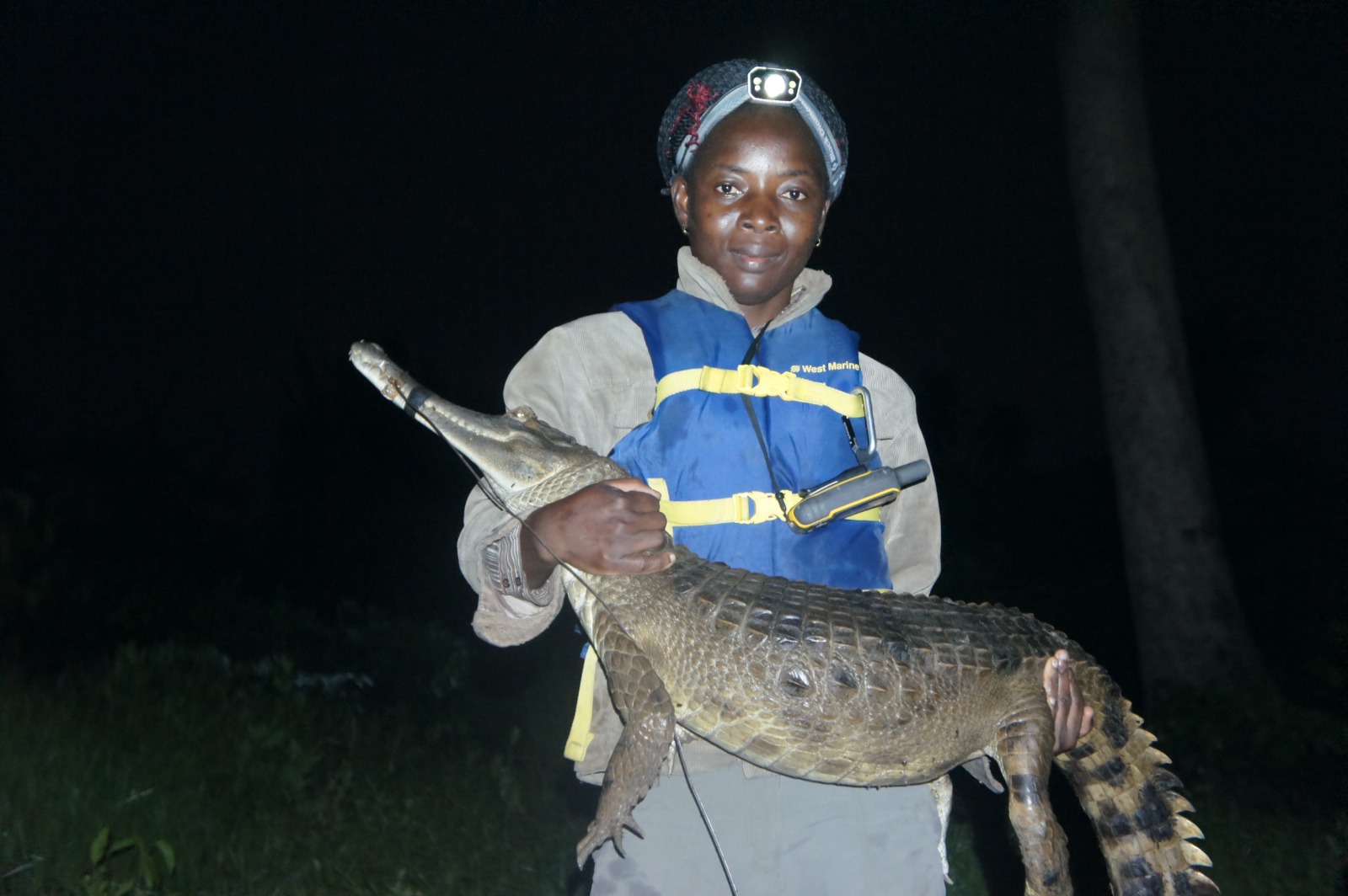
On a moonlit boat trip up the Hana River in Taï National Park, Christine Kouman glides through darkness toward the flicker of eyes reflecting in her flashlight. She has made this journey dozens of times over the past decade, chasing one of Africa's most elusive creatures through the last stretches of the Upper Guinean Forest. The object of her obsession: the critically-endangered West African slender-snouted crocodile, a species so rare that most people — even in the surrounding villages of southwestern Côte d'Ivoire — have never seen one. "I can say it's a gentle crocodile," Kouman tells me, easing closer to a floating log that suddenly reveals itself to be something far more ancient. "It feeds mainly on fish, and I've never heard of the species attacking people. I've been working on them for more than 10 years now, and during those 10 years, I touched them, handled them, but I still have all my fingers and my toes. I'm still in one piece." The largest specimen she ever captured stretched 2.85 metres — roughly the length of a compact car — and required a snare pole and considerable patience to secure. "When you catch one, it will fight, but it does tire quickly," she explains. "Then you can handle it more easily."
Kouman, who co-founded the conservation NGO EBURCO, has dedicated her career to an animal that most of the world has overlooked. Her research, supported by Project Mecistops at Florida International University's Tropical Conservation Institute, has produced some of the first concrete knowledge about a species that lives almost entirely hidden beneath forest canopies and overhanging vegetation. Her Ph.D. work uncovered the crocodile's spatial ecology — its home ranges, preferred micro-habitats, and social dynamics — findings that shape conservation strategies to this day. The slender-snouted crocodile, she discovered, has adapted to its rainforest environment in remarkable ways. With no open riverbanks for sunning, it has learned to bask on fallen trees and rocks that jut above the waterline, displaying an unexpected talent for climbing. The crocodiles also linger beneath overhanging fruit trees, waiting for the satisfying plop of fallen mangoes or wild figs to attract fish within striking range. "It's a strategy to use critical resources in a shared area," Kouman says of their surprisingly peaceful coexistence. "They share the river with their conspecifics, but most of the time, when one is within the shared area, the other is not. By doing this, they avoid conflict."
Now Kouman is working alongside park authorities to ensure that Taï National Park — one of West Africa's last intact rainforest fragments — remains a stronghold for a species that has already disappeared from much of its former range. The stakes are high. The Upper Guinean Forest, which once stretched unbroken across the region, has been reduced to scattered fragments, and the slender-snouted crocodile has vanished from Ghana, Togo, and Benin. But in the murky waters of the Hana River, something endures. Each night that Kouman sets out in her boat, she is not just tracking an animal — she is building the case for its survival, one data point at a time.