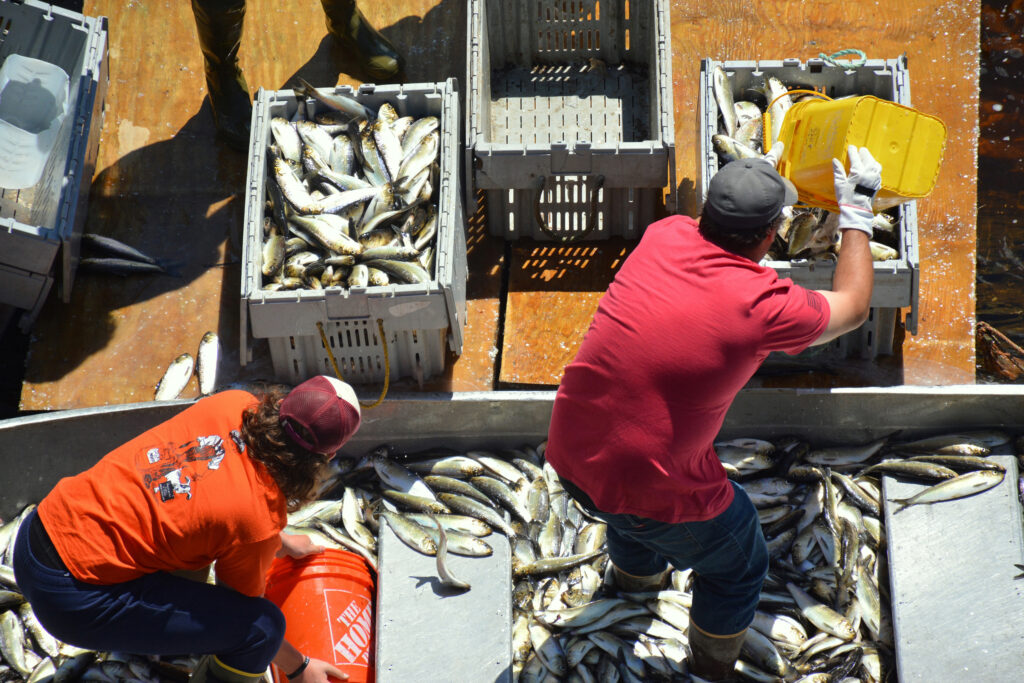
Each summer, the Sebasticook River in Benton, Maine, transforms into a river of silver. Alewives flash through the water by the thousands, so thick that locals say you could almost walk across their backs. It's a scene that would have been unimaginable 35 years ago, when fewer than 800 alewives made this same journey.
Last year, 9 million alewives swam up the Sebasticook River to spawn. That's not a typo. Nine million.
The revival of this small, silvery fish is one of the most remarkable conservation success stories on the entire Atlantic coast. And it happened because people worked together to remove dams that had blocked the alewives' path for centuries.
Beginning in the 1700s, dams created giant roadblocks throughout Maine's rivers. Alewives can wriggle through shallow water and climb over small rapids, but they can't leap over tall walls of water. Instead, they got trapped downstream, where they became easy targets for seals, otters, eagles, and other predators. By the 1980s, many rivers had almost no alewives left.
But slowly, Mainers began removing those dams. Today, stepped pools and fish ladders help alewives climb past the obstacles that remain. The fish once again swim "right into the heart of your town," said Anne Zegers, 32, who monitors fisheries for the Gulf of Maine River Herring Network.
The impact goes far beyond the rivers. Alewives act like a "biological conveyor belt," carrying nutrients from the ocean into inland waters, explained Rustin Taylor, 47, executive director of the Alewife Harvesters of Maine. They feed cod, trout, ospreys, bald eagles, and even lobsters. The Passamaquoddy tribe called them siqonomeq—"the fish that feeds all."
Bailey Bowden, 60, grew up hearing stories about alewives from older relatives in Penobscot, a town of 1,100 people. Now he leads the local alewife committee. "It's pretty impressive to see a brook full of fish, thousands and thousands of these fish that you can just reach down into the water and catch them with your hands," he said.
Maine towns now celebrate the fish's return with festivals and 5K runs each spring. Benton holds its annual Alewife Festival on the riverbank, with fish-themed crafts, smoked fish samples, and live music. In the coastal town of Penobscot, it's the biggest event of the year.
The comeback isn't complete—scientists continue monitoring populations, and some dams remain. But the numbers tell a clear story: what was once nearly lost has come roaring back. In a world full of environmental bad news, Maine's alewives show that when humans undo the damage they've done, nature can recover faster than anyone expected.