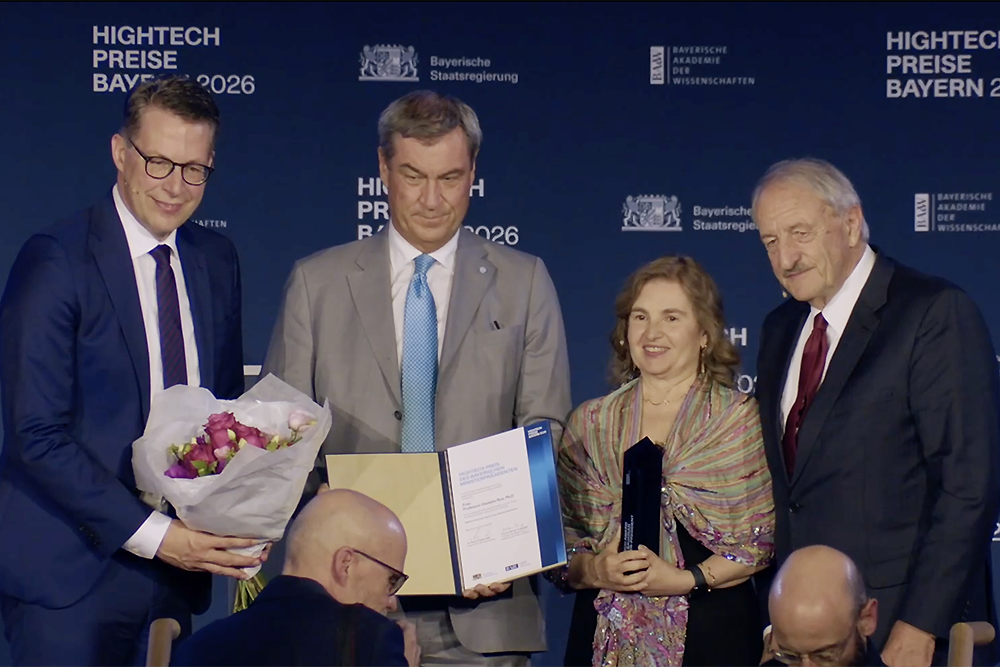
On a warm evening in late July, Daniela Rus stepped onto the stage at the Herkulessaal of the Munich Residence and accepted the 2026 High-Tech Prize from the Bavarian Minister-President. The moment marked something rare in science: recognition not just for a clever idea, but for a decades-long effort to build robots that actually work in the messy, unpredictable real world.
Rus is the director of MIT's Computer Science and Artificial Intelligence Laboratory, known in the research world as CSAIL. She has spent thirty years pushing robotics in directions many people are only beginning to imagine. The prize, awarded jointly by the Bavarian State Government and the Bavarian Academy of Sciences and Humanities, is the most highly endowed award for technology and engineering in all of Germany.
Her work spans four major areas: self-organizing robot teams that cooperate on their own, soft robots made from flexible materials, autonomous vehicles and machines, and brain-inspired artificial intelligence. Together they describe a single vision: giving machines the smarts to reason and adapt outside the controlled environment of a laboratory.
Some of her inventions sound like science fiction. Rus helped create an ingestible robot that folds up like origami, can be swallowed, and then unfolds inside a child's digestive system to safely retrieve swallowed button batteries, which are a serious danger to small children. She also helped design small autonomous boats that can link together on their own to form bridges and platforms, turning a city's waterways into flexible infrastructure that can be rearranged as needed.
Perhaps her most mind-bending contribution is the liquid neural network. Inspired by the compact nervous system of a tiny worm just one millimeter long, these networks can steer a vehicle through unfamiliar territory using only 19 control neurons. Traditional AI systems need thousands of neurons to do the same thing. That efficiency impressed the tech world enough that Rus and former colleagues spun the research into a company called Liquid AI, building AI models designed to run efficiently on the devices where they are needed.
Rus sees AI not as a replacement for human intelligence but as a partner to it. "AI gives machines the ability to do work that humans don't want to do," she said. "It's not a battle between humans and machines. Both form a system that solves problems that neither humans nor machines can solve alone."
Lorenzo Masia, a professor at the Technical University of Munich, called Rus "a pioneer in soft robotics and physical AI" and said the prize would help bring this science to a wider audience. Rus's previous honors include the 2025 IEEE Edison Medal, the 2024 John Scott Award, and she was elected to the National Academy of Engineering and the American Academy of Arts and Sciences. She is also a MacArthur Fellow from the class of 2002.
Her message to the world is clear: robots and AI are tools to extend human capability, not rival it. With this prize, that message is reaching an even bigger stage.