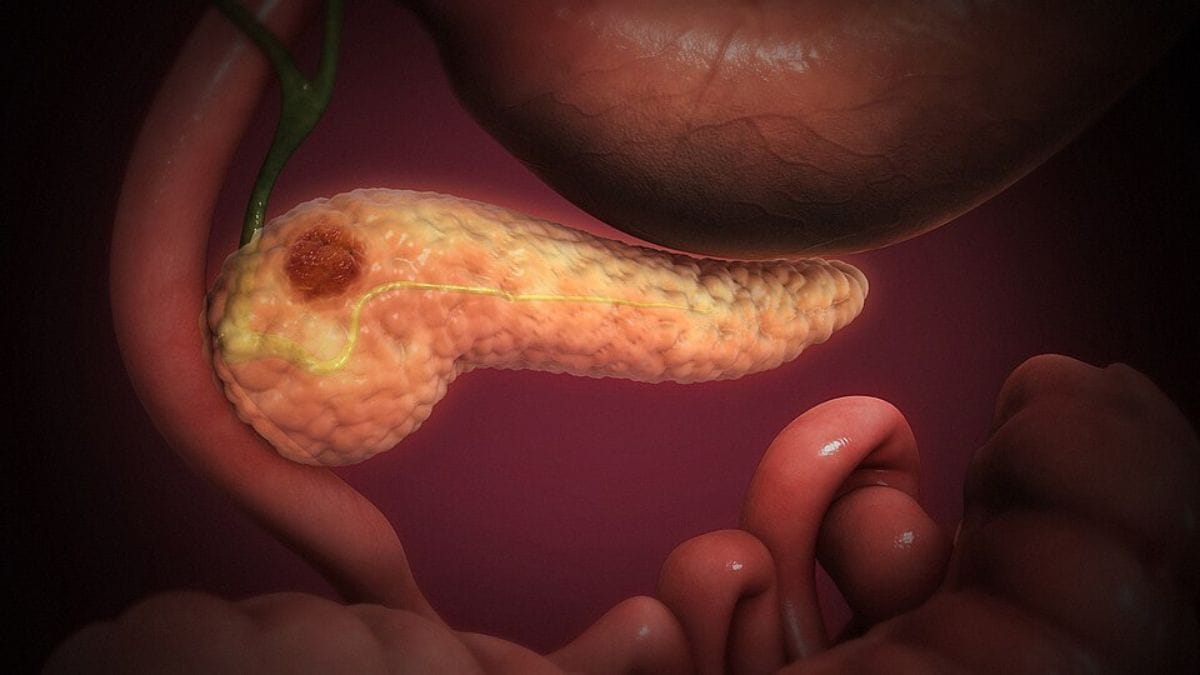
When pancreatic cancer spreads beyond the organ itself, survival odds have been brutally thin for four decades—until now. Revolution Medicines, a California biotechnology company, has announced results from a Phase 3 trial showing that a new drug called daraxonrasib nearly doubled survival time for patients with advanced pancreatic cancer, extending median survival to 13.2 months compared to just 6.7 months with standard chemotherapy. The findings, published in the New England Journal of Medicine, represent a breakthrough that oncologists have pursued since 1982, when scientists first identified the KRAS gene as the culprit in more than 90 percent of all pancreatic cancers.
The disease itself tells a cruel story. Pancreatic cancer accounts for only about 2 percent of all cancers in India, yet causes 3.4 percent of cancer-related deaths—a gap that reveals just how lethal it is. The pancreas sits deep in the abdomen, tucked against the posterior wall, making it nearly invisible to routine ultrasounds. Early warning signs like mild stomach discomfort, indigestion, fatigue, and unexplained weight loss are easy to dismiss. By the time alarming symptoms appear—jaundice from a tumor blocking the bile duct, or sudden spikes in blood sugar—the cancer has often already metastasized. "Most of the time it is detected late, either locally advanced or already metastatic," says Dr. Mohit Saxena, consultant in medical oncology at Manipal Hospital in Gurugram. "That is the unfortunate part."
The problem daraxonrasib solves has haunted medicine for nearly 40 years. In healthy cells, the KRAS gene briefly activates when growth signals arrive, then switches off. In cancer, the gene mutates and never switches off again—the cell divides endlessly. Researchers knew this was the problem from the late 1980s onward, yet the gene remained untouchable. "It was a large molecule, so it was difficult to block it," explains Dr. Saxena. Every attempt to design a drug that could latch onto KRAS failed because the protein would shift its shape and slip away. For nearly three decades, the medical consensus was firm: KRAS was "undruggable."
Daraxonrasib works by targeting a specific, previously hidden pocket on one variant of the KRAS protein. Dr. Rashi Agrawal, senior director and clinical administrator at Max Hospital in Delhi-NCR, explains how it succeeds where others failed: the drug "zeroes in on this particular mutation, cutting off the signal that tells cancer cells to keep growing." Because daraxonrasib is a targeted oral medication, patients can take it at home—a marked improvement over chemotherapy's grueling infusions. The FDA has already granted expanded access to the drug even before formal approval, reflecting the urgency of this unmet medical need.
The significance extends beyond raw survival numbers. For decades, pancreatic cancer patients with advanced disease had essentially two options: chemotherapy combinations that slow cancer but rarely stop it, or immunotherapy, which has revolutionized treatment for other cancers but fails almost universally in pancreatic cancer. Only patients carrying a rare marker called MSI-high benefit from immunotherapy. "Everyone else has very few options," says Dr. Niti Raizada, principal director of medical oncology at Fortis Hospitals, Bengaluru. Daraxonrasib is being used as a second-line treatment after chemotherapy, offering hope where little existed before. For a disease that has claimed countless lives while dodging medical intervention for four decades, this represents not just progress—but the cracking of a code that seemed permanent.