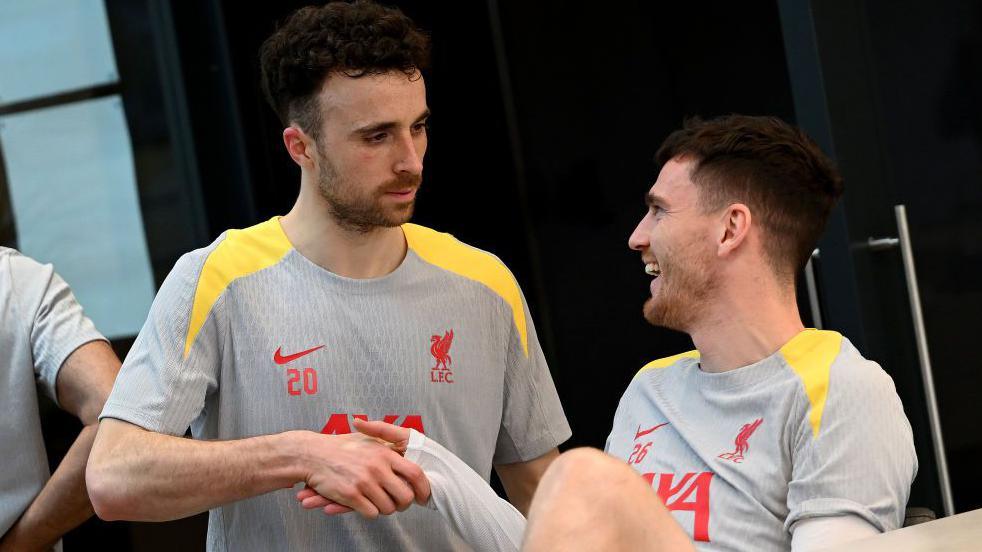
Andrew Robertson's voice steadied as he read Rute Cardoso's letter aloud: "Diogo will be with you in your thoughts, in your steps, in your heart." The Scotland captain was holding more than words—he was carrying the unfinished dream of his former Liverpool teammate, Diogo Jota, who died aged 28 in a car crash last July, months after helping Portugal secure World Cup qualification.
The story of these two footballers is one of parallel longings. Both had watched the World Cup from home while their nations waited outside the tournament door. Jota missed the 2022 tournament through a calf injury after earning 49 caps for Portugal. Robertson had endured Scotland's absence from the World Cup since 1998. When Scotland finally qualified in November, Robertson couldn't suppress his thoughts of his departed friend. "I couldn't get my mate Diogo Jota out of my head today," he said after the match. "We spoke so much about going to the World Cup because he missed the last one with Portugal and I did with Scotland. I know he'll be smiling over me today."
Cardoso's letter, published by FIFA, transformed that private grief into something more universal. Writing as the mother of Jota's three children, she traced the contours of their friendship—the battles fought together on the pitch, the laughter off it, the shared conversation about dreams. She saw in Robertson's qualification not just a personal triumph, but a continuation of Jota's legacy. "When you step on to the pitch, I know it won't just be you walking out," she wrote. "Diogo will be with you in your thoughts, in your steps, in your heart."
Robertson, filmed by FIFA reading the letter, was visibly moved. He spoke of carrying Jota with him through every match of the tournament. "I'm not only just playing for me. I'm playing for both of us," he said. The Scotland defender transferred from Liverpool to Tottenham at the season's end, but the connection to his former teammate travels further than any club change. As the tournament begins on June 11, Robertson faces Haiti on Sunday, Morocco on June 19, and Brazil on June 24—Scotland's first World Cup matches in 25 years.
What emerges from this correspondence is not maudlin sentimentality but a kind of quiet determination. Robertson acknowledged that the memories would make him laugh and sometimes cry as he enters a tournament "full of emotion." But he framed this not as a burden but as a presence—Jota there at the front of his mind, inseparable from his own ambitions. Cardoso's gratitude was directed back toward Robertson himself: "Thank you for not forgetting him. Thank you for taking him with you. Thank you for turning the pain of loss into strength and into something so beautiful." She ended with a challenge wrapped in tenderness: "Cherish that dream, Andy. Live it for yourself and for him." In the weeks ahead, as Robertson takes the pitch in his nation's first World Cup since 1998, that letter will move with him—a reminder that some bonds transcend the final whistle.