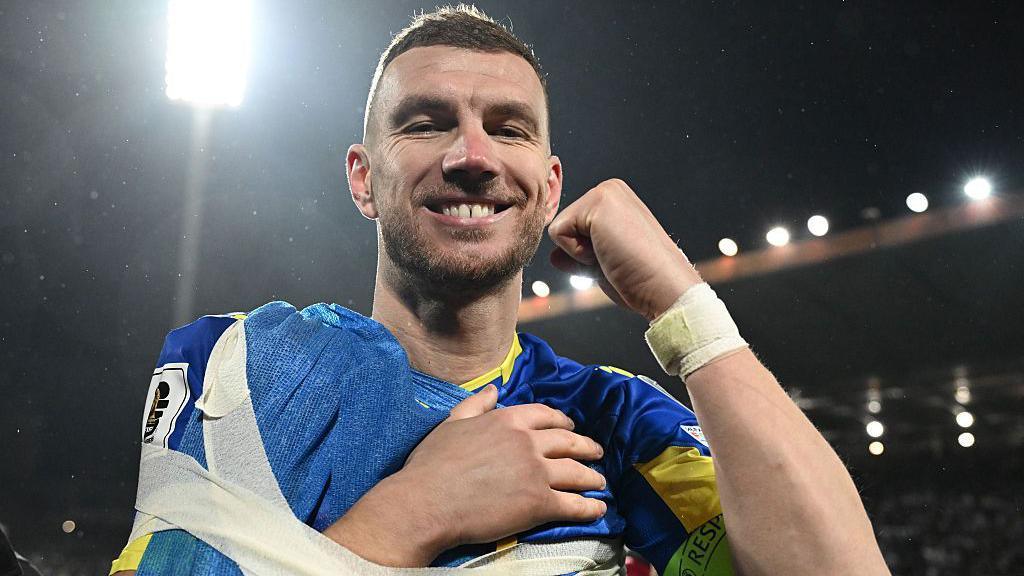
Edin Dzeko celebrated Bosnia-Herzegovina's World Cup qualification while nursing his arm in a sling—an image that somehow captures everything about the 40-year-old striker's improbable journey. After beating Italy on penalties to secure only their second appearance at football's greatest stage, the Bosnian Diamond stood as both ending and beginning: the final chapter of a career forged in war and resilience, and the opening of a new era for a nation still healing from decades of pain.
Dzeko was six years old when the Bosnian War erupted in 1992, a conflict that killed around 80,000 Bosnian Muslims and included the Srebrenica Genocide—the largest massacre in Europe since the Holocaust. For nearly four years, Serbian snipers besieged Sarajevo, targeting civilians including children. Dzeko's family crowded into a 35-square-metre apartment after shells destroyed their home. One afternoon, his mother kept him indoors while he wanted to play on the local football pitch. That day, a shell struck the field and killed several children—a mercy he never forgot.
Yet from this devastation emerged one of Europe's greatest strikers. Playing for Sarajevo club Željezničar, the lanky teenager was dismissed as "Kloc" (lamp-post) and sold to Czech side Teplice for just 25,000 euros. No one could have predicted what followed: Dzeko became the first player ever to score at least 50 goals in three of Europe's top leagues—the Premier League, Bundesliga, and Serie A. He won two Premier League titles with Manchester City, alongside honours at Inter Milan and Wolfsburg. Yet he never distanced himself from his roots. He has donated extensively to renovate Željezničar, became Bosnia's first Unicef ambassador in 2009, and remains so accessible that, as his friend Mirza Trbonja told AFP, "When he comes, you need a lasso to catch 10 minutes with him."
Over 148 international appearances spanning 17 years, Dzeko scored 73 goals for Bosnia—both national records. He led the team to their first World Cup in 2014, a qualification that felt historic to a nation asserting its sporting legitimacy after independence. But that golden generation faded. Heartbreak struck repeatedly in play-offs for Euro 2016, 2020, and 2024, until a miraculous turnaround saw Bosnia overcome Wales and then Italy to reach Qatar in 2022.
This second World Cup qualification feels weightier still. A decade of disappointment had settled over the country, and many feared Bosnia's moment had passed. Yet they refused to accept that narrative. Journalist Sasa Ibrulj observes that Dzeko's career embodies what the nation needed: "resilience, persistence and proving people wrong." The squad reflects a unique dynamic—17 of 26 players were born outside Bosnia, part of a diaspora thought to number two million. They carry the hopes of a scattered people, united by what musician Alen Dokic calls "Bosanski Inat": a cultural refusal to break, no matter what comes.
As Dzeko steps toward retirement, having carried his country's resilience for two decades, Bosnia enters uncharted waters. Against Canada in their opening match, and grouped with Switzerland and Qatar, they begin not just a tournament but a reimagining of what's possible. The Bosnian Diamond's final dance may well light the way for generations to come.